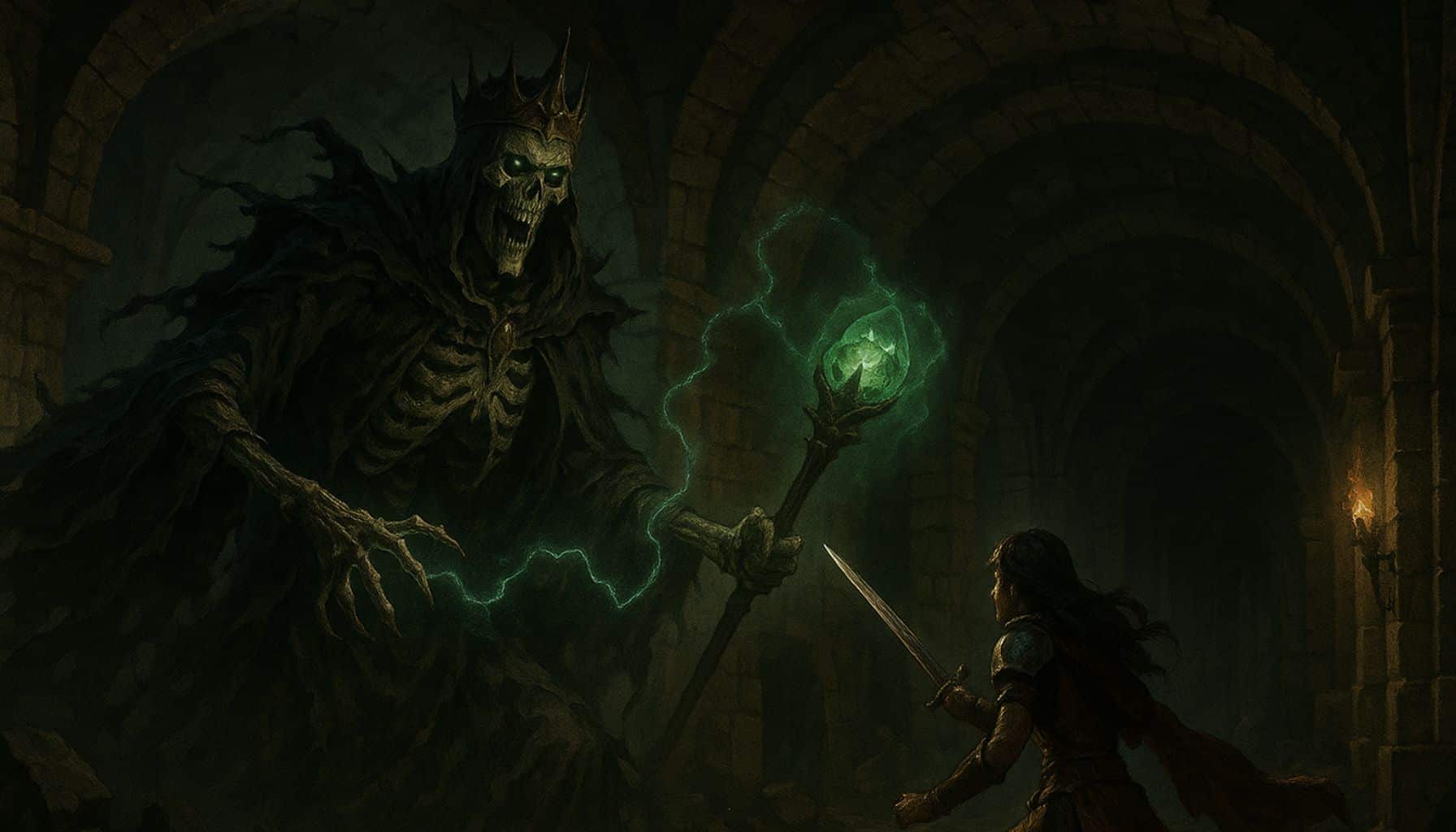
Among the myriad horrors found in the Monster Manual, few command the immediate dread and respect of the lich. As one of Dungeons & Dragons’ most iconic undead villains, the lich represents the terrifying pinnacle of arcane ambition: an immortal spellcaster who has voluntarily embraced the curse of undeath to preserve their power for eternity. Unlike mindless zombies or hungry ghouls, the lich is defined by its intellect and its agency. It is a creature that chose its fate, trading its humanity for the ability to continue its magical studies forever, free from the constraints of mortal frailty.
In D&D terms, a lich is generally an 11th-level (or higher) wizard, cleric, or sorcerer who has trapped their soul within a phylactery (a magical jar or box) allowing them to rejuvenate if their physical body is destroyed. This specific mechanic makes them uniquely compelling monsters for Dungeon Masters (DMs). They are recurring villains by design; defeating them in combat is merely a temporary setback unless the players can locate and destroy their hidden soul vessel. This dynamic creates natural, multi-stage campaign arcs that challenge players not just tactically, but strategically.
However, the lich has not remained static over the last fifty years. Just as D&D itself has transformed from a niche wargaming offshoot into a global storytelling phenomenon, the lich has evolved in lore, mechanics, and aesthetics across every single edition. From a skeletal figure with high hit points in the earliest booklets to a complex, lair-dwelling mastermind in modern play, the changes to the lich reflect the changing priorities of the game designers and the community.
This article will walk systematically through each major era of D&D history, from Original D&D (OD&D) and the Basic/Expert lines, through the crunch of Advanced D&D (1E and 2E), the systemic overhaul of 3rd Edition, the tactical grid of 4th Edition, and finally the cinematic storytelling of 5th Edition and the upcoming “One D&D” revisions. In each section, we will explore what changed, why it matters, and how the lich served the specific needs of that era’s gameplay style.
Ultimately, the evolution of the lich mirrors the shifts in D&D’s design philosophy as a whole. We see a clear trajectory: the lich begins as a loose concept inspired by pulp horror, evolves into a simulationist challenge for high-level wargamers, transforms into a customizable template for system mastery, and finally settles as a story-rich, mechanically streamlined villain designed to anchor narrative campaigns. By understanding the lich, we understand the history of D&D.
- Before the Editions: Mythic and Literary Roots of the Lich
- OD&D and Early Supplements: The Lich Is Born
- Basic/Expert and BECMI: Liches in the Parallel D&D Line
- AD&D 1st Edition: Defining the Archetype
- AD&D 2nd Edition: Story-Driven and Variant Liches
- D&D 3rd Edition and 3.5: The Lich as a Template
- D&D 4th Edition: The Lich as a Role-Focused Monster
- D&D 5th Edition: Iconic, Accessible, and Story-Centric
- Playtests and “One D&D”: The Future of the Lich
- Cross-Edition Comparison: How the Lich Reflects D&D’s Design Philosophy
- Building and Using Liches in Your Own Multi-Edition Campaigns
- Final Thoughts: Why the Lich Endures
Before the Editions: Mythic and Literary Roots of the Lich
Long before Gary Gygax and Dave Arneson penned the first rules of D&D, the concept of the deathless sorcerer haunted human mythology and folklore. The fear of a powerful individual who cheats death through dark magic is a near-universal trope. In Slavic folklore, for example, Koschei the Deathless serves as the primary archetype for the D&D lich. He was a sorcerer who hid his soul inside a needle, which was inside an egg, inside a duck, inside a hare, inside an iron chest, buried under an oak tree. This “external soul” concept is the direct ancestor of the lich’s phylactery, establishing the rule that you cannot kill the monster until you destroy the object holding its life force.
Try my AI Tabletop RPG generators...and an extensive library of content!
Beyond folklore, early fantasy literature of the 20th century provided the aesthetic language for the lich. Authors like Clark Ashton Smith and Robert E. Howard populated their “Sword and Sorcery” stories with ancient, withered wizards who ruled over crumbling empires. Clark Ashton Smith, specifically in stories like “The Empire of the Necromancers,” used the term “lich” (an archaic English word for “corpse”) to describe the walking dead. These literary villains were not just physical threats; they were sources of existential dread, representing a blasphemous refusal to accept the natural order.
These broader inspirations informed the earliest D&D approach by establishing the lich as something distinct from a ghost or vampire. The literary lich was defined by dryness, decay, and intellect. They were skeletal, yes, but they were also kings and priests. This context explains why early D&D liches felt so stark and alien; they were meant to evoke the feeling of stumbling into a forbidden tomb in a pulp novel, where the primary emotion was not just fear of physical harm, but the horror of encountering an intellect that had outlived its own humanity.
Understanding these roots helps contextualize why early liches were presented as such formidable, almost unfair challenges. They were not designed to be balanced encounters for a party of four adventurers; they were mythic barriers, intended to stop all but the most legendary heroes. The DNA of Koschei and the pulp necromancers ensured that from day one, the lich was a “final boss” concept, representing the ultimate triumph of magic over nature—and the terrible price paid for that victory.
Notable Pre-D&D Inspirations
- Koschei the Deathless (Slavic Folklore): The primary origin of the “soul in a hidden object” trope, directly inspiring the phylactery mechanic.
- The Mummy / Imhotep (Universal Monsters / Folklore): Provided the aesthetic of the preserved, cursed spellcaster who retains their magic after death.
- Sauron (J.R.R. Tolkien’s The Lord of the Rings): While not skeletal, his persistence as a spirit bound to the One Ring mirrors the lich’s dependence on a phylactery.
- The Nazgûl / Ringwraiths (Tolkien): Their status as sorcerer-kings who faded into undeath due to power artifacts influenced the “loss of humanity” theme.
- Thulsa Doom (Robert E. Howard’s Kull stories): An undying skull-faced sorcerer who established the visual of the skeletal wizard tyrant.
- Xaltotun (Robert E. Howard’s The Hour of the Dragon): An ancient wizard resurrected to conquer the world, establishing the “ancient evil returns” narrative hook.
- The Liches of Zothique (Clark Ashton Smith): Specifically popularized the word “lich” in fantasy to describe reanimated corpses, often with sorcerous traits.
- Vathek (William Beckford’s Vathek): An early Gothic novel feature a caliph seeking forbidden knowledge and damnation, setting the tone for the lich’s hubris.
- The Barrow-wights (Tolkien): While distinct, these treasure-guarding undead spirits reinforced the connection between ancient tombs and magical malice.
- Dracula (Bram Stoker): Though a vampire, his status as an aristocratic, intelligent undead mastermind set the social mold for the lich.
- Mordaunt (E.R. Eddison’s The Worm Ouroboros): A conjurer whose dealings with death and destiny provided a tonal blueprint for high-fantasy villains.
- Lovecraftian Sorcerers (H.P. Lovecraft): Characters like Joseph Curwen (The Case of Charles Dexter Ward) who use alchemy to transcend death, influencing the “scientific/arcane” approach to undeath.
⚔️ Fantasy RPG Random Tables Books
Make life as a Gamemaster easier…
If you play Dungeons & Dragons, Pathfinder, or other fantasy RPGs, this
RPG random tables series
is packed with encounters, NPCs, treasure, and more. Available in eBook or print—either way, you’ll have a wealth of adventure ideas at your fingertips.



These influences set the tone for liches as high-level, campaign-defining entities rather than throwaway monsters. They were born from stories where the protagonist usually fled or barely survived, rather than fought a tactical skirmish. This mythic weight meant the lich entered D&D with a reputation already established before the first die was rolled.
As D&D evolved, every edition has had to negotiate between this “mythic horror” origin and the necessity of creating a “balanced game monster.” The transition from a folklore nightmare to a stat block with hit points and armor class is the story of D&D itself—a constant struggle to quantify the unquantifiable terror of the unknown.
OD&D and Early Supplements: The Lich Is Born
The lich made its official D&D debut not in the original 1974 “White Box” set, but shortly after in the Greyhawk supplement (1975). In these early days, the stat block was incredibly sparse compared to modern standards. The lich was described as a skeletal monster of 11+ Hit Dice, capable of using magic as a high-level Magic-User or Cleric. The presentation was purely mechanical, focusing on their raw power and the fact that they were “monsters” in the truest sense of the wargaming tradition.
These early liches were defined by what they could withstand. They were immune to charm, sleep, enfeeblement, polymorph, cold, electricity, and insanity. This list of immunities was the game’s way of saying “your usual tricks won’t work.” In OD&D, combat was often lethal and quick; the lich stood out because it simply refused to die. The rules-light nature of OD&D meant that the specific spell list was often left to the referee (DM) to determine, meaning a lich could have any spell the referee thought appropriate for an 11th-level caster.
What made them uniquely dangerous in this era was the lack of safety nets for players. There were no “death saves,” and resurrection was difficult. The lich’s touch often caused paralysis—a terrifying sentence in a game where being immobile usually meant automatic death from subsequent attacks. The stat block was a skeleton key for the DM to introduce a threat that required high-level magic items and armies to defeat, not just a lucky roll.
Because the system relied so heavily on the referee’s imagination, the “tactics” of an OD&D lich were entirely dependent on how cruel the DM wanted to be. There were no “Legendary Actions” or “Lair Actions” to balance the action economy. Instead, the lich was simply a high-level wizard who didn’t need to breathe or sleep, and who likely had a dungeon full of traps designed by a sadistic intellect.
Key Mechanical Traits of OD&D-Era Liches
- 11+ Hit Dice: Placed them in the highest tier of monster durability for the time, comparable to dragons.
- Touch Paralysis: A successful hit paralyzed the target with no mention of a duration limit, often a death sentence.
- Magic-User/Cleric Capability: They cast spells as at least a level 11 caster, giving them access to “Death Spell” and “Disintegrate.”
- Immunity to Non-Magical Weapons: Players literally could not hurt them without finding magic items first.
- Heavy Magic Resistance: Specific immunities to Sleep, Charm, Cold, and Electricity nullified the most common party tactics.
- Turn Resistance: Clerics had a very difficult time turning liches; usually requiring a result of “7” or higher on 2d6 even at high levels.
- Frightening Appearance: While not always a codified mechanic, the mere description often triggered morale checks for hirelings.
- Phylactery Concept (Implied/Vague): The concept existed in lore notes but wasn’t the strictly codified “respawn point” mechanic it would become later.
- No Constitution Score: Unlike PCs, their HP was purely Hit Dice rolls, making them variable but generally spongy.
Looking back, these early liches seem crude. They were essentially “skeletons with spells.” However, this barebones approach gave early referees immense freedom. A lich wasn’t constrained by a specific list of “prepared spells” in the book; it was a terrifying narrative device that could do whatever the plot required.
Early Lore and Player Perception
In the earliest texts, liches were described with brevity that bordered on the cryptic. There were no long paragraphs about their tragic backstories or their specific motivations for seeking undeath. The text assumed you knew what a lich was: an evil wizard who died and kept moving. This lack of explanation pushed groups to interpret liches in wildly different ways. To some, they were demonic overlords serving chaotic gods; to others, they were reclusive sages who just wanted to be left alone to read their books.
The art of the era reinforced this ambiguity. Illustrations were often simple ink drawings of robed skeletons. They didn’t look like “characters”; they looked like obstacles. This shaped the early player perception of the lich as an “end boss.” You didn’t negotiate with a lich in OD&D. You didn’t ask it for quest information. You entered its crypt when you were Level 10+, and you hoped you had enough wands to blast it apart before it paralyzed the entire party.
The mystery was part of the horror. Because the Monster Manual didn’t tell you how a lich became a lich (the ritual was a guarded secret), players felt a genuine sense of forbidden knowledge when they encountered one. The lich represented the upper limit of the game’s power curve. Seeing one meant you had reached the end of the line—either for the campaign or for your character.
⚔️ Fantasy RPG Random Tables Books
Make life as a Gamemaster easier…
If you play Dungeons & Dragons, Pathfinder, or other fantasy RPGs, this
RPG random tables series
is packed with encounters, NPCs, treasure, and more. Available in eBook or print—either way, you’ll have a wealth of adventure ideas at your fingertips.
| Source/Book | Amount of Lore | Mechanical Emphasis | Typical Role in Campaigns |
|---|---|---|---|
| Greyhawk Supplement (1975) | Almost None | High HD, Immunities, Spell Level | The “Super-Wizard” opponent. |
| Eldritch Wizardry (1976) | Minimal | Interaction with Psionics/Artifacts | Guardian of high-level loot. |
| Basic Set (Holmes, 1977) | Very Brief | Basic combat stats | The ultimate dungeon boss. |
| Strategic Review Articles | Moderate (for the time) | Clarifying Phylacteries | Rare, unique named nemesis. |
| Monster Manual (1977) | Low to Moderate | Defined immunities and paralysis | The standard for high-level undead. |
| Various OD&D Modules | Situation Specific | Trap-setter and magic-user | The architect of the dungeon. |
The OD&D lich was a creature of mystery. It was a blank slate upon which DMs could project their most lethal dungeon designs. The reputation of the lich as “the thing you only meet when you’re ready to die” was forged in these early years, creating a legacy of fear that would persist even as the rules became more forgiving.
Basic/Expert and BECMI: Liches in the Parallel D&D Line
While Advanced Dungeons & Dragons (AD&D) was adding complexity and detail, the “Basic” line (Basic/Expert/Companion/Master/Immortals, or BECMI) took a different path. In the Basic/Expert sets, the game remained focused on streamlined dungeon crawling. Here, the lich was still a terrifying foe, but it was presented with a different design philosophy. The Basic lich was rarer, appearing only in higher-level sets (Companion and Master), and its stats were simplified to fit the “pick up and play” nature of the line.
The BECMI lich maintained the core identity—undead spellcaster—but the math was different. The power curve in BECMI went all the way to level 36 (and beyond into Immortality), meaning liches had to scale differently than their AD&D counterparts, who topped out around level 20. A BECMI lich might be a challenge for a level 25 party, wielding spells that could alter reality on a massive scale. However, the narrative framing was often more “fairy tale” or “high fantasy” compared to the gritty “sword and sorcery” of AD&D.
Differences Between Basic/BECMI and AD&D Liches
- Stat Block Simplicity: BECMI blocks were shorter, listing AC, HD, and Move, with less focus on granular resistances.
- XP Scaling: XP values for liches in BECMI were astronomical, reflecting the high-level cap (up to level 36).
- Spell Selection: BECMI liches drew from a slightly different spell list, often focusing on direct damage and “save or die” effects common in Basic.
- Treasure Types: BECMI used specific “Treasure Type” codes (like Type F or G) that virtually guaranteed massive magical hoards.
- Integration: Liches appeared later in the product line (Companion Set onwards), whereas AD&D introduced them earlier.
- Monster Hierarchy: In BECMI, liches were explicitly ranked below “Nightshades” and other Master-level threats.
- Phylactery Rules: The rules for destroying a phylactery were often simpler or hand-waved compared to AD&D’s specific requirements.
- Alignment: BECMI used a 3-point alignment system (Law/Neutral/Chaos), so liches were almost exclusively “Chaotic” rather than “Neutral Evil” or “Lawful Evil.”
- Module Usage: Often used as “faction leaders” in the broader geopolitical wargame that high-level BECMI became.
- Setting Tone: Fits the “Mystara” setting, where liches were often ancient, eccentric wizards from lost civilizations like Nithia.
These differences highlight how the two product lines diverged. Basic D&D prioritized playability and high-level progression, turning the lich into a stepping stone toward Immortality. AD&D prioritized simulation and grit, making the lich a complex puzzle of immunities. The lich sat at the crossroads, capable of being both a streamlined dungeon boss and a complex simulation of magical undeath.
Module Appearances and Adventure Design
It was in the adventures (modules) that the Basic-line lich truly came alive. Since the rulebooks were sparse, modules like the M Series (Master) or CM Series (Companion) taught DMs how to use these monsters. Liches in these adventures were rarely found in 10×10 rooms waiting to be hit. They were hidden masterminds, often manipulating nations or guarding artifacts essential to the plot.
The adventures introduced the idea of the lich as a “Patron” or a “Social Encounter.” In high-level BECMI play, players might need to negotiate with a lich to stop a greater threat (like an Immortal or a sphere of annihilation). This shifted the lich from a pure combatant to a campaign actor. The modules subtly enforced the idea that a creature with Intelligence 18+ shouldn’t just fight to the death; they should have contingency plans, escape routes, and minions.
| Adventure Title | Lich’s Narrative Role | Edition/Year |
|---|---|---|
| M1: Into the Maelstrom | Planar threat/obstacle | Master (1985) |
| CM1: Test of the Warlords | Ancient regional power | Companion (1984) |
| M2: Vengeance of Alphaks | Manipulator behind war | Master (1986) |
| X2: Castle Amber | (Implied/Variant) Cursed wizard | Expert (1981) |
| M5: Talons of Night | Keeper of forbidden lore | Master (1987) |
| DA2: Temple of the Frog | Proto-lich/Cult Leader mechanics | Blackmoor (1975/1986) |
| H4: The Throne of Bloodstone | High-level minions (Witch-King) | AD&D/Battlesystem (Mixed) |
| IM1: The Immortal Storm | Cosmic pawn/adversary | Immortals (1986) |
These adventures helped solidify the lich as a campaign capper. You didn’t fight a lich in the middle of an adventure; you fought them at the end, or you dealt with them to get to the end. They were the punctuation marks on long, epic sentences of gameplay.
AD&D 1st Edition: Defining the Archetype
Advanced Dungeons & Dragons 1st Edition is where the lich truly became the “Thematic Villain” we recognize today. The Monster Manual (1977) and subsequent articles in Dragon magazine fleshed out the ecology of the lich. 1E introduced the specific requirement of the phylactery as a soul vessel and the gruesome process of creating one. The tone leaned heavily into Gothic horror; becoming a lich wasn’t just a spell, it was a ritual of ultimate evil that required the sacrifice of sentient life.
1E also introduced the idea of the lich’s lair as an extension of its will. Liches were no longer just wandering monsters; they were bound to places of power—forgotten crypts, ruined towers, or planes of negative energy. The lore emphasized their obsession with time and memory. Liches were described as having severed their ties to humanity to pursue obsessions that spanned centuries. This added a layer of tragedy and madness to the archetype. They weren’t just evil; they were insane with purpose.
Try my AI Tabletop RPG generators...and an extensive library of content!
Lore Elements Popularized in 1E
- The Phylactery: Firmly established as a jar/box containing the soul and written strips of parchment.
- The Ritual of Becoming: Described as a lethal, highly dangerous process often involving poison.
- Rot and Decay: Descriptions emphasized the physical degradation of the lich’s form over centuries.
- Mental Stat Requirements: High Intelligence/Wisdom became a prerequisite, barring “dumb” wizards from the transformation.
- Former Archmages: Explicitly stated that liches were formerly at least 18th level (in some contexts) or very high-level Magic-Users.
- Isolationism: The trope of the lich seeking solitude to continue research undisturbed.
- Undead Control: The ability to command lesser undead became a key flavor element.
- Touch of Cold/Paralysis: The description of the lich’s touch as a supernatural cold that freezes the soul.
- Magical Sight: Liches could see invisible creatures and through illusions.
- Fear Aura: The mere sight of a lich caused creatures to flee in panic (mechanically codified).
- Strategic Brilliance: Lore emphasized they had centuries to prepare for intruders.
- Hatred of the Living: A general enmity toward living things, viewing them as cattle or annoyances.
1E cemented the lich as the mastermind. If you saw zombies, there was a cleric nearby. If you saw a coordinated army of wights, wraiths, and spectres, there was a lich behind it. This edition moved the lich from a “big skeleton” to the “General of the Dead.”
Mechanics, Difficulty, and Lethality
Mechanically, the 1E lich was a nightmare. In an edition known for its difficulty, the lich stood out. It possessed a laundry list of immunities: charm, sleep, enfeeblement, polymorph, cold, electricity, insanity, and death magic. It could only be hit by +1 or better magical weapons. Its touch inflicted 1d10 damage and permanent paralysis (no save in some early printings, or a difficult save in others).
Furthermore, the 1E lich had access to the full Magic-User spell list. In 1E, high-level spells were devastating. A lich could cast Power Word Kill, Time Stop, or Trap the Soul. Unlike modern editions where combat lasts 3-5 rounds, a 1E lich could end a fight in one round if the party lost initiative. The “Save or Die” mechanic was prevalent, and the lich was the master of it.
| Feature | Typical High-Level PC | Lich | Impact on Encounter Feel |
|---|---|---|---|
| Hit Points | 40-60 (Wizard) / 60-80 (Fighter) | 11 HD (avg 50-60) | Paradoxically low HP made liches “glass cannons.” |
| Armor Class | AC 0 to -2 (Plate + Shield) | AC 0 (Natural) | Very hard to hit for the era; required good THAC0. |
| Immunities | None (relied on saves) | Charm, Sleep, Cold, Elec, etc. | Negated 50% of the Wizard’s offensive book. |
| Weapon Vulnerability | Normal weapons hurt | +1 or better only | Martial characters were useless without magic gear. |
| Save vs. Magic | Good, but failable | High resistance | Liches rarely failed saves against player spells. |
| Paralysis | Caused by ghouls/liches | On Touch (Permanent) | Melee combat was incredibly risky; one hit = game over. |
| Spell Access | Limited by spellbook | Full high-level access | Lich always had the perfect counter-spell. |
| Fear Effect | Via spell only | Aura (Sight based) | Party might run away before combat starts. |
| Turning | Cleric ability | Highly Resistant | Clerics often failed to turn, wasting a round. |
| Initiative | d6 based | d6 based (High Dex implied) | Entire fight often hinged on who rolled higher on the d6. |
The 1E lich represents early D&D’s “killer dungeon” ethos perfectly. It was deadly, uncompromising, and unfair. It didn’t care about “encounter balance.” It demanded that players be smart, prepared, and lucky. If they weren’t all three, they died.
AD&D 2nd Edition: Story-Driven and Variant Liches
AD&D 2nd Edition (1989) shifted the focus from pure dungeon crawling to world-building and narrative. This was the golden age of campaign settings like Forgotten Realms, Ravenloft, and Planescape. Consequently, the lich received a massive lore expansion. Van Richten’s Guide to the Lich (1993) is perhaps the most defining text of this era, deconstructing the psychology, physiology, and sociology of the lich.
2E explored the “why.” Why become a lich? It wasn’t just “to be evil.” It was to protect a loved one, to finish a great work of art, to guard a kingdom, or to exact revenge. 2E introduced “Archliches”—good-aligned liches who sought undeath for noble purposes. This moral complexity gave DMs tools to create liches that were tragic figures, allies, or complex political actors. In settings like Ravenloft, liches like Azalin Rex were Darklords—prisoners of their own power, tortured by the very immortality they sought.
Story Hooks for 2E-Era Liches
- The Baelnorn: Elven liches who choose undeath to guard their clan’s knowledge or tombs (Good aligned).
- The Banelich: Clerics of Bane (Forgotten Realms) forced into lichdom to serve the dark god.
- The Dracolich: Dragons who undergo the transformation, combining physical might with spellcasting (Cult of the Dragon).
- The Darklord: A lich trapped in the Mists of Ravenloft, cursed to rule a domain but never learn new magic (Azalin Rex).
- The Fallen King: A ruler who refused to let his dynasty end, now ruling a kingdom of bones.
- The Obsessive Collector: A lich who cares nothing for power, only for collecting every scroll in existence.
- The Elemental Lich: A caster who merged with elemental planes (Dark Sun settings).
- The Githyanki Lich-Queen: Vlaakith, ruling from the Astral Plane, consuming the souls of her own people.
- The Failed God: A lich attempting to ascend to divinity (a la Vecna).
- The Family Guardian: An ancestor who stays behind to watch over their descendants.
- The War-Lich: A general who leads undead armies in the Blood War (Planescape).
- The Void Lich: Tied to the Spelljammer setting, drifting in the phlogiston.
This era positioned liches as “villains with history.” A 2E lich wasn’t just a stat block in room 4B; it was an NPC with a name, a personality, and a plot arc that might span the entire campaign.
Templates, Variants, and Specialist Liches
2E is also responsible for the explosion of lich variants. The Monstrous Compendiums and setting guides introduced dozens of specific types. We saw the Demilich (a floating skull of immense power, popularized by the Tomb of Horrors but fleshed out in 2E), the Psionic Lich, and the Defiler Lich of Athas.
This proliferation was a double-edged sword. It enriched the game world, allowing for “desert liches” and “sea liches,” but it also complicated the rules. Each variant had its own specific immunities and phylactery rules. However, it cemented the idea that “Lich” was a category of existence, not just a single monster.
| Variant Name | Edition/Source | Defining Trait | Typical Role |
|---|---|---|---|
| Standard Lich | 2E Core | Classic spellcaster | Dungeon Boss |
| Demilich | 2E Core / Tomb of Horrors | Floating skull, soul trap | Super-Boss / Trap |
| Archlich | Spelljammer / FR | Good alignment, retains mind | Sage / Quest Giver |
| Dracolich | Cult of the Dragon | Undead Dragon | Campaign Ender |
| Banelich | Forgotten Realms | Cleric based, serves Bane | Cult Leader |
| Psionic Lich | Dark Sun / Psionics HB | Uses Psionics, not magic | Alien Threat |
| Defiler Lich | Dark Sun | Drains life from land | Environmental Hazard |
| Baelnorn | Forgotten Realms (Elves) | Elven guardian, stationary | Tomb Guardian |
| Alhoon (Illithilich) | Menzoberranzan Box | Undead Mind Flayer | Underdark Mastermind |
| Suel Lich | Greyhawk | Possesses bodies, burns out | Body Snatcher |
| Dry Lich | Sandstorm (late 2E/3E) | Desiccation aura | Desert Warlord |
| Vampiric Lich | Ravenloft (Guide to Liches) | Drains blood and magic | Hybrid Horror |
This explosion of variants made the lich ecosystem robust. DMs could surprise players who thought they knew what a lich was. “Oh, you cast Silence? Too bad, this is a Psionic Lich.” It kept the monster fresh and terrifying.
D&D 3rd Edition and 3.5: The Lich as a Template
D&D 3rd Edition (2000) brought a seismic shift in design: the introduction of the “Template” system. Previously, a lich was a specific monster. In 3E/3.5, “Lich” became a template that could be applied to any humanoid creature with the Craft Wondrous Item feat and a high enough caster level. This was revolutionary.
Suddenly, a DM didn’t have to use the standard “11th-level Wizard Lich.” They could make a Lich Druid, a Lich Bard, a Lich Monk/Sorcerer multiclass, or a Lich Kobold. This democratization of lichdom meant that the mechanics finally caught up with the narrative diversity of 2E. If the DM could build a character, they could make it a lich. This era empowered “min-maxing” DMs to create truly unique villains that surprised players with unexpected class combinations.
Examples of 3E/3.5 Lich Builds
- Lich Sorcerer: Focused on raw firepower and Charisma-based saves, often having more HP due to Charisma synergy (with feats).
- Lich Cleric: A terrifying tank with self-healing (inflict wounds) and heavy armor proficiency.
- Lich Bard: A master manipulator who uses undead music to buff minions while confusing the party.
- Lich Druid: Blighted nature themes, turning forests into rotting swamps.
- Lich Wizard/Archmage: The classic build, optimized for spell reach and metamagic feats.
- Lich Mystic Theurge: Combining Cleric and Wizard spells for endless utility.
- Lich Psion: Utilizing the psionic rules to bypass magical defenses.
- Lich Rogue/Assassin (Arcane Trickster): Using invisibility and sneak attacks with touch spells.
- Lich Hexblade: A martial/caster hybrid delivering curses with every sword strike.
- Lich Warlock: Spamming eldritch blasts and invocations with undead durability.
- Lich Pale Master: A prestige class specifically designed to synergize with undead traits.
- Lich Dragon Disciple: Boosting stats physically while retaining spell slots.
3E transformed the lich into a toolkit. It allowed DMs to tailor the villain exactly to the party’s weaknesses, making the lich the ultimate “custom boss.”
Crunch, Optimization, and Encounter Complexity
3.5 is famous for its “crunch”—complex, interlocking rules. Liches epitomized this. A 3.5 lich had damage reduction (DR 15/Bludgeoning and Magic), immunities, spell resistance, touch attacks, fear auras, and a full character sheet of feats and skills. Running a high-level lich in 3.5 was a mathematical exercise.
⚔️ Fantasy RPG Random Tables Books
Make life as a Gamemaster easier…
If you play Dungeons & Dragons, Pathfinder, or other fantasy RPGs, this
RPG random tables series
is packed with encounters, NPCs, treasure, and more. Available in eBook or print—either way, you’ll have a wealth of adventure ideas at your fingertips.
Players responded by “optimizing” the fun out of the encounter. Because the rules were so codified, players knew exactly what they needed: a mace (for bludgeoning), Death Ward (for negative energy), and high saves. The combat became a game of “Rocket Tag”—whoever unleashed their combo first won. A lich might cast Time Stop, drop five Delayed Blast Fireballs, and end the fight. Or, a Paladin might Smite Evil with a disrupted weapon and one-shot the lich.
| Tactical Element | Lich Advantage | Party Counterplay | Complexity | Common Outcome |
|---|---|---|---|---|
| Damage Reduction | DR 15/Bludgeoning & Magic | Bring magic maces/hammers | Low | Party switches weapons or fails to do damage. |
| Spell Resistance | High SR (e.g., 20+) | Spell Penetration Feat / Assay Resistance | Medium | Casters waste turns failing SR checks. |
| Paralyzing Touch | DC based on stats (Permanent) | Remove Paralysis / High Fort Save | Medium | One failed save removes a PC from the fight. |
| Phylactery | Hidden off-site | Divination spells / Questing | High | Lich returns in 1d10 days; recurring villain. |
| Minions | Undead Leadership / Summoning | Turn Undead / AoE Spells | High | Action economy war; board gets cluttered. |
| Buff Stacking | Mage Armor, Shield, Fly, Displacement | Dispel Magic / Greater Dispel | Very High | A battle of buffs and debuffs before damage. |
| Save or Die | Finger of Death, Wail of the Banshee | Death Ward | Low | Someone dies instantly or nothing happens. |
| Fear Aura | Free action (60 ft) | Paladin Aura / Heroes’ Feast | Low | Low-will characters flee immediately. |
| Feat Synergy | Metamagic (Quicken, Maximize) | Counterspell (rarely used effectively) | High | Lich casts 2-3 spells per round, overwhelming PCs. |
| Touch AC | Usually low | Touch spells / Rays | Medium | The lich’s “Achilles heel” was often touch AC. |
3.5 liches were the peak of mechanical complexity. They required DMs to master the system to run them effectively, but when done right, they were unstoppable engines of magical destruction.
D&D 4th Edition: The Lich as a Role-Focused Monster
D&D 4th Edition (2008) radically changed the game engine. It focused on tactical, grid-based combat and clear “Monster Roles.” The lich was reimagined to fit this structure. Liches were typically categorized as Controllers (manipulating the battlefield) or Solo monsters (designed to fight a whole party alone).
The stat block was redesigned for usability. Gone were the lists of 50 spells the DM had to memorize. Instead, the lich had specific “Powers”—standard actions, move actions, and triggered actions—printed right on the card. This made running a lich infinitely easier. A 4E lich might have a “Necrotic Orb” attack and a “Shadow Ray,” rather than a generic spell list.
4E also emphasized mobility and “Lair” feel (though Lair Actions weren’t fully formalized until 5E). Liches had abilities to teleport, push players, and create zones of necrotic damage. The fight felt like a raid boss in an MMO: dynamic, positional, and flashy.
Signature 4E Lich Abilities
- Action Points: Solo liches could take extra actions, simulating the speed of a master caster.
- Necrotic Aura: Automatic damage to anyone standing near the lich, discouraging melee piling.
- Indestructible: Mechanics that allowed the lich to rise again during the fight or escape automatically at 0 HP.
- Spellmaster: Abilities to recharge powers, ensuring they always had their “big guns” available.
- Shadow Walk: Teleportation abilities to constantly shift position on the grid.
- Control Zones: Creating areas of darkness or difficult terrain to split the party.
- Minion Control: Specific powers to explode their own minions for damage.
- Second Wind: Healing mechanics to prolong the fight.
- Domination: Powers to briefly turn a PC against their allies.
- Triggered Actions: Reactions that happened when the lich was hit or bloodied (50% HP).
4E liches were designed to be fun to fight. They weren’t just save-or-die machines; they were tactical puzzles that required teamwork and movement to defeat.
Narrative Integration in 4E’s World-Building
4E had a very specific cosmology involving the Shadowfell and the Elemental Chaos. Liches were strongly tied to the Shadowfell and the god Orcus. The lore was epic and high-fantasy. Liches were often leaders of vast organizations or key players in the war between gods and primordials.
The “Dawn War” pantheon and the specific world of the Nentir Vale gave liches a place in history. Books like Open Grave: Secrets of the Undead provided ready-to-run lich NPCs with built-in plot hooks. The lore was less about “generic evil wizard” and more about “cosmic threat.”
| Name/Archetype | Tier | Role in Story | Signature Ability |
|---|---|---|---|
| Acererak | Epic | Planar Threat / Devourer | Soul-draining traps and sphere of annihilation. |
| Vecna | Epic/God | God of Secrets | Reality manipulation; knowledge checks to fight. |
| Osterneth | Epic | The Bronze Lich / Herald | Teleporting bone fortress; elusive spy. |
| Generic Lich (Level 14) | Paragon | Dungeon Boss | Standard necrotic blasting and control. |
| Dracolich | Epic | Dragon/Undead Hybrid | Breath weapon mixed with necrotic zones. |
| Lich Vestige | Paragon | Pact Entity (Warlock) | Social encounter / Forbidden knowledge. |
| Nethermancer Lich | Paragon | Shadow Mage | Blinding and obscuring vision. |
| Pact-Bound Lich | Epic | Servant of Orcus | Summoning demons and undead simultaneously. |
4E refined the lich into a cinematic “set-piece boss.” While some grognards missed the simulationist aspects of 3.5, 4E succeeded in making the lich feel like a dynamic threat that commanded the battlefield.

D&D 5th Edition: Iconic, Accessible, and Story-Centric
D&D 5th Edition (2014) sought to bridge the gap between old-school flavor and modern playability. The 5E lich returns to the “spellcaster” roots of 1E/3E but simplifies the execution. The stat block is manageable, featuring a curated spell list, but the real innovation is Lair Actions and Legendary Actions.
Legendary Actions allow the lich to act at the end of other creatures’ turns, solving the “action economy” problem where a single boss gets overwhelmed by a party of five. A lich can cast a cantrip, use its paralyzing touch, or frighten enemies between player turns.
Lair Actions allow the environment itself to fight. On initiative count 20, the lich can regain spell slots, tether spirits to players to share damage, or summon apparitions. This captures the 1E feel of the “wizard in his tower” without the complex math of 3.5 or the grid-dependency of 4E.
Hallmark Mechanical Features of 5E Liches
- Legendary Actions: 3 actions per round (Cantrip, Paralyzing Touch, Frightening Gaze) to keep pressure up.
- Lair Actions: Environmental effects (regaining spell slots, negative energy tether) that occur on Initiative 20.
- Legendary Resistance: The ability to choose to succeed on a saving throw 3 times/day, preventing “one-shot” defeats.
- Rejuvenation: Codified rules for the phylactery reforming the body in 1d10 days.
- Paralyzing Touch: High damage (3d6 cold) plus a Con save for paralysis, harkening back to OD&D lethality.
- Spell List: Curated list including Power Word Kill, Finger of Death, and Globe of Invulnerability.
- Truesight: 120 ft, negating invisibility and illusions automatically.
- Immunities: Poison, non-magical physical damage (stone skin effect), charm, exhaustion, fright, paralysis.
- Turn Resistance: Advantage on saves against Turning.
- Damage Resistances: Cold, Lightning, Necrotic (very durable against blasters).
- High DC: Spell save DC is typically 20+, making it hard for players to resist effects.
- Intellect: 20 Int means they play smart; target healers, counterspell revivify.
5E makes the lich approachable for new DMs while remaining scary for players. It hits the “sweet spot” of design—iconic, functional, and dangerous.
Lore, Personality, and Role in Modern Campaigns
5E lore focuses heavily on personality. The Monster Manual and Volo’s Guide to Monsters emphasize that liches are individuals. They have bonds, flaws, and ideals. Adventures like Tomb of Annihilation (Acererak) or Curse of Strahd (Exethanter) showcase liches with unique goals. Acererak wants to birth a god of death; Exethanter is a senile librarian who just wants his memory back.
This edition encourages “Social Combat.” Players might talk to a lich, trade with it, or trick it. The lich is often a “Quest Giver” or a “Keeper of Lore” before it becomes a combat encounter. This reflects the modern shift toward roleplay-heavy streams and podcasts.
| Concept Name | Goal or Obsession | Relationship to Party | Primary Story Function |
|---|---|---|---|
| The Alzhedo Archive | Collects every book ever written | Neutral / Transactional | Information Broker / Lore Keeper |
| The Fallen Hero | Protecting a kingdom that no longer exists | Tragic Enemy | Moral Dilemma / Guardian |
| The God-Maker | Harvesting souls to birth a deity | Antagonist | Campaign Big Bad |
| The Senile Sage | Has forgotten who they are; confused | Uneasy Ally | Puzzle / Social Encounter |
| The Planar Merchant | Trades magic items for memories/souls | Neutral / Patron | Shopkeeper (High Level) |
| The Guildmaster | Runs a thieves guild from the shadows | Hidden Enemy | Political Mastermind |
| The Phylactery Hunter | Hunts other liches to destroy them | Rival | “Enemy of my Enemy” |
| The Living Dungeon | Merged consciousness with the lair walls | Environmental | Survival Horror |
| The Repentant | Seeks a way to reverse the lichdom ritual | Quest Giver | Redemption Arc |
| The Mentor | Teaches necromancy to worthy students | Patron | Dark Mentor |
5E liches anchor story arcs. They are the center of gravity for the narrative, providing history, conflict, and stakes.
Playtests and “One D&D”: The Future of the Lich
As Wizards of the Coast prepares the 2024 updates (Project Sigil/One D&D), playtests suggest further evolution. A major trend is the removal of “Spell Slots” for monsters in favor of “Arcane Bursts” or spell-like abilities that are easier to track. The goal is to reduce DM cognitive load. We might see liches who don’t “cast Fireball” using a slot, but have a “Hellfire Detonation” action that recharges.
There is also a push toward better integration of “Monster Families.” Liches may get clearer “minion” synergies or stat blocks that explicitly buff nearby undead. The design seems to be moving toward making monsters distinct from PCs—a lich doesn’t need to follow the rules of a Player Character Wizard; it just needs to function as a Boss Monster.
Speculative Design Directions
- Action-Oriented Casting: Replacing complex spell slots with specific “Magical Actions” (e.g., “Arcane Blast” vs. “Firebolt”).
- Reaction Expansion: More robust reaction options to make the lich feel faster and more responsive.
- Phylactery Mechanics: Clearer rules on how to find/destroy phylacteries during the encounter (e.g., skill challenges).
- Modular Spell Lists: “Themes” for liches (Necromancer, Elementalist, Enchanter) to easily swap ability sets.
- Social Stat Blocks: codified “Social HP” or interaction tables for non-combat encounters.
- Lair Building Tools: More explicit guidance on building a lich’s dungeon layout.
- Variant Families: Returning to 2E’s variety with distinct stat blocks for Baelnorns, Alhoons, etc.
- Reduced Stun/Paralysis: Moving away from “skip turn” mechanics (which aren’t fun) toward “dazed” or “slowed” conditions.
The future lich will likely be easier to run but just as deadly, focusing on cinematic flair over bookkeeping.
Continuity vs Reinvention
Despite these changes, the core will remain. The lich is a survivor. It has survived the transition from wargame to RPG, from “Theater of the Mind” to “Grid,” and from “Crunch” to “Narrative.” Future editions will likely keep the phylactery, the skeletal form, and the high intelligence. These are the non-negotiables.
The tension lies in how much to change. If you remove the spell slots, does it still feel like a Wizard? If you remove the permanent paralysis, is it still scary? D&D design is a pendulum, and the lich is the weight at the bottom.
| Element | Timeless or Edition-Specific | Examples by Edition |
|---|---|---|
| Phylactery | Timeless | Present in all (implied in early OD&D, codified in 1E). |
| Skeletal Form | Timeless | Consistent art and description since 1975. |
| Spell Slots | Edition-Specific | OD&D/1E/2E/3E/5E used slots; 4E used Powers; One D&D may use Actions. |
| Paralysis Touch | Timeless | A staple, though the duration/save difficulty changes. |
| Alignement | Edition-Specific | Always Evil until 2E introduced Archliches/Baelnorns. |
| Legendary Actions | Edition-Specific | Only present in 5E (and likely One D&D). |
The lich acts as a barometer. If the lich changes, the game has changed.

Cross-Edition Comparison: How the Lich Reflects D&D’s Design Philosophy
Tracing the lore shows a clear path from “Monster” to “Person.” In OD&D and 1E, the lich was a thing of nightmares, a boogeyman without a face. By 2E, it had a backstory. By 3E, it had a class and a build. By 4E, it had a role in the cosmos. By 5E, it had a personality and a tragic flaw.
This trajectory mirrors D&D’s shift from a game about “exploring dungeons” to a game about “telling stories.” The lich had to evolve because the players’ questions evolved. Players stopped asking “What is its AC?” and started asking “Why is it doing this?”
Cross-Edition Lore Observations
- Motivation: Shifted from “Chaotic Evil existence” to “Specific goal-oriented villainy.”
- Origin: Went from unknown/vague to a specific, high-cost ritual.
- Phylactery: Evolved from a loot object to a plot device driving entire campaigns.
- Cosmology: Liches moved from generic crypts to specific planes (Shadowfell, Negative Energy Plane).
- Morality: The introduction of Good/Neutral liches in 2E/3E broke the “Always Evil” monolith.
- Social Role: Evolved from “mute killer” to “monologuing mastermind.”
- Servants: Shifted from random undead to organized hierarchies and cults.
- Knowledge: Went from hoarding gold to hoarding secrets.
- Identity: From “The Lich” to specific named legends (Vecna, Acererak, Azalin, Szass Tam).
- Tragedy: Modern editions emphasize the cost of immortality (loss of taste, touch, emotion).
- Ecology: 2E and 3E books (Libris Mortis) explained how they function biologically (or don’t).
- Setting Ties: Deep integration into setting histories (Netheril in FR, Suel in Greyhawk).
Mechanical Evolution and Player Experience
The mechanics tell the story of the “Game” part of the RPG. 1E was about survival horror. 3E was about system mastery. 4E was about tactical combat. 5E is about cinematic action. The lich changed to provide the correct puzzle for each generation of players.
⚔️ Fantasy RPG Random Tables Books
Make life as a Gamemaster easier…
If you play Dungeons & Dragons, Pathfinder, or other fantasy RPGs, this
RPG random tables series
is packed with encounters, NPCs, treasure, and more. Available in eBook or print—either way, you’ll have a wealth of adventure ideas at your fingertips.
Try my AI Tabletop RPG generators...and an extensive library of content!
| Dimension | Early Editions (OD&D/1E) | Middle Editions (2E/3E/3.5) | 4E | 5E |
|---|---|---|---|---|
| Spell Complexity | High/Arbitrary. DM choice. | Extremely High. Buff stacking/Counterspelling. | Low. Powers on card. | Medium. Curated list. |
| Defenses | Immunities & Low AC. | DR & SR (Math based). | HP & Mobility. | Legendary Resistance & HP. |
| Action Economy | 1 Action (but devastating). | 1 Action + Quicken Spell. | Action Points & Minions. | Legendary & Lair Actions. |
| Lethality | Save or Die / Perm Paralysis. | Save or Die / Stat Damage. | Attrition / damage output. | High Damage / Exhaustion. |
| Preparation | Needs magic items to hit. | Needs specific spells (Death Ward). | Needs tactical positioning. | Needs resource management. |
| Social Options | Non-existent. | Possible (esp. 2E). | Skill Challenges (4E). | High (RP focused). |
| Minions | Meat shields. | Leadership Feat / Summoning. | 1 HP Minion rules. | Standard monster allies. |
| Environment | Traps (arbitrary). | Dungeon design rules. | Terrain powers/Zones. | Lair Actions (Mechanized). |
| Weakness | Phylactery (vague). | Phylactery (hard rules). | Encounter based. | Phylactery (plot hook). |
| Role | The End Boss. | The Template/Builder. | The Controller/Solo. | The Legendary Villain. |
The lich serves as a perfect lens to view the “gameplay loop” of each era.
Art, Imagery, and Cultural Impact
Visually, the lich has transformed from a generic skeleton in robes to a regal, terrifying figure. Early art was stark and black-and-white. 2E introduced the “Gothic” look—elaborate crowns and jewels. 3E gave us the “spiky bits” and glowing eyes typical of the dungeon-punk aesthetic. 5E art is painterly, emphasizing the magical aura and the rotting grandeur.
This imagery has permeated pop culture. The “Lich King” from World of Warcraft, the Lich from Adventure Time, and Skeletor all owe a debt to the D&D lich. The visual of the floating, crowned skull or the withered wizard is now universal shorthand for “magic user gone bad.”
Visual Trends
- OD&D: Crude, simple skeletons in robes.
- 1E: More detailed, often depicting rot and withered flesh rather than clean bone.
- 2E: Gothic influence; crowns, jewelry, elaborate thrones (Ravenloft style).
- 3E: “Dungeon Punk”; glowing green eyes, floating runes, tactical gear.
- 4E: Dynamic poses, action-oriented art, magical energy flares.
- 5E: Cinematic realism; emphasis on lighting, atmosphere, and “regal decay.”
- The Demilich: The jeweled skull became an icon in itself.
- Glowing Eyes: Became the standard signifier of intelligence in undead.
- Phylactery Art: Started appearing in art as a focal point (amulets, jars).
- Color Palette: Shifted from black/white to Greens/Purples (Necrotic colors).
Building and Using Liches in Your Own Multi-Edition Campaigns
Just because you are playing 5E doesn’t mean you can’t run a “1E Style” lich. DMs should treat the history of the lich as a toolbox. If you want a horror campaign, use the 1E approach: give the lich unfair immunities and permanent paralysis. If you have min-maxing players, use 3.5 concepts: build the lich with specific feats and synergies. If you want a dynamic fight, steal 4E’s “minion” rules and “bloodied” reactions.
How to “Borrow” Lich Traits
- From 1E: Make the paralysis permanent until magically cured to increase dread.
- From 1E: Give the lich immunity to Level 1-3 spells (like a Globe of Invulnerability) to shrug off cantrips.
- From 2E: Give the lich a tragic backstory and a reason to talk before fighting.
- From 2E: Use “Variant Liches” like the Bardic Lich or Psionic Lich to surprise players.
- From 3E: Give the lich specific feats (like Metamagic) to surprise players with “Subtle Spells.”
- From 3E: Optimize the spell list to counter the specific party (e.g., silence for casters).
- From 4E: Use “Minions” (1 HP enemies) to flood the board without tracking HP.
- From 4E: Give the lich a “Push/Pull” ability to move players into hazards.
- From 4E: Create “Zones” of necrotic damage that persist on the battlefield.
- From 5E: Lean into Lair Actions; make the room fight the players.
- From 5E: Use Legendary Resistances to keep the boss alive against “Save or Suck” spells.
- From Folklore: Hide the phylactery inside a living creature or a weird object, not just a box.
Running Cross-Edition-Inspired Lich Encounters
To run a truly memorable lich, mix these elements. Start with a 2E social interaction. Transition to a 4E tactical fight with minions and zones. If the players start winning, trigger a 1E-style “unfair” ability. And when they finally kill it, trigger the 5E/3E phylactery hunt.
| Encounter Style | Prep Focus | Player Experience Goal | Recommended Lich Traits |
|---|---|---|---|
| Old School (OD&D/1E) | Traps & Immunities | Fear, Caution, High Lethality | Permanent Paralysis, Spell Immunity, Instant Death spells. |
| Narrative (2E) | Backstory & Setting | Emotional Investment, Mystery | Tragic flaw, unique variant (Bard/Cleric), monologue. |
| Tactical Crunch (3.5) | Feats & Buffs | Puzzle Solving, Optimization | Pre-cast buffs, Metamagic, high AC/Saves. |
| Cinematic (4E) | Terrain & Movement | Excitement, Teamwork, Mobility | Teleportation, Area Control, Minions, “Bloodied” actions. |
| Modern Boss (5E) | Action Economy | Heroic Fantasy, Pacing | Lair Actions, Legendary Actions, Counterspell. |
| The Hybrid | All of the above | A “Definitive” D&D Experience | 5E Stats + 4E Minions + 1E Paralysis + 2E Lore. |
| The Puzzle | Phylactery Location | Investigation, Deduction | Lich rejuvenates instantly until puzzle is solved. |
| The Warlord | Army Management | Epic Scale War | Lich commands waves; PCs must break through lines. |
| The Horror | Atmosphere | Dread, helplessness | Invisible stalkers, silence, darkness, hit-and-run. |
| The God-Tier | Reality Warping | Awe, Desperation | 9th level spells, terrain alteration, planar shifts. |
Final Thoughts: Why the Lich Endures
The lich endures because it speaks to a fundamental human anxiety: the fear of death and the desire to conquer it. Every D&D monster represents a threat, but the lich represents a choice. It is a villain that looked at the natural order and said “No.” This hubris, combined with the sheer mechanical power of a high-level spellcaster, makes the lich the ultimate foil for adventurers who are themselves seeking power and glory.
Across fifty years of editions, the rules have changed. THAC0 gave way to Ascending AC. Fortitude saves gave way to Constitution saves. But the lich remained. It adapted. When the game was about survival, the lich was a killer. When the game was about story, the lich was a character. When the game was about tactics, the lich was a commander. This adaptability proves that the core concept—the undying wizard—is stronger than any single ruleset.
The lich also serves as a benchmark for players. Defeating a goblin is a Tuesday. Defeating a dragon is a heroic feat. But defeating a lich? That is a career definition. It implies you have mastered the game’s systems, uncovered its secrets, and overcome a foe that has had centuries to prepare for your arrival.
As we look toward future editions, whether it’s “One D&D” or whatever follows, we can be certain of one thing: the lich will be there. It might have new mechanics. It might have a streamlined stat block. But it will still be waiting in the dark, clutching its phylactery, ready to teach a new generation of heroes that some secrets are better left buried.
The lich is dead. Long live the lich.