
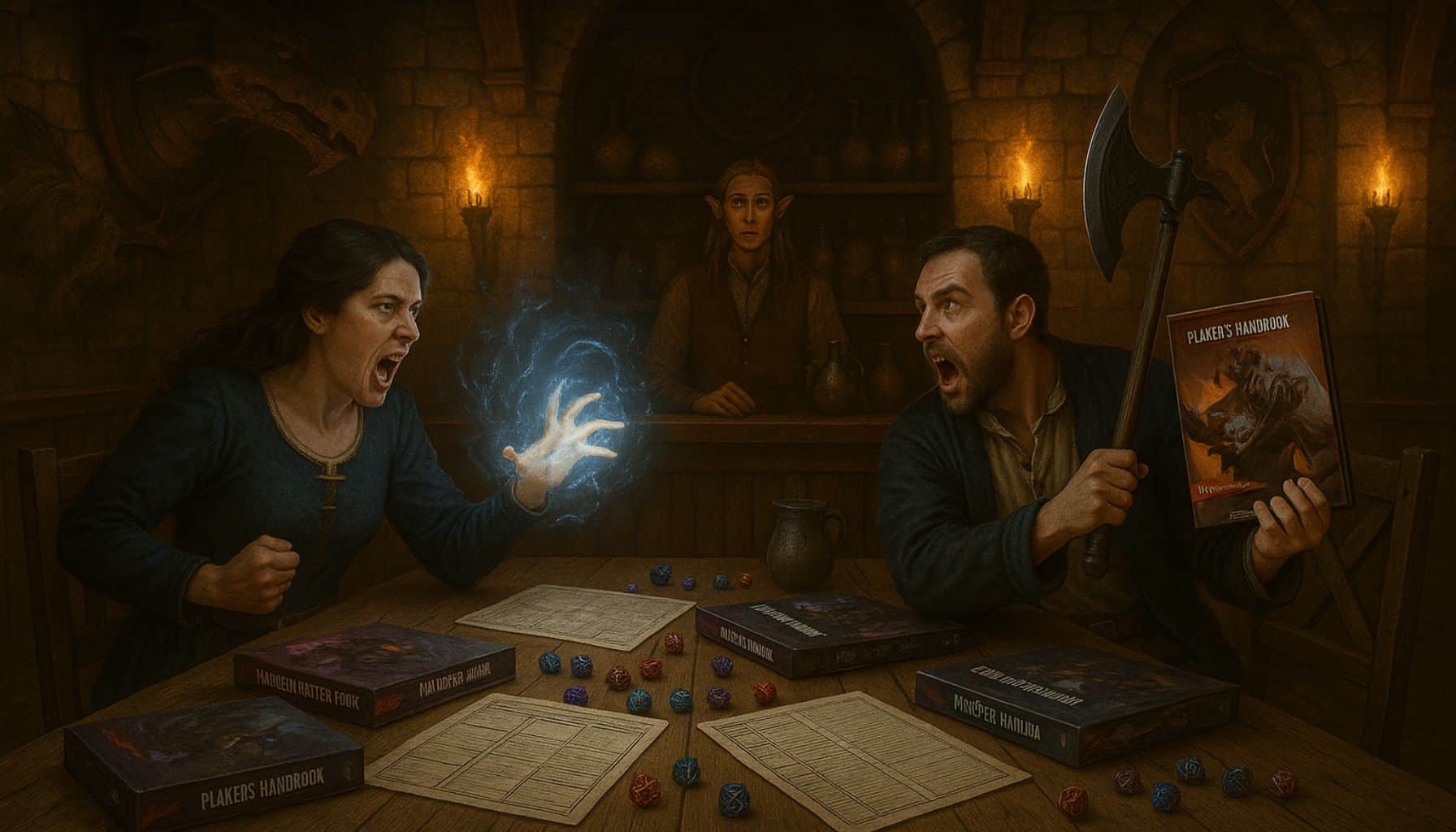
Marriage is an epic campaign. It has a long runtime, high stakes, and requires a massive amount of resource management. For some of us, however, the line between the vow “till death do us part” and the mechanics of a Death Saving Throw has become dangerously thin. We are the couples who calculate our household budget in gold pieces. We are the partners who view a dishwasher that actually cleans dishes as a Legendary Artifact requiring attunement. This is what happens when tabletop logic seeps into the foundations of domestic life, turning a partnership into a permanent party of two.
The shift usually happens slowly. First, you are just painting minis on the dining room table on a Tuesday night. Next thing you know, you are asking your spouse if they have enough movement speed to grab you a seltzer from the fridge before the commercial break ends. It is a descent into a specific kind of madness where standard communication is replaced by game jargon. Why ask “How was your day?” when you can ask “Did you encounter any wandering monsters at the office?” It is affectionate, sure, but it is also deeply weird to anyone looking in from the outside.
There is a distinct comedy in applying high fantasy logic to low stakes reality. In D&D, you slay dragons, treat with gods, and save the multiverse. In marriage, the “Boss Fight” is usually a clogged drain or a miscommunication about whose turn it is to call the insurance company. When you approach these mundane tasks with the gravity of a paladin swearing a sacred oath, the absurdity highlights just how silly life can be. It turns the drudgery of adulthood into a series of side quests that yield XP, even if the loot is just a clean living room.
Small quirks signal the takeover. You find d20s in the silverware drawer because someone was rolling for spoon selection. There is a character sheet used as a coaster on the nightstand. You have serious debates about whether the dog is Chaotic Good or Chaotic Neutral (he is Chaotic Hungry). These aren’t just messy habits; they are flags planted in the soil of your relationship. They signify that you have built a shared language, one where “I failed my perception check” is a valid legal defense for not noticing the new haircut.
Ultimately, this blurring of worlds is a strength. It gives you a framework to understand each other’s strengths and weaknesses. It provides a shorthand for stress, for success, and for those days when you just rolled a natural 1 on life. This article explores the hilarity of living with a Dungeon Master, the perils of treating your spouse like an NPC, and how, if you play your cards right, D&D can actually make you a better, funnier, and more forgiving partner.
How the Game Sneaks Into Daily Life
The creep begins innocently enough. You start using game terms as shorthand because they are efficient. Why explain that you are physically exhausted and emotionally drained when you can just say “I’m at 1 HP”? But soon, the game mechanics start dictating the rhythm of the house. You find yourself mentally calculating the DC (Difficulty Class) of getting out of bed on a Monday morning. You start viewing your morning coffee not as a beverage, but as a Potion of Haste necessary to avoid taking a level of Exhaustion.
Try my AI Tabletop RPG generators...and an extensive library of content!
Arguments take on a bizarre tactical quality. Instead of just bickering, you are rolling for initiative to see who speaks first. You are checking for line of sight before making a passive-aggressive comment. Household chores become fetch quests with terrible rewards. The grocery list isn’t just food; it is an inventory management puzzle where you are trying to maximize carry weight without becoming encumbered. The mundane becomes gamified, which makes it more bearable, but also infinitely more ridiculous.
The danger lies in the accidental miscommunication. If you tell your non-gamer in-laws that you are “planning to murder hobo your way through the weekend,” they might call the police. If you tell your spouse you are “splitting the party” to go to the hardware store, they might just think you are breaking up with them. The jargon creates a secret language that reinforces your bond, but it can also alienate you from the rest of the civilized world that doesn’t understand why you are shouting “Counterspell!” when someone tries to interrupt your story.
Ultimately, this pseudo-roleplay layer adds a filter of fun to the boring parts of life. It allows you to frame a bad day as a “bad session” that you can recover from after a Long Rest. It lets you treat a difficult mother-in-law as a high-level encounter requiring buffs and strategic positioning. As long as you both know the rules of this weird homebrew setting you have created, it works.
- The Coffee Pot: Referring to the morning brew as a Potion of Vitality or Elixir of Wakefulness.
- The Commute: Describing heavy traffic as “Difficult Terrain” that halves your movement speed.
- The Dishwasher: Rolling a Dexterity check (stacking skills) to fit that last plate in without breaking anything.
- The Trash: Calling the weekly garbage run a “Banishing Ritual” to remove rot from the realm.
- The Sick Day: Announcing you have been hit with a debuff and require a Greater Restoration (soup).
- The Paycheck: Referring to salary day as “Loot Drop” or “Gold Acquisition Phase.”
- The GPS: Treating the navigation voice as a confused NPC guide with a low Intelligence score.
- The Blanket Hog: Accusing your partner of “Grappling” the duvet and restraining you.
- The Leftovers: Making a Constitution saving throw to eat the questionable takeout from three days ago.
- The Social Event: Describing a dinner party as a “Charisma Encounter” you are not prepped for.
- The Cat: Referring to the pet as a “Familiar” that grants advantage on happiness but disadvantage on stealth.
- The IKEA Furniture: A high-level Intelligence puzzle that usually results in Psychic Damage.
- The Lost Keys: A failed Investigation check that halts the main quest.
- The Snoring: Describing it as an Area of Effect thunder spell disrupting your long rest.
- The Date Night: Calling it a “Side Quest” to improve faction reputation with your spouse.
- The Child: A “Level 1 Human Fighter” with zero wisdom and high destructibility.
Humor is the ultimate defensive buff in a marriage. When the ceiling leaks or the car breaks down, being able to crack a joke about “environmental hazards” takes the edge off the panic. It reminds you that you are playing the same game, even if the DM (the universe) is being unfair.
⚔️ Fantasy RPG Random Tables Books
Make life as a Gamemaster easier…
If you play Dungeons & Dragons, Pathfinder, or other fantasy RPGs, this
RPG random tables series
is packed with encounters, NPCs, treasure, and more. Available in eBook or print—either way, you’ll have a wealth of adventure ideas at your fingertips.





The Perils of “Rules as Written” in Relationships
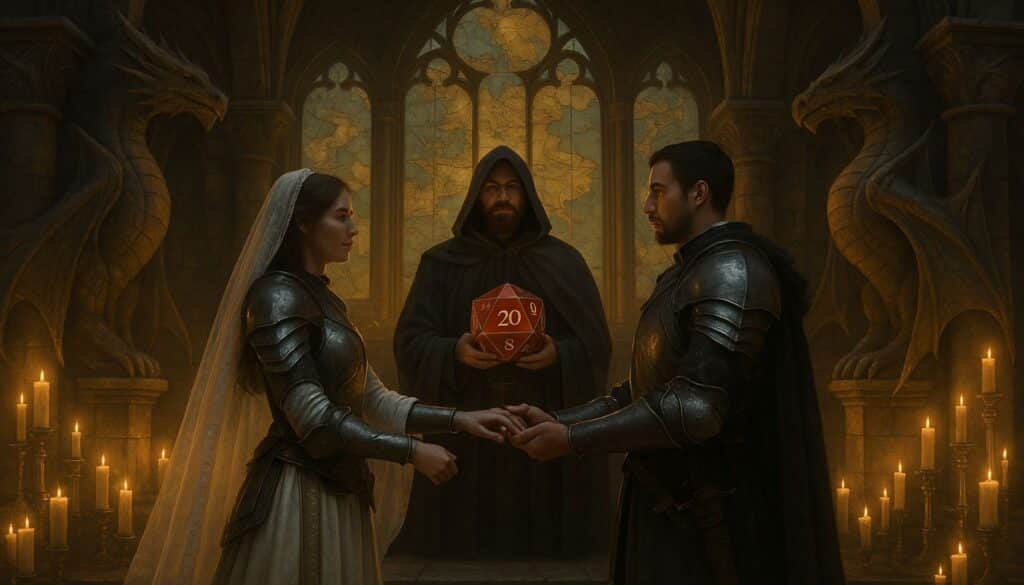
There is a certain type of D&D player known as the “Rules Lawyer.” They quote the handbook chapter and verse to get their way. In a marriage, this behavior is a fast track to sleeping on the couch. Trying to apply “Rules as Written” (RAW) to human emotions is a disaster. You cannot pull out a rulebook during an argument and say, “Technically, I didn’t say I would do the dishes, I said I might do the dishes, which implies a percentage chance.” That is not a winning strategy; that is a plea for divorce.
Crunchy mechanics offer safety and predictability, while human emotions are messy and chaotic “homebrew.” A partner relying on RAW logic tries to win arguments on technicalities. They treat an apology like a spell slot that, once expended, fixes the problem instantly. They act as if “consent” to a plan is a toggled condition rather than an ongoing conversation. This rigid thinking invalidates feelings because feelings rarely follow the grid movement rules of 5th Edition.
It creates a dynamic where one partner is the DM trying to tell a story of connection, and the other is a player trying to exploit a glitch in the system. If your spouse says, “I feel like you aren’t listening,” and you respond with, “I rolled a 19 on my Perception check, I heard every word,” you have missed the point entirely. You are engaging with the mechanics of the conversation, not the spirit of the relationship.
- The “Technically”: Starting a sentence with “Technically…” during an emotional moment (Automatic Fail).
- The Spell Slot Apology: Thinking saying “Sorry” once fixes a recurring behavior without a cooldown period.
- The Feat Defense: Claiming you can’t be expected to cook because you didn’t take the Chef feat.
- The Surprise Round: Bringing up an old grievance in the middle of a nice dinner to get a tactical advantage.
- The Metagaming: Using knowledge your character (you) shouldn’t have (like checking their phone) to win an argument.
- The RAW Chores: Refusing to clean the bathroom because the chore chart only specified “clean the kitchen.”
- The Action Economy: Complaining that your partner took two Bonus Actions (asks) in one turn.
- The Hit Point Logic: Acting like emotional hurt doesn’t matter because you are “still standing.”
- The Alignment Defense: Justifying bad behavior by claiming “It’s what my character would do.”
- The Inspiration Hoarding: Refusing to give a compliment because you gave one yesterday and they haven’t “used it” yet.
- The Cooldown Complaint: Asking for intimacy immediately after a fight because the “combat encounter” is over.
- The DM Authority: Trying to overrule your partner’s feelings because you think you are the narrator of the marriage.
Relationships thrive on the “Rule of Cool,” which in marriage means “The Rule of Kindness.” Flexibility, interpretation, and reading the intent are far more important than the letter of the law. If you are technically right but your spouse is crying, you have lost the encounter.
Turning Conflicts Into Co-Op Play
The best shift a gamer couple can make is realizing they are not in a PvP (Player vs. Player) match. You are in a Co-Op campaign. The dirty laundry is the monster. The budget deficit is the dungeon. Your spouse is the other party member essential to your survival. When you frame conflict this way, it stops being “Me vs. You” and becomes “Us vs. The Problem.” You stop trying to defeat your partner and start trying to buff them so you can both clear the level.
D&D teaches us that a balanced party is better than a solo hero. You have different stats. Maybe one of you has high Wisdom (emotional intelligence) and the other has high Strength (carrying the groceries). Recognizing these roles prevents resentment. You don’t get mad at the Wizard for not tanking damage; you shouldn’t get mad at the partner with social anxiety for not wanting to make the phone call. You embrace the asymmetry of your builds.
Narrative framing helps recontextualize the grind. Instead of “We are fighting about money again,” it becomes “We need to allocate resources for the upcoming quest to buy a house.” It sounds silly, but it lowers the emotional temperature. It turns a stressor into a strategic puzzle. You can sit down for a “Session Zero” to discuss boundaries and expectations for the upcoming week, just like you would for a new campaign.
- The Party Objective: Explicitly stating the shared goal (e.g., “We want a clean house”) before arguing about how to get there.
- The Session Zero: A weekly check-in to discuss feelings, boundaries, and upcoming scheduling hazards.
- The Debrief: Talking about an argument after it’s over to see what went wrong, without judgment (like post-game chat).
- The Assist Action: Explicitly asking “How can I give you Advantage on this task?”
- The Short Rest: Agreeing to take a 20-minute break during a heated argument to regain HP (patience).
- The Loot Split: Ensuring free time and spending money are divided fairly, not competitively.
- The Role Call: Identifying who is the “Face” (talks to waiter) and who is the “Tank” (deals with complaints) for the night.
- The Inspiration Die: Giving your partner a small treat or compliment to help them through a tough moment.
- The No-PvP Rule: establishing that insults and low blows are banned at the table.
- The Readied Action: “If you cook, I will clean.” Setting up triggers for cooperation.
- The Perception Check: Asking “Are you venting or looking for a solution?” to understand the encounter type.
- The Bardic Inspiration: Cheering on your partner while they do something difficult, even if you can’t help physically.
- The Scouting Run: One person checking the mail or answering the door to warn the other of danger.
- The Party Face: Letting the extrovert handle the in-laws while the introvert handles the logistics.
Channel the best parts of tabletop teamwork. Remember the high-fives after a boss kill. Remember the shared panic when a plan goes wrong. That camaraderie is the secret sauce of a happy marriage. You are adventure buddies first, roommates second.

Love Languages, But Make Them D&D
The “Five Love Languages” are a bit cliché, but translating them into D&D mechanics makes them instantly understandable to the gamer brain. “Acts of Service” sounds like a chore. “Casting Support Spells” sounds tactical and heroic. “Gifts” sounds materialistic. “Loot Drops” sounds awesome. By gamifying affection, you remove the awkwardness of asking for what you need. You can simply tell your partner, “I need a long rest,” or “I need you to equip me with a snack.”
In-game archetypes reflect these needs. The Paladin shows love by protecting (Acts of Service). The Bard shows love by singing praises (Words of Affirmation). The Rogue shows love by… stealing your hoodie (Physical Touch/Gifts?). Understanding your partner’s class helps you understand how they love. If you are expecting a poem from a Barbarian, you are going to be disappointed. But if you appreciate that they killed the spider for you, you realize you are loved.
| Love Language | D&D Analogy | Example Behaviors | Potential Pitfalls |
|---|---|---|---|
| Acts of Service | Support/Buff Spells | Doing the dishes (Bless), Fixing the car (Mending), Packing lunch (Heroes’ Feast). | Casting spells they didn’t ask for (solving problems they just wanted to vent about). |
| Words of Affirmation | Bardic Inspiration | “You critted that presentation,” “You look like a Charisma 20 today.” | Spamming the same line until it feels like a macro script rather than genuine praise. |
| Receiving Gifts | Rare Loot Drops | Buying their favorite dice, bringing home a specific snack, finding a cool rock. | Giving them items your character would want (buying them a game you want to play). |
| Quality Time | Short/Long Rests | No-phone couch sitting, playing a 2-player campaign, walking the dog together. | Treating the time as “downtime” to ignore them while scrolling Reddit. |
| Physical Touch | Touch Range Spells | Back scratches, holding hands (maintaining concentration), cuddling (grappling). | Invading personal space when their AC is high (they are overstimulated/angry). |
| Shared Activities | The Party Quest | Building IKEA furniture together, painting minis, co-op video games. | Quarterbacking their turn (telling them how to do the activity correctly). |
| Emotional Support | Healing Word | Listening to a rant, validating feelings, offering a shoulder to cry on. | Trying to “fix” the damage instead of just healing the HP. |
| Protection/Safety | Tanking Aggro | Handling difficult phone calls, dealing with the rude waiter, killing bugs. | Over-protecting to the point of being patronizing or controlling. |
Gamified love languages are endearing as long as you stay grounded. Don’t let the metaphor replace the sincerity. Sometimes, you just need to say “I love you,” not “I admire your high stats.”
⚔️ Fantasy RPG Random Tables Books
Make life as a Gamemaster easier…
If you play Dungeons & Dragons, Pathfinder, or other fantasy RPGs, this
RPG random tables series
is packed with encounters, NPCs, treasure, and more. Available in eBook or print—either way, you’ll have a wealth of adventure ideas at your fingertips.
When the Campaign Becomes the Third Partner
There is a reality we need to address: D&D is a needy hobby. It is not like knitting or reading, which can be put down instantly. It is a scheduled, multi-hour commitment that takes up mental RAM and physical space. A serious campaign can feel like a third partner in the marriage. It demands Friday nights. It demands money for books. It demands emotional energy when your character dies.
This creates logistical friction. If you have a session every week, that is 52 nights a year your spouse is essentially a widow/widower to the dice. If you are the DM, the prep time can eat up your entire weekend. The tension between “I need to prep” and “We need to clean the garage” is the true final boss of the hobby.
Balancing Game Time and Quality Time
You have to build a firewall between fantasy and reality. Boundaries are key. Neither partner should feel like an NPC in the other’s life, standing around waiting for the “hero” to finish their game so the real plot can continue. Scheduling strategies are essential. If Friday is Game Night, Saturday must be Date Night. It is the law of equivalent exchange.
You also need to understand social energy. After a four-hour session, the gamer partner might be “peopled out” and need silence. The non-gamer partner might have been waiting all night to talk. This mismatch creates conflict. Navigating it requires mutual agreement and respecting the mana bar of your spouse.
- The Blackout Night: A designated night where no D&D talk or prep is allowed.
- The Trade-Off: If you get 4 hours to game, you owe 4 hours of focused chore/kid/date duty.
- The Calendar Block: Putting game nights on the shared family calendar months in advance.
- The “Hard Stop” Rule: Agreeing that the game ends at 10 PM, no matter what, to allow for connection before sleep.
- The Worldbuilding Bond: Asking your spouse for ideas for your campaign (even if they don’t play) to include them.
- The “AFK” Signal: Letting the group know that if the spouse calls, the game pauses immediately.
- The Seasonal Break: Taking a month off D&D during busy life seasons (holidays, big work projects).
- The Location Swap: Hosting the game at home so you aren’t physically absent, versus playing away to keep the house quiet.
- The Energy Check: Telling your spouse “My social battery is at 10%” after a game so they know not to launch into a heavy topic.
- The Hobby Swap: You play D&D one night; they get a night for their hobby while you handle the house.
- The “No Phones” Dinner: A ritual to reconnect before the gaming starts.
- The Reality Anchor: Ensuring you ask about their day before you launch into a story about what the goblin did.
Balance prevents resentment. If the game feels like a threat to the marriage, the marriage will kill the game. If the game feels like a healthy outlet, the marriage will protect it.

When One Partner Isn’t a Player
The mixed-hobby marriage is common. One person owns 50 sets of dice; the other thinks dice are for Yahtzee. This is fine. You don’t need to share every hobby. But you do need to manage the exclusion. The non-playing partner can feel like they are on the outside of an inside joke that never ends. They hear you laughing with your friends and feel isolated.
Curiosity and respect bridge this gap. The gamer needs to respect that D&D is boring to watch. The non-gamer needs to respect that D&D is important to their spouse. You don’t have to play to support. You can be the patron of the arts. You can be the provider of snacks. But the gamer must ensure the hobby doesn’t absorb all emotional bandwidth. If you cry over an NPC death but are stoic about your spouse’s bad day at work, you have a problem.
- The “Soap Opera” Recap: Summarizing the session as a dramatic story (focus on gossip/betrayal) rather than mechanics.
- The Social Invite: Inviting the spouse to the pre-game dinner or post-game hang, but letting them skip the dragon slaying.
- The “NPC” Cameo: Letting them voice a villain or a merchant for 5 minutes just for fun.
- The Art Share: Showing them character art or minis because they look cool, regardless of the stats.
- The Boundary: Not forcing them to play “just once” if they have said no. Respect the “No.”
- The jargon Ban: Agreeing not to use D&D slang when talking to them.
- The Appreciation: Explicitly thanking them for handling the kids/house while you played.
- The “Other” Friends: Ensuring you have couple friends who have nothing to do with D&D.
- The Listener: Asking about their hobby with the same enthusiasm you want them to show for yours.
- The Reality Check: Remembering that your spouse is real and your character is not.
Love defines compatibility, not shared stats. You can be a Level 20 Wizard married to a Level 0 Commoner, and it can be the best romance in the realm.
The Heroic Side of Letting D&D In
Despite the scheduling tetris and the weird jargon, D&D is a net positive for marriage. It is a machine that generates laughter. There is nothing quite like the shared memory of a disastrous plan failing spectacularly. It builds a library of inside jokes that acts as a fortress against the boring parts of life.
Collaborative creativity deepens intimacy. When you roleplay, you are often revealing parts of yourself—your bravery, your fears, your moral compass—under the mask of a character. Seeing your quiet spouse give a rousing speech as a Paladin changes how you see them. It reminds you that they are complex, multi-faceted, and capable of surprise.
Try my AI Tabletop RPG generators...and an extensive library of content!
How Roleplay Builds Real Empathy
Roleplaying is literally the practice of empathy. You are training your brain to see the world through different eyes. This translates directly to marriage. If you can understand why a Goblin resorts to banditry, you can understand why your spouse is grumpy about the dishes. D&D encourages active listening; if you miss a detail, you die. In marriage, if you miss a detail, you sleep on the couch. The stakes are similar.
The game teaches adaptability. Plans never survive contact with the enemy. Marriages never survive contact with reality without adjustment. Gamers are used to pivoting. We are used to failing forward. We know that a Natural 1 isn’t the end of the story; it’s just a complication we have to improvise around.
- Reading the Room: Noticing when the “mood” shifts, just like an Insight check.
- Active Listening: Paying attention to subtext and tone, not just words.
- Negotiating Goals: Finding a compromise where everyone gets some loot.
- Failing Forward: Treating mistakes as plot points rather than disasters.
- Sharing the Spotlight: Knowing when to step back and let your partner shine.
- Identifying Triggers: Knowing what upsets the “party” and avoiding it.
- Strategic Planning: Breaking big problems into manageable rounds.
- Patience: Waiting for your turn without interrupting.
- Celebration: Cheering for your partner’s successes like they rolled a Nat 20.
- Accepting Flaws: Loving a character (or spouse) despite their low stats.
- Improvisation: “Yes-Anding” your partner’s ideas instead of shutting them down.
- Team Cohesion: Remembering you win or lose together.
- Resource Management: Knowing when you are both out of spell slots (energy).
- Defusing Tension: Using humor to break a deadlock.
- Narrative Empathy: Understanding your partner’s backstory explains their current behavior.
Roleplay is practice for compassion. It forces you to ask “What would they do?” instead of “What do I want?”

The Magic Items We Make Together
Every marriage creates its own lore. The ticket stub from the first movie you saw. The ugly mug you bought on a honeymoon. In D&D terms, these are magic items. They grant bonuses to your relationship. They are the artifacts you have crafted through the grind of daily life.
Couples “attune” to one another. Over time, you gain access to special abilities: The Look that says “I want to leave this party,” The Hand Squeeze that grants Advantage on anxiety saves. These are the real superpowers.
| Relationship Artifact | Real-World Meaning | The “Bonus” It Grants |
|---|---|---|
| The Blanket of Fortitude | The specific blanket you curl up under to watch movies. | Grants Resistance to cold damage and work stress. |
| The Chalice of Morning | The coffee mug your partner fills for you every day. | Removes the “Grumpy” condition; restores 1d4 Sanity. |
| The Totem of the Inside Joke | A random object (e.g., a rubber duck) that makes you both laugh. | Casts Tasha’s Hideous Laughter on command; dispels anger. |
| The Amulet of the Date | The calendar reminder for your anniversary. | Prevents the “Forgot Important Event” catastrophe (Instant Death). |
| The Boots of the Walk | The sneakers you wear for evening strolls. | +2 to Communication; allows deep talks while moving. |
| The Shield of the United Front | Backing each other up in front of the kids/parents. | +5 AC against social pressure and manipulation. |
| The Potion of the Takeout | The menu for the pizza place on speed dial. | Instantly resolves the “What’s for dinner?” hunger crisis. |
| The Ring of Silence | Putting phones away during dinner. | Grants Advantage on Insight checks into your partner’s day. |
| The Helm of the Listener | Nodding and saying “That sucks” without offering solutions. | Grants the “Validated” buff to the speaker. |
| The Map of the Future | Your shared 5-year plan or vision board. | Prevents the party from getting lost or splitting up. |
These artifacts, not dice or rules, are what truly power a marriage. They are the loot you keep after the session ends.
Leveling Up: The Long-Term Campaign
Marriage, much like Dungeons & Dragons, is not a “one-shot” adventure; it is a sprawling, multi-year campaign that takes you from Level 1 to Level 20. When you first move in together, you are squishy. You have starting equipment (a futon and a toaster), no gold, and you are susceptible to “Total Party Kills” from minor threats like assembling furniture or deciding where to spend Thanksgiving. You are figuring out your class features and accidentally lighting the tavern on fire.
As the years go by, you grind XP. You survive the random encounters of job losses, the dungeon crawls of moving houses, and the boss fights of raising children or pets. You stop checking the rulebook every five minutes and start playing by instinct. You develop synergy. You learn that your partner isn’t just a random NPC you picked up at a tavern; they are the tank to your healer, the rogue to your wizard. You start to anticipate their moves before they make them.
This progression is the ultimate reward of the hobby-marriage merger. You aren’t just getting older; you are leveling up. You are unlocking “Epic Boons” that young couples haven’t earned yet. You realize that the goal isn’t just to loot the room, but to build a stronghold that can withstand any siege the DM (life) throws at you.
The Tiers of Matrimonial Play
In D&D, play is divided into tiers. Tier 1 is “Local Heroes” (fixing the sink). Tier 2 is “Heroes of the Realm” (getting a mortgage). Tier 3 is “Masters of the Realm” (surviving teenagers). Tier 4 is “Masters of the World” (retirement). Recognizing which tier you are in helps you manage expectations. You cannot expect Tier 4 stability when you are on a Tier 1 budget. You have to respect the grind.
Each tier comes with its own monsters. In the early levels, the monsters are external: money, time, judgmental relatives. In the later levels, the monsters become more existential: health scares, mid-life crises, the realization that you have told the same story about the goblin and the pie 400 times. But high-level characters have high-level tools. You have advantage on saving throws against boredom because you have spent a decade building a shared imagination.
- Level 1 (The Honeymoon Phase): High Charisma, low Wisdom. You burn all your spell slots on “Romance” and ignore resource management.
- Level 3 (The Cohabitation Subclass): You choose your archetype. Are you the “Hosting Couple” or the “Hermit Couple”?
- Level 4 (The First ASI): Ability Score Improvement. You finally learn how to load the dishwasher correctly (+1 Int).
- Level 5 (Extra Attack): Life speeds up. You are juggling two careers, a pet, and a social life. You can do twice as much in a turn.
- Level 8 (The Feat Selection): You stop trying to boost your stats and start taking feats like “Selective Hearing” or “Iron Stomach” (for cooking failures).
- Level 11 (Tier 3 Play): You are unshakeable. You can communicate an entire paragraph of information with a single eyebrow raise.
- Level 14 (The Class Feature): “Timeless Body.” You stop caring what other people think of your hobbies. You wear the D&D shirt to the fancy dinner.
- Level 17 (9th Level Spells): You have access to “Wish.” If you say “I wish we had pizza,” pizza appears.
- Level 20 (The Capstone): You have mastered the game. You can sit in silence for hours and be perfectly content. You are a two-person pantheon.
- The Multiclass Dip: Taking a level in “Handyman” when something breaks, even if it’s not your main build.
- The Retraining: Realizing a strategy (yelling) isn’t working and swapping it for a new skill (patience) during a long rest.
- The Prestige Class: Becoming “Grandparents” or “The Cool Aunt/Uncle,” unlocking new skill trees.
⚔️ Fantasy RPG Random Tables Books
Make life as a Gamemaster easier…
If you play Dungeons & Dragons, Pathfinder, or other fantasy RPGs, this
RPG random tables series
is packed with encounters, NPCs, treasure, and more. Available in eBook or print—either way, you’ll have a wealth of adventure ideas at your fingertips.
Surviving to the high levels requires acknowledging that you will take damage. You will fail saves. But as long as you have a cleric nearby (each other) to cast Revivify on your spirit, you keep leveling.
Unlocking Relationship Feats
Just as characters gain special abilities that break the standard rules, long-term couples unlock “Relationship Feats.” These are passive buffs that you acquire simply by surviving long enough without killing each other. They represent the specialized skills that only your specific party possesses. Maybe you have the “Pack Tactics” feat, granting you Advantage on social interactions when you are standing next to each other.
These feats are often invisible to outsiders. They don’t understand how you can navigate a crowded grocery store without speaking, or how you know exactly which movie the other person wants to watch based on a vague hand gesture. That is the “Telepathic Bond” feat. It is earned through thousands of hours of roleplay.
| Relationship Feat | Prerequisite | Effect Description |
|---|---|---|
| Sentinel | 5+ Years Married | When a creature (relative) attacks your partner with a passive-aggressive comment, you can use your Reaction to intercept and attack. |
| Keen Mind | Level 4 “Partner” | You always know which way is North, how many hours until sunset, and exactly where your spouse left their keys. |
| Dungeon Delver | Shared Bank Account | You have Advantage on perception checks to find hidden fees and Resistance to impulse buying traps. |
| Inspiring Leader | 10+ Pep Talks | You can give a 10-minute speech that grants your partner Temporary HP (confidence) before a job interview. |
| Alert | Parenting/Pet Owner | You cannot be surprised while sleeping; you wake up instantly at the sound of a gagging cat or crying child. |
| Lucky | 3x Anniversaries | Three times per day, you can reroll a failed joke or an accidentally insensitive comment to save the mood. |
| Tavern Brawler | IKEA Survivor | You are proficient with improvised weapons (pillows, towels) during playful arguments. |
| Great Weapon Master | Heavy Lifter | You take a -5 penalty to comfort (carry all grocery bags in one trip) to deal +10 damage to the chore list. |
| Actor | In-Law Visit | You have Advantage on Deception and Performance checks to pretend you enjoy the dry turkey. |
| Resilient (Wisdom) | The “I Told You So” | You gain proficiency in Wisdom saves to resist saying “I told you so” when you were right. |
These feats prove that you aren’t just playing parallel games; you are optimizing your build to support one another. You cover their weaknesses, and they buff your strengths. That is the meta-game of marriage.
The Encumbrance of Matrimony: Inventory Management for Two
In Dungeons & Dragons, encumbrance rules are boring, so most groups ignore them. In marriage, encumbrance rules are the leading cause of screaming matches on Saturday mornings. Merging two lives means merging two inventories, and suddenly you realize that your spouse is carrying an absurd amount of “Vendor Trash” that they refuse to sell. You are forced to confront the reality that your house has a finite carrying capacity, and you are currently over the limit because someone refuses to throw away a T-shirt from a concert they didn’t even attend in 2008.
This is the Battle of the Hoard. D&D players are naturally conditioned to keep everything because “I might need this for a puzzle later.” This logic is disastrous when applied to domestic life. You end up with a garage full of “Quest Items” that have no active quest. You have a drawer full of mysterious keys that don’t open anything, but you keep them because you are terrified that the moment you toss them, you will encounter the Locked Door of Destiny.
Navigating this requires a high Wisdom score. You have to discern between a “Legendary Artifact” (the heirloom quilt) and “Cursed Loot” (the ugly vase your mother-in-law gave you that you can’t get rid of without taking psychic damage). You also have to manage the “Bag of Holding” paradox, which is the belief that if you just shove the mess into a closet and close the door, the mess ceases to exist on this plane of existence. Spoiler alert: It does not.
Distinguishing “Quest Items” form “Vendor Trash”
Every gamer has a “Box of Cables.” It is the ultimate component pouch. It contains an HDMI cable, a charger for a phone that hasn’t existed since 2012, and a wire that might be for a printer or might be for a bomb. In a marriage, you have to audit this box. You have to sit down and cast Identify on a Tupperware container of frozen soup that has been in the freezer so long it has developed sentience.
The friction comes when one partner is a “Loot Goblin” who picks up everything, and the other is a “Minimalist Monk” who wants to own nothing but a robe and a stick. The Goblin argues that the broken toaster can be crafted into something new (Artificer logic). The Monk argues that it is difficult terrain that is ruining the Feng Shui of the kitchen. You have to roll Persuasion to convince your spouse that keeping 400 plastic grocery bags is not “resource prep,” it is a fire hazard.
- The Box of Cables: A “Component Pouch” containing items for spells you will never cast (connecting a VCR to a Smart TV).
- The Fancy Candle: A “consumable item” that is too rare to use, so it sits on a shelf gathering dust for 5 years until it loses its scent.
- The Mystery Key: A quest item for a dungeon (padlock) that was destroyed three moves ago.
- The Instruction Manual: A tome of knowledge for a dishwasher you no longer own.
- The Takeout Sauce Packet: An “Alchemist’s Supply” kit. You have 300 soy sauces but zero ketchup.
- The Hotel Shampoo: “Potions of Cleaning” stolen from taverns, hoarded for an apocalypse that requires tiny hair products.
- The Old Paint Can: Kept in the garage for “touch ups,” currently solid as a rock. A petrified ooze.
- The Broken Chair: A “Fixer Upper” project that requires a high-level Mending spell you do not have prepared.
- The Gift Bag: You cannot throw away a gift bag; you must reuse it. It is a cycle of passing the same paper sack back and forth forever.
- The Dried Pen: A wand with zero charges left. Why is it back in the cup?
- The Single Sock: A tragedy. The other half of the pair was banished to the Astral Plane by the dryer.
- The Expired Coupon: A discount scroll that fizzled because you forgot to cast it before the deadline.

The War for Attunement Slots (Decorating)
In 5th Edition D&D, you can only attune to three magic items at once. In a living room, you only have so many “Attunement Slots” for decoration before the room looks like a pawn shop exploded. This is where taste clashes. You want to hang your framed map of Middle Earth (The Map of the Known World). Your spouse wants to hang a “Live Laugh Love” sign (The Sigil of the Basic Witch).
Decorating is a negotiation of aesthetic stats. You are trying to balance the “Cozy” stat with the “Functional” stat. You have to decide if the giant bean bag chair provides enough Comfort bonus to justify the penalty to Movement Speed in the living room. You have to agree on whether the collection of Funko Pops constitutes a “Display of Wealth” or a “Ward Against Intimacy.”
| Domestic Item | Rarity | Attunement Effect | Cursed Property |
|---|---|---|---|
| The Decorative Pillow | Uncommon | +2 to Visuals, +0 to Comfort. | Removal Curse: Must be removed from the bed every night and replaced every morning. Consumes 10 minutes/day. |
| The Wedding China | Rare | +5 to Charisma when hosting in-laws. | Fragility: If looked at wrong, it shatters. Touching it requires a Dex save (DC 20). |
| The Treadmill | Very Rare | Intended to give +2 Strength. | Transformation: After 3 weeks, it polymorphs into a “Very Expensive Clothes Rack.” |
| The Recliner | Legendary | +10 to Short Rest effectiveness. | Aesthetic Drain: Gives -5 to the room’s Style stat. Cannot be moved by mortal hands. |
| The Novelty Mug | Common | Holds liquid (Standard). | Cabinet Jam: Always rotates handle-out to block the cupboard door from opening. |
| The Thermostat | Artifact | Controls the climate of the realm. | Dad Sense: If touched by anyone other than the attuned user, the owner instantly knows and becomes hostile. |
| The Wi-Fi Router | Wondrous | Connects the home to the Weave. | Blink: Randomly ceases to function during critical moments (boss fights/streaming). |
| The “Guest” Towel | Uncommon | Looks fluffy and soft. | Forbidden: Cannot be used by actual residents. Only for high-level NPCs (guests). |
The “Bag of Holding” Paradox (The Purse/Trunk)
Every marriage has at least one “Bag of Holding.” Usually, it is a purse, a diaper bag, or the trunk of the car. It defies physics. You ask your spouse for a tissue, and they reach into the void and pull out a tissue, a granola bar, a screwdriver, and a receipt from 2019. It is an infinite inventory that bypasses encumbrance, but retrieving an item requires an Action and a successful Investigation check.
The danger of the Bag of Holding is that it becomes a graveyard for lost items. You will lose your sunglasses, accuse your partner of stealing them, and three years later find them at the bottom of the bag, crushed under a water bottle. The Bag is also a heavy weapon. If you swing a fully loaded purse at a burglar, it deals 2d8 bludgeoning damage plus 1d4 psychic damage from the sheer chaos inside.
- The Black Hole Effect: Any item placed in the center console of the car disappears for 1d4 months.
- The Mom/Dad Reflex: The ability to produce a band-aid or snack from the bag instantly as a Reaction.
- The Weight Limit: The bag is always exactly 1 pound lighter than the airline weight limit. This is a magic effect.
- The “Junk Drawer”: A stationary Bag of Holding in the kitchen. It contains batteries, rubber bands, and gum. It is the heart of the home.
- The Mystery Smell: Something in the bag has spoiled. You must empty the entire void to find the source.
- The Emergency Stash: Finding a $20 bill in an old bag is like finding loot on a skeleton.
- The Infinite Crumbs: No matter how much you clean it, the bottom of the bag generates 1d4 crumbs per day.
- The Weaponization: “Hold my purse” is a command that transfers the heavy load to the tank (partner) so the rogue (you) can move freely.
- The Portal: If you put your hand in too deep, you might touch the hand of a version of yourself from a parallel universe searching for chapstick.
- The Audit: Trying to clean the bag is a downtime activity that takes 4 hours and results in “Why do we have so many mints?”
Inventory management is the unsexy part of the campaign, but it is necessary. If you don’t manage your loot, your loot manages you. The couple that declutters together, stays together. Or at least, they can find the remote without rolling a 20.
Final Thoughts on D&D in Marriage
When Dungeons & Dragons rules your marriage, life gets a little weirder, a little louder, and a lot funnier. You might annoy your neighbors with shouts of “Fireball!” at 11 PM. You might confuse your accountant by referring to your tax return as a “tribute to the local lord.” But you also build a partnership based on shared imagination.
⚔️ Fantasy RPG Random Tables Books
Make life as a Gamemaster easier…
If you play Dungeons & Dragons, Pathfinder, or other fantasy RPGs, this
RPG random tables series
is packed with encounters, NPCs, treasure, and more. Available in eBook or print—either way, you’ll have a wealth of adventure ideas at your fingertips.
D&D complicates communication with its jargon, but it elevates connection through play. It gives you a safe space to be silly, to be heroic, and to be a team. It teaches you that no matter how big the monster is—whether it’s a Tarrasque or a mortgage—you can take it down if you coordinate your attacks.
So, keep the character sheets on the fridge. Keep the dice in the junk drawer. Embrace the fantasy. Just remember that the most important campaign isn’t the one with the dragons; it’s the one you’re playing with the person sitting across the table from you. Treat them like the MVP of your party, and you’ll never roll a natural 1 on love. Marriage works best when you both realize you are co-adventurers on the same quest, looking for the same loot: a happy life.
