
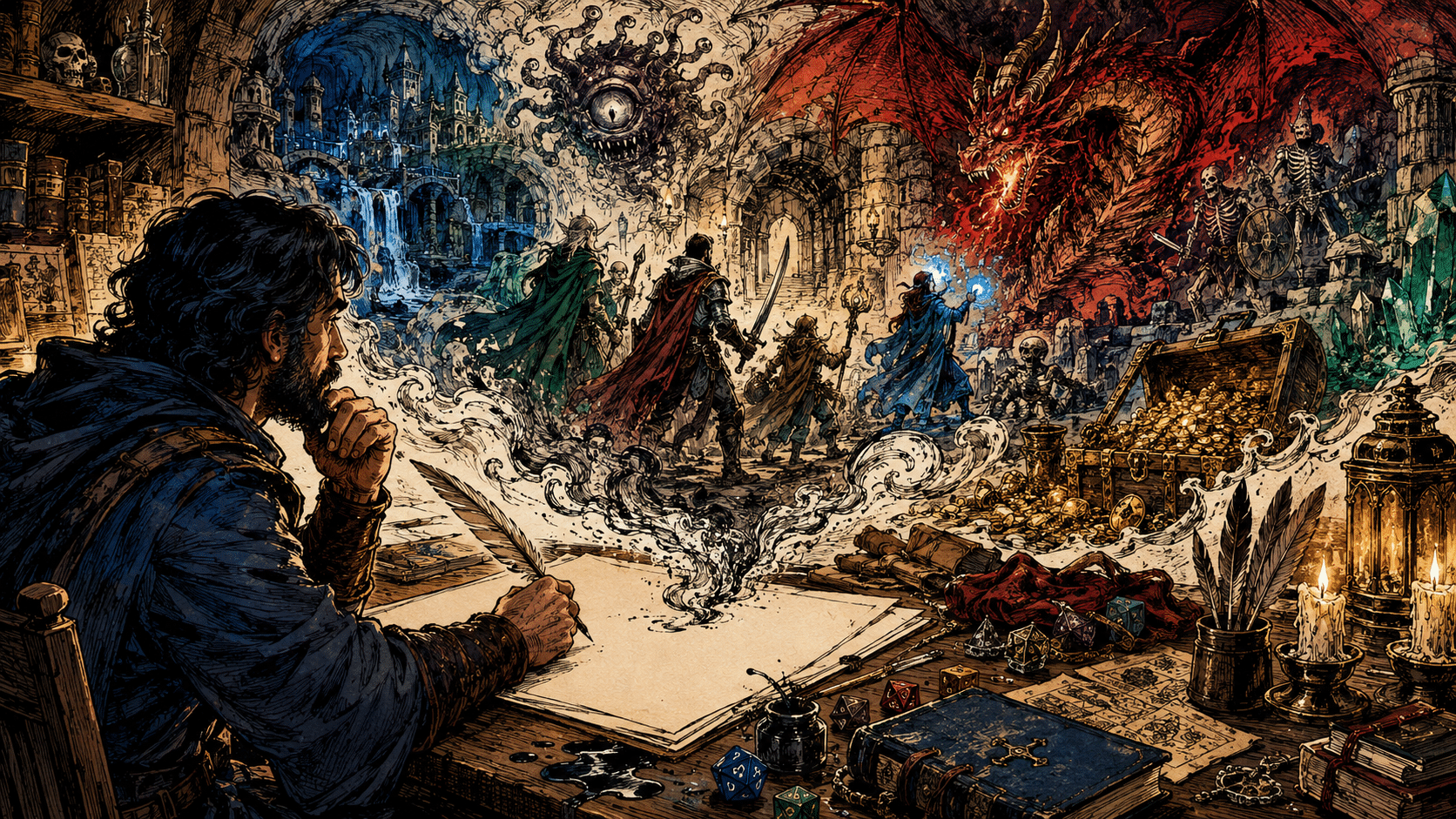
The blank prep document is not a document. It is a white void with ambition. It stares back at you like an ancient lich who has just asked, “So, Dungeon Master, what happens next?” Your notes say things like “swamp???” and “cool villain maybe moth-related,” and somehow the session begins in four hours.
Then there is the cursor. Blink. Blink. Blink. A tiny rectangular inquisitor. It knows you have not named the mayor. It knows your dungeon has no second room. It remembers every time you improvised a shopkeeper and accidentally made them the emotional centerpiece of the campaign. The cursor is not neutral. The cursor has opinions.
This is where AI prompts can help. Not by replacing your imagination, your world, or your sacred right to cackle behind a screen, but by giving you a pile of usable ingredients when your brain has become mashed potatoes. AI can turn “I need a spooky forest thing” into factions, rumors, monsters, NPCs, clues, and three terrible consequences if the party ignores the glowing tree that whispers tax advice.
AI is not replacing the DM. AI is the goblin intern who brings too many ideas, labels none of them correctly, and occasionally sets the filing cabinet on fire. This guide will show you how to use that goblin productively for adventures, NPCs, encounters, locations, puzzles, loot, villains, recaps, and emergency prep when your players are already texting, “So excited for tonight!”
Why Blank Pages Are the Real Final Boss
Campaign prep is intimidating because Dungeons & Dragons contains infinite possibility, which is another way of saying “too many doors and all of them are screaming.” You can create anything: kingdoms, curses, monsters, gods, sewer politics, an entire economy based on enchanted cheese. Unfortunately, “anything” is not a plan. “Anything” is what your players do when you expected them to follow the road.
Player unpredictability makes prep especially spicy. You build a haunted abbey with layered symbolism, tragic lore, and a stained-glass angel that cries blood. The party spends forty minutes interrogating a turnip vendor because you said he had “shifty eyebrows.” The blank page knows this. It whispers, “Why prepare? They will adopt the mimic anyway.”
Try my AI Tabletop RPG generators...and an extensive library of content!
Then there is perfectionism, time pressure, and the haunting memory of that one improvised shopkeeper named Boblin. Boblin was supposed to sell rope. Now Boblin has a fan club, a tragic divorce, and a destiny. AI prompts help by taking vague ideas and turning them into structured possibilities: hooks, NPC motives, encounter twists, clues, consequences, and enough names that no one has to be called “Dave the Third” unless you choose it on purpose.
Using AI as a creativity engine is different from letting it write everything. A creativity engine gives you sparks: possible villains, encounter complications, dungeon rooms, strange rumors, puzzle mechanisms, suspiciously specific goat prophecies. You still decide what belongs in your campaign. You are not outsourcing the soul of your game; you are asking for kindling.
Letting AI write everything without your judgment is how you end up with a twelve-page monologue from an elf named Xylandriel Moonwhisper who explains the entire plot while everyone reaches for snacks. The DM stays in charge of tone, canon, pacing, emotional stakes, and whether the goblin accountant is funny, tragic, or secretly a warlock of compound interest.
Needing help does not make you less creative. Dungeon Masters have always used tools: random tables, published modules, folklore, mythology, movies, novels, dreams, panic, and that one historical fact you learned on accident and immediately turned into a necromancer cult. AI prompting is another tool in the same overcrowded backpack.
⚔️ Fantasy RPG Random Tables Books
Make life as a Gamemaster easier…
If you play Dungeons & Dragons, Pathfinder, or other fantasy RPGs, this
RPG random tables series
is packed with encounters, NPCs, treasure, and more. Available in eBook or print—either way, you’ll have a wealth of adventure ideas at your fingertips.





So do not feel guilty. Every DM has stolen from folklore, renamed a tavern “The Drunken Something,” and pretended they knew what was behind the left-hand door. AI prompts simply give you more somethings to choose from.
Foundations of a Good AI DND Prompt
A strong AI prompt gives context. Tell the goblin intern what kind of campaign you are running, who the party is, what level they are, what has happened recently, and what you need at the table. “Give me a dungeon” produces generic fantasy soup. “Create a three-room haunted dwarven bathhouse for four level 5 characters in a grim-comic campaign, with social clues, steam hazards, and a ghost who refuses to stop giving etiquette lessons” produces adventure fuel.
Good prompts also define the desired output. Do you want a bullet list, a table, boxed text, NPC stat suggestions, ten rumors, three encounter variants, or a one-page session prep sheet? AI is much more useful when you tell it how you plan to use the result. “Make this table-ready” is a magical phrase, especially if you are prepping while eating cereal over your keyboard.
Constraints are your friends. Include tone, setting details, things to avoid, party level, encounter difficulty, and any canon that must not be contradicted. If your campaign is whimsical, ask for whimsy. If your game is gothic horror, say so. If you hate puzzles involving chessboards, mention that before the AI gives you the Royal Tomb of Extremely Chess Again.
The Prompt Formula Every DM Should Tattoo on Their Spellbook
A reliable prompt formula looks like this:
Act as [role]. Create [thing] for [party/context]. Use [tone/style]. Include [specific elements]. Avoid [unwanted elements]. Format as [output type].
For example: “Act as a veteran D&D adventure designer. Create three swamp adventure hooks for a level 4 party in a darkly comedic campaign. Include a moral dilemma, a weird NPC, a ticking clock, and a monster that is not undead. Avoid saving-the-world stakes. Format as a table with hook, conflict, twist, and opening scene.”
Useful components to add to prompts include:
- Party level: “for four level 6 characters”
- Party composition: “with a cleric, rogue, barbarian, and wizard”
- Campaign tone: “grim, whimsical, heroic, absurd, gothic, cozy”
- Setting type: “desert city, cursed forest, sky islands, underdark market”
- Recent events: “after the party betrayed a thieves’ guild”
- Villain motive: “revenge, grief, pride, survival, love, prophecy”
- Encounter difficulty: “easy warm-up, deadly boss, resource-draining gauntlet”
- Moral dilemma: “no perfect answer, both sides have a point”
- Time limit: “the ritual completes at midnight”
- Environmental hazard: “rising water, collapsing bridge, sentient fog”
- Desired format: “bullet points, table, one-page prep, read-aloud text”
- NPC personality: “cheerful liar, exhausted idealist, dramatic coward”
- Secrets or twists: “one hidden betrayal, one misunderstood monster”
- Player relevance: “connect to the paladin’s oath”
- Things to avoid: “no chosen-one prophecy, no modern slang, no spiders”
- Mechanical boundaries: “use 5e-style difficulty but no full stat blocks”
- Session use: “designed for a two-hour session”
- Improvisation aids: “include names, rumors, and fallback clues”
Treat prompt-writing like spellcasting. If you mumble “make adventure,” you may accidentally summon a cursed duck, three unrelated ruins, and an elf who speaks entirely in exposition. If you specify your components, you get something closer to a controlled fireball.
Precision does not kill creativity. It gives creativity a saddle, reins, and a signed waiver. The clearer your prompt, the less likely you are to receive twelve pages of suspicious elf monologues when all you needed was a goblin with a key.
Adventure Hook Prompts for Emergency Session Prep
Sometimes the next session is in two hours, your notes are blank, and all you have is coffee, panic, and the phrase “vague swamp idea.” This is not failure. This is traditional DM cuisine. AI is excellent at producing adventure hooks quickly, especially if you ask for conflict, stakes, urgency, and a reason the players should care beyond “a hooded figure approaches.”
A good hook is not just an event. It is a problem pointed at the party. Someone wants something. Someone else will suffer. Something is running out of time. Something smells like wet moss and bad decisions. Ask the AI to include who is involved, what goes wrong if nobody acts, and how the hook connects to the characters’ goals, allies, enemies, or unpaid bar tabs.
Avoid prompts like “Give me fantasy adventure hooks.” That is how you get “a village is threatened by goblins,” which is fine, but also the narrative equivalent of dry toast. Instead, ask for hooks with pressure: “Create five swamp adventure hooks where the party must choose between saving a town and preserving an ancient nature spirit.”
| Adventure Prompt Category | Sample AI Prompt Wording | Best Campaign Tone | Possible Twist |
|---|---|---|---|
| Swamp Emergency | “Create 5 urgent swamp hooks for level 4 PCs with weird locals and a moral dilemma.” | Dark comedy | The monster is protecting eggs from the village. |
| Noble Request | “Generate a noble patron hook where the job sounds simple but hides a scandal.” | Political intrigue | The patron hired the villain first. |
| Missing Person | “Create a missing-person hook tied to a festival and a supernatural bargain.” | Folk horror | The missing person left willingly. |
| Monster Hunt | “Design a monster hunt where killing the beast makes things worse.” | Grim fantasy | The beast is sealing a worse creature underground. |
| Tavern Rumor | “Give me 10 tavern rumors, 3 true, 4 distorted, 3 false, for a coastal campaign.” | Sandbox adventure | The silliest rumor is completely true. |
| Road Encounter | “Create a travel hook involving a broken carriage, a secret, and a dangerous deadline.” | Heroic fantasy | The passengers are disguised criminals. |
| Fey Bargain | “Make a fey hook where the reward is tempting but linguistically dangerous.” | Whimsical menace | The fey never lies, but pronouns matter. |
| Dungeon Discovery | “Generate a hook for a newly revealed ruin connected to an old party mistake.” | Classic adventure | The ruin remembers the party. |
| Cult Activity | “Create a cult hook with subtle signs, public denial, and one sympathetic cultist.” | Mystery horror | The cult prevents a real apocalypse badly. |
| Rival Party | “Design a hook where rival adventurers reach the quest first and make it worse.” | Comedic adventure | The rivals are actually competent, just unlucky. |
| Local Disaster | “Create a town crisis caused by magic infrastructure failing during a holiday.” | Absurd fantasy | The repair manual is sentient and offended. |
| Personal Backstory | “Generate 3 hooks tied to the rogue’s estranged mentor and a stolen relic.” | Character drama | The mentor stole it to protect the rogue. |
Once the AI gives you hooks, refine them. Ask follow-up questions like, “Make it darker,” “Add a comedic NPC,” “Connect it to the rogue’s backstory,” or “Give me an opening scene that starts in the middle of trouble.” You can also ask for three different versions: tragic, silly, and morally complicated.
⚔️ Fantasy RPG Random Tables Books
Make life as a Gamemaster easier…
If you play Dungeons & Dragons, Pathfinder, or other fantasy RPGs, this
RPG random tables series
is packed with encounters, NPCs, treasure, and more. Available in eBook or print—either way, you’ll have a wealth of adventure ideas at your fingertips.
One excellent revision prompt is: “Make the villain sympathetic but still extremely punchable.” This creates the perfect D&D antagonist: someone whose pain is understandable, whose methods are unacceptable, and whose hat practically begs to be thrown into a river.
Remember, adventure hooks should be invitations, not railroad tickets. You are not shoving the party onto the Plot Express while goblins check boarding passes.
Offer a situation, not a script. The players choose how to enter the mess. Your job is to make the mess interesting enough that they step in voluntarily, boots first.
NPC Prompts That Prevent Every Shopkeeper from Becoming Dave
NPCs are where campaigns become alive, weird, and legally complicated. AI can help create memorable characters with voices, flaws, motives, secrets, and mannerisms you can use immediately. Instead of “the blacksmith is gruff,” you can get “the blacksmith treats every weapon like a troubled child and refuses to sell swords to people with bad posture.”
Every DM knows the pain of inventing an NPC on the spot and accidentally giving them the emotional depth of a wet napkin. The party asks the name of the fishmonger, and suddenly you say, “Uh… Dave.” Three sessions later Dave is central to the plot, married to a sea hag, and beloved by the bard. This is how campaigns happen, but it is nice to have options.
When prompting for NPCs, ask for table-ready traits: name, appearance, voice, desire, fear, secret, useful information, and one thing they do while talking. Mannerisms are gold. A nervous priest who rearranges candles whenever lying is easier to roleplay than “wise priest number seven.”
Try these NPC prompt ideas:
- “Create a tavern owner with a warm personality, a dangerous secret, and three rumors they might share.”
- “Generate a rival adventurer who is annoying, talented, and secretly desperate for approval.”
- “Create a noble patron whose request is reasonable but whose methods are morally rancid.”
- “Design a suspicious priest who may be innocent, corrupt, or possessed; give clues for each possibility.”
- “Create a goblin accountant for a thieves’ guild, including voice, ledger-based threats, and one adorable hobby.”
- “Generate a haunted librarian who remembers books that have not been written yet.”
- “Create a traveling merchant with strange goods, a fake accent, and a real problem.”
- “Design a villain in disguise the party can meet socially before realizing the truth.”
- “Create a quest giver with bad judgment who keeps escalating minor problems into disasters.”
- “Generate three henchmen with hobbies who are loyal to the villain but not enthusiastic about overtime.”
- “Create a cursed child who is creepy, sympathetic, and not secretly evil by default.”
- “Design a talking animal with strong opinions about local politics and snacks.”
- “Create a fey trickster whose bargains are funny until they are not.”
- “Generate a dungeon prisoner who can help the party but is lying about why they were locked up.”
- “Create a retired hero who is famous, tired, and wrong about one important historical event.”
- “Design a black-market healer who saves lives with illegal magic and terrible bedside manner.”
- “Create a castle guard with one useful clue, one personal problem, and one reason not to trust the party.”
- “Generate a ship captain who fears dry land and owes money to a mermaid court.”
AI can also provide dialogue snippets. Ask for “five short lines this NPC might say when nervous,” or “three insults from a noble who thinks they are being polite.” Request secrets, relationship maps, and improvisation aids: “What does this NPC know, what do they suspect, what are they wrong about?”
Most importantly, ask for contradictions. Interesting characters often want two incompatible things. A priest wants peace but craves recognition. A goblin accountant wants order but works for chaos gremlins. A retired hero wants to be forgotten but cannot stop giving dramatic speeches near fireplaces.
A great NPC needs one memorable feature, one desire, and one problem the players can make worse. That is the holy trinity of table chaos.
If you remember nothing else, remember this: a weird hat is not a personality, but it is a strong opening argument.

Encounter Design Prompts for Balanced Chaos
AI can help design combat and non-combat encounters that are more interesting than “monsters stand in a room waiting to become soup.” Good encounters have objectives, terrain, tactics, complications, and alternate win conditions. The goblins are not just there to be stabbed; they are trying to burn documents, escape with a hostage, finish a ritual, or unionize.
Prompt for encounter purpose. Is this meant to drain resources, reveal lore, create tension, introduce a villain, reward cleverness, or punish the party for licking the glowing crystal? Encounters are better when they do more than subtract hit points.
Also ask for dynamic terrain. Bridges collapse. Statues animate. Fog lies. Mushrooms explode because fantasy ecosystems are dramatic. An encounter with movement, choices, and environmental pressure feels alive, even if the enemies are mechanically simple.
| Encounter Type | Sample AI Prompt | Terrain Feature | Complication | Non-Combat Resolution Option |
|---|---|---|---|---|
| Ambush | “Create a level 3 forest ambush with tactical goblins and a nonlethal objective.” | Fallen logs and thorn patches | Goblins want a stolen map, not murder | Trade false map or intimidate leader |
| Ritual Interruption | “Design a ritual encounter with escalating effects each round.” | Glowing sigil platforms | Destroying sigils harms captives | Arcana checks to reverse ritual |
| Monster Negotiation | “Create an encounter with a hungry monster that can be reasoned with.” | Narrow cave ledges | Monster protects its young | Offer food or remove threat |
| Chase | “Generate a city chase with obstacles and skill choices.” | Rooftops, market stalls | Innocents in the path | Predict route and cut off target |
| Siege Moment | “Create a small-scale gate defense encounter for level 6 PCs.” | Barricades and burning oil | Gate mechanism jams | Repair, rally guards, or parley |
| Haunted Room | “Design a ghost encounter where memories are weapons.” | Shifting furniture | Attacking strengthens ghost | Resolve unfinished business |
| Rival Duel | “Create a social-combat hybrid duel against rival adventurers.” | Arena with hazards | Crowd changes rules mid-fight | Win crowd support or expose cheating |
| Trap Gauntlet | “Make a trap encounter with clues and multiple solutions.” | Rotating hallway | Time pressure from pursuing ooze | Disable, outrun, or redirect ooze |
| Beast Stampede | “Create a wilderness encounter involving panicked animals.” | Ravine and mudslide | Predators caused the stampede | Calm herd or scare predators away |
| Magical Disaster | “Design an unstable wizard lab encounter.” | Floating debris | Spells trigger wild effects | Stabilize crystals with skill checks |
Review AI-generated encounters carefully. Balance matters, especially in D&D, where action economy is the invisible dragon sitting on your initiative tracker. Five weak enemies can be scarier than one big enemy. One big enemy can become sad paste if the party surrounds it and begins the traditional ritual of “everyone smite now.”
AI sometimes has odd ideas about difficulty. “Balanced for level 3” may mean one sleepy bandit with a spoon, or it may mean a dragon wearing another dragon. Treat generated mechanics as suggestions, not law. Check monster damage, hit points, save DCs, and whether the encounter accidentally shuts down one player for an entire fight.
Try my AI Tabletop RPG generators...and an extensive library of content!
Also review for fun. An encounter can be technically balanced and still boring. Ask: Can the players make meaningful choices? Can different classes contribute? Is there something to interact with? Does the battlefield change? Is there a reason not to simply stand still and exchange damage until everyone becomes broth?
Use AI for variety. Ask for alternate objectives: rescue, escape, delay, negotiate, protect, steal, survive, distract, reveal. Ask for enemies with tactics, not just stat blocks with legs.
Then adjust numbers, pacing, and danger based on your actual table. You know whether your players are tactical masterminds, chaos raccoons, or emotionally attached to every enemy with a speaking role.
Location Prompts for Taverns, Tombs, Swamps, and Other Poor Life Choices
AI is excellent at generating fantasy locations with sensory details, history, secrets, factions, and interactive features. A tavern becomes more than a bar when the fireplace whispers legal advice, the basement floods with prophetic ale, and the owner refuses to explain why every mirror faces the wall.
Ask for locations players can touch, break, misunderstand, loot, climb, befriend, insult, or accidentally set on fire. Static scenery is fine for postcards. D&D locations should have handles, levers, rumors, stains, questionable ladders, and at least one object that makes the barbarian say, “Can I lift it?”
Use these location prompt templates:
- “Create a haunted tavern with three ghosts, five rumors, one secret room, and a drink that causes visions.”
- “Design a sunken temple for level 5 characters with air pockets, drowned murals, and a sleeping guardian.”
- “Generate a goblin market with bizarre stalls, illegal goods, social rules, and one merchant who recognizes the party.”
- “Create a living forest with moods, paths that move, animal messengers, and a central mystery.”
- “Design a wizard tower where each floor reflects a failed experiment and offers an interactive hazard.”
- “Create a cursed battlefield with ghostly reenactments, scavenger factions, and a buried truth.”
- “Generate a floating city with political factions, sky hazards, and a festival about to go wrong.”
- “Design an underworld ferry crossing with strange passengers, payment options, and forbidden questions.”
- “Create a fey court with etiquette rules, dangerous compliments, and hidden exits.”
- “Generate a dragon graveyard with bone weather, treasure taboos, and rival treasure hunters.”
- “Design an arcane prison with magical security, sympathetic inmates, and one prisoner who should not be released.”
- “Create an abandoned mine with old sabotage, new monsters, and environmental clues.”
- “Generate a celestial library where books judge readers and forbidden knowledge rearranges itself.”
- “Design a desert oasis that appears only at noon and remembers everyone who has lied beside it.”
- “Create a sewer shrine maintained by polite cultists with excellent sanitation standards.”
- “Generate a mountain monastery built around a sleeping giant’s ear.”
To request environmental storytelling, ask AI for “details that imply history without exposition.” This is how you get cracked statues, old scorch marks, children’s graffiti over royal propaganda, repaired doors with mismatched hinges, and strange smells that suggest something was recently alive in the walls.
Use prompts like: “Give me ten environmental clues in this location, including rumors, old damage, strange smells, graffiti, local customs, and three details the players will definitely overanalyze.” They will overanalyze the spoon. You know they will. Put meaning in the spoon or prepare to invent spoon lore under pressure.
Locations should not be static backdrops. They should offer choices: which faction to trust, which door to open, which forbidden bell to ring even though the sign says “do not ring.”
They should offer dangers, clues, moods, and temptations. A good location has texture. It says, “Something happened here,” and “Something is still happening,” and “Please do not lick the glowing moss.”
And yes, include one object the barbarian will try to lift. If you do not provide one, they will choose a load-bearing pillar.
Villain Prompts for Bad Guys With Better Motives Than “Because Evil”
AI can help create layered villains with goals, fears, resources, public masks, private wounds, and catastrophic plans. A villain is not just a stat block with a dramatic coat. A villain is a person, monster, spirit, tyrant, angel, fungus, or municipal committee that wants something badly enough to ruin everyone’s weekend.
⚔️ Fantasy RPG Random Tables Books
Make life as a Gamemaster easier…
If you play Dungeons & Dragons, Pathfinder, or other fantasy RPGs, this
RPG random tables series
is packed with encounters, NPCs, treasure, and more. Available in eBook or print—either way, you’ll have a wealth of adventure ideas at your fingertips.
Good villains do not need to be reasonable, but they should be understandable. “I will blot out the sun because I am evil” is workable if the voice is good, but “I will blot out the sun because sunlight reveals the plague scars my kingdom refuses to acknowledge” gives the party something to chew on emotionally before they start chewing through hit points.
Prompt AI for layers: What does the villain claim to want? What do they actually want? What wound drives them? What line will they not cross? What line did they already cross and now pretend was necessary? Give them assets: minions, money, magic, influence, blackmail, monsters, public approval, or a really excellent bakery that funds the apocalypse.
| Villain Archetype | AI Prompt Angle | Sympathetic Motive | Dramatic Flaw |
|---|---|---|---|
| Fallen Hero | “Create a former hero whose solution became tyrannical.” | Wants to prevent another disaster | Cannot trust anyone else |
| Grieving Necromancer | “Design a necromancer driven by loss, not cackling evil.” | Wants to restore family | Treats consent as optional |
| Corrupt Noble | “Create a beloved noble hiding monstrous bargains.” | Wants stability for their city | Confuses control with care |
| Fey Monarch | “Generate a fey villain bound by strange promises.” | Wants to preserve their realm | Cannot understand mortal urgency |
| Cult Prophet | “Design a prophet who is partly right.” | Wants to stop a real threat | Sacrifices people too easily |
| Dragon Banker | “Create a dragon using debt instead of fire.” | Believes order prevents war | Greed disguised as civilization |
| Vengeful Spirit | “Generate a ghost villain with justified anger.” | Was betrayed and erased | Punishes descendants unfairly |
| Revolutionary Leader | “Create a rebel antagonist with noble goals and brutal methods.” | Wants freedom for the oppressed | Romanticizes violence |
| Mad Archmage | “Design an archmage whose experiment could save or destroy reality.” | Wants to cure mortality | Thinks ethics are for assistants |
| Monster Sovereign | “Create a monster ruler defending their people.” | Protects a hunted species | Refuses diplomacy |
| Angelic Zealot | “Generate a celestial villain pursuing perfect justice.” | Wants to end corruption | Cannot tolerate mercy |
| Cursed Child Ruler | “Design a child monarch corrupted by inherited magic.” | Wants safety and love | Terrified of losing power |
AI can generate villain schemes, escalation timelines, minions, lairs, signature spells, taunts, and moral dilemmas. Ask for “a three-stage plan that escalates if the party ignores it,” or “five clues that reveal the villain’s public mask is false.”
One of the best villain prompts is: “Give me three ways the villain reacts if the party ruins their plan.” This prevents villains from feeling like video game bosses waiting behind fog doors. Maybe they retaliate socially. Maybe they frame the party. Maybe they offer a deal. Maybe they send a singing telegram with a curse in the chorus.
Make villains proactive. If the party ignores them, the villain should not sit in a chair labeled “Boss Fight” eating crackers.
They should move, scheme, adapt, recruit, threaten, and occasionally make the party say, “Wait, are we the side quest?”
Mystery, Puzzle, and Clue Prompts That Don’t Make Players Cry
AI can generate riddles, puzzles, investigation scenes, clue webs, and mysteries, but beware: puzzles must be solvable by actual humans at an actual table on actual snacks. What seems “simple” in prep may become impossible once the wizard is distracted, the rogue is suspicious of nouns, and the barbarian thinks every inscription is a challenge to arm wrestle.
When prompting for mysteries, ask for multiple clue paths. Never hide progress behind a single roll or one exact interpretation. If the party misses the bloodstain, they might find the torn glove. If they ignore the witness, they might notice the alibi contradiction. If they burn down the library, well, first of all, typical, but perhaps the smoke reveals invisible ink.
For puzzles, request alternate solutions and failure states that move the story forward. “The door never opens unless they solve my moon logic riddle” is dangerous. “Solving the puzzle opens the safe route; failing it opens the loud route full of skeletons who are disappointed in you” is better.
Prompt ideas for mysteries and puzzles:
- “Create murder mystery clues for a noble banquet, using the three clue rule for each major conclusion.”
- “Design an ancient door puzzle with symbols, a physical interaction, and two alternate solutions.”
- “Generate symbolic riddles themed around seasons, grief, and forgotten gods.”
- “Create a magical lock that can be opened by logic, sacrifice, spellcasting, or brute force with consequences.”
- “Design three false suspects who each look guilty for different reasons.”
- “Write cryptic prophecies that are useful but easy to misinterpret.”
- “Create a cursed object mystery where the curse reveals the owner’s hidden guilt.”
- “Generate a missing persons investigation with clues in a tavern, shrine, and abandoned mill.”
- “Design heist complications that force improvisation without ending the mission.”
- “Create secret cult signs hidden in public art, receipts, and local greetings.”
- “Generate monster behavior clues that let players identify the creature before combat.”
- “Design trial-by-spirit challenges where each test reveals character values.”
- “Create library research discoveries with useful lore, misleading records, and one forbidden book.”
- “Design puzzle rooms with alternate solutions for magic, skill checks, roleplay, and brute force.”
- “Generate a locked-room mystery in a wizard tower where the room is innocent but the staircase lies.”
- “Create a treasure map puzzle where landmarks have changed since the map was made.”
Use the three clue rule: for every conclusion the players must reach, provide at least three clues. Prompt AI like this: “For each major revelation, give me three clues in different locations, using different skills or approaches.” This prevents one failed Investigation check from murdering your entire plot in a dark alley.
Also ask for hints in escalating levels: subtle, obvious, and “the wizard finally looks under the rug.” For example: “Provide three hint levels for each puzzle: poetic nudge, direct clue, and emergency table-saving clue.” There is no shame in the emergency clue. The goal is not to watch your friends suffer while you guard a pun about moonstones.
The goal of a puzzle is not to defeat the players’ brains. You are not the SAT with goblins.
The goal is the glorious moment when everyone yells at once, points at the map, knocks over a drink, and feels like geniuses.
Roleplay and Dialogue Prompts for When Your Mouth Betrays You
AI can create dialogue lines, accents, arguments, speeches, rumors, negotiation scenes, and emotional beats. This is useful because sometimes your mouth betrays you. The solemn king opens his mouth and unexpectedly becomes Australian, and now the entire monarchy has a regional accent nobody can explain.
Ask for short, usable lines rather than speeches. You do not need an NPC to deliver a novella unless the players are trapped, cursed, or polite beyond reason. You need openings, reactions, threats, confessions, evasions, and “what they say when accused of goat theft.”
| Roleplay Situation | Sample AI Prompt | Desired Emotional Tone | Useful Output Format |
|---|---|---|---|
| Noble Negotiation | “Create 10 short lines for a proud duke negotiating with adventurers he dislikes.” | Polite contempt | Dialogue snippets |
| Tavern Rumors | “Generate 12 rumors in distinct local voices, half unreliable.” | Gossipy and funny | Rumor table |
| Villain Taunt | “Write 8 combat taunts for a grieving necromancer.” | Tragic menace | One-liners |
| Confession | “Create a confession scene for an NPC who betrayed the party but regrets it.” | Guilty and tense | Beats plus lines |
| Merchant Haggling | “Generate dialogue for a merchant who compliments and insults customers simultaneously.” | Comic irritation | Short exchanges |
| Interrogation | “Create evasive answers for a captured spy who wants to survive.” | Nervous defiance | Q&A prompts |
| Royal Speech | “Write a brief coronation speech hiding fear of rebellion.” | Grand but anxious | 1-minute speech |
| Fey Bargain | “Create fey dialogue with beautiful wording and dangerous loopholes.” | Charming threat | Offer clauses |
| Party Argument | “Generate points of conflict between two allied NPCs before a mission.” | Heated but personal | Argument beats |
| Emotional Farewell | “Write short farewell lines from a mentor who expects to die.” | Tender and restrained | 6 lines |
Prompt for distinct voices without asking for full scripts. Try: “Give me five short lines, three mannerisms, two topics they avoid, and one phrase they repeat.” That is much easier to use than a page of dialogue the players will interrupt after sentence two.
Ask for personality tags: “speaks in military metaphors,” “overexplains when nervous,” “never answers directly,” “uses pet names for enemies,” “sounds cheerful when furious.” These tags help you improvise in character without reading.
Also request subtext: “What does this NPC want but will not say?” This is roleplay dynamite. The guard says, “Move along,” but wants someone to notice the blood on his sleeve. The queen says, “We are grateful,” but wants the party far from the prince. The goblin accountant says, “All invoices are final,” but wants friendship and maybe dental insurance.
Use AI dialogue as ammunition, not a script. Load your pockets with lines, motives, and reactions.
Players will interrupt, insult the duke’s hat, adopt the villain’s familiar, and ask the prisoner for relationship advice. The script was doomed. Bring ammo.
Loot, Magic Item, and Reward Prompts That Aren’t Just Another +1 Sword
AI can generate rewards that do more than increase numbers. Magic items, cursed relics, titles, favors, property, secrets, companions, faction influence, divine blessings, weird pets, and legal rights to a haunted toll bridge can all be more memorable than another +1 sword.
The best rewards create choices. A cloak that lets you turn into mist once per day is useful. A cloak that turns you into mist but whispers secrets from everyone you pass through is interesting. A sword that deals more damage is fine. A sword that refuses to harm cowards, kings, or anyone named Brenda is a campaign event.
Prompt for story connection. Ask AI for items tied to the dungeon’s history, the villain’s methods, the cleric’s god, or the rogue’s terrible childhood mentor. Rewards should make the world feel deeper, not like treasure fell from a vending machine labeled “balanced loot.”
Reward prompt templates:
- “Create 10 weird magic items for a level 4 party, each with a minor drawback and roleplay use.”
- “Design a sentient weapon that wants peace but was forged for war.”
- “Generate cursed treasure that is tempting, useful, and not immediately obvious as cursed.”
- “Create boons from gods tailored to a cleric, paladin, and skeptical rogue.”
- “Design three fey bargains as rewards, each with beautiful wording and dangerous consequences.”
- “Generate political favors a city council could grant that matter in future sessions.”
- “Create secret maps that reveal locations, lies, or moving landmarks.”
- “Design spell variants themed around frost, memory, or insects for a wizard.”
- “Generate downtime rewards for characters who train, carouse, research, or build contacts.”
- “Create magical mounts or pets with personalities, needs, and inconvenient habits.”
- “Design ancestral relics that awaken as the character resolves family history.”
- “Generate items with drawbacks that encourage creative use rather than raw power.”
- “Create a haunted musical instrument that can charm ghosts but attracts critics from beyond the grave.”
- “Design a minor artifact that gives faction influence instead of combat bonuses.”
- “Generate non-monetary rewards from a grateful village that create future obligations.”
Balance AI-generated items mechanically. Check rarity, attunement, charges, save DCs, action economy, and whether the item stacks too well with existing character abilities. A bonus action teleport every round may sound fun until the rogue becomes a hummingbird made of knives.
Also check whether the item allows the bard to legally become the moon. If yes, decide whether your campaign is ready for lunar litigation. AI is good at cool concepts but not always reliable about mechanical consequences.
Great rewards deepen the story, reveal lore, tempt bad decisions, or create new relationships. They should make players curious.
The dream response is: “This is definitely cursed, but I’m wearing it anyway.”
Session Recap, Prep, and Campaign Management Prompts
AI can help summarize sessions, track NPCs, organize plot threads, create prep notes, generate reminders, and turn chaotic player decisions into something resembling a campaign. This is like hiring a scribe who does not demand hazard pay, even after the party spends an entire session weaponizing soup.
Campaign management is where AI becomes quietly powerful. Feed it a concise summary of what happened, then ask it to extract open questions, unresolved NPCs, active threats, player goals, and likely next scenes. Suddenly your campaign notes look less like a raccoon attacked a corkboard.
⚔️ Fantasy RPG Random Tables Books
Make life as a Gamemaster easier…
If you play Dungeons & Dragons, Pathfinder, or other fantasy RPGs, this
RPG random tables series
is packed with encounters, NPCs, treasure, and more. Available in eBook or print—either way, you’ll have a wealth of adventure ideas at your fingertips.
You can also use AI between sessions to prepare recaps, update faction clocks, remember promises, and identify dangling plot hooks. The players may forget they insulted the ambassador’s ghost-horse, but the world should not.
| Campaign Management Task | Sample AI Prompt | Desired Output Format | DM Benefit |
|---|---|---|---|
| Session Recap | “Summarize these notes as a dramatic 2-minute recap.” | Read-aloud recap | Starts session smoothly |
| NPC Tracking | “Extract all NPCs mentioned and list status, location, and attitude.” | NPC table | Prevents lost characters |
| Plot Threads | “Identify unresolved plot hooks and rank by urgency.” | Prioritized list | Clarifies prep focus |
| Player Goals | “List each PC’s apparent goals based on these notes.” | Character table | Supports character-driven prep |
| Faction Updates | “Update faction reactions after the party’s actions.” | Faction clock notes | Makes world feel alive |
| Next Session Prep | “Create a one-page prep sheet for the likely next session.” | Bullet prep sheet | Saves time |
| Loose Ends | “Find forgotten promises, debts, clues, and threats.” | Checklist | Prevents continuity errors |
| Villain Timeline | “Advance the villain’s plan by one week if unopposed.” | Timeline | Keeps pressure active |
| Rumor Refresh | “Generate new rumors based on last session’s events.” | d10 rumor table | Reflects consequences |
| Location Notes | “Organize these messy location notes into keyed areas.” | Room key | Improves usability |
| Treasure Log | “Track loot gained, sold, cursed, or unidentified.” | Inventory table | Avoids treasure confusion |
| Opening Scene | “Suggest three strong opening scenes for next session.” | Scene options | Beats blank-page panic |
Prompt safely and efficiently. You usually do not need to paste a massive transcript. Summarize the important events: who the party met, what they learned, what they changed, what they promised, what exploded, and which NPC they adopted against your will.
Ask for categorized outputs like “open questions,” “NPCs involved,” “player goals,” “possible next-session scenes,” “consequences,” and “prep priorities.” Categories turn chaos into handles. Handles are useful when your campaign has become a chandelier of knives.
Campaign management prompts are not glamorous. They do not roar, breathe fire, or wear skull pauldrons.
But neither is forgetting the name of the queen the party swore loyalty to three sessions ago. Use the scribe. The scribe remembers.
Prompt Troubleshooting: When the AI Gives You Fantasy Oatmeal
Sometimes AI gives you fantasy oatmeal: bland, beige, technically edible, and full of names like “Elarion Shadowvale” and “Thornwick Duskmere.” Common problems include generic results, too much text, wrong tone, unusable mechanics, repetitive ideas, lore contradictions, and names that sound like rejected cough syrups.
The fix is usually tighter prompting. Add context, constraints, and examples. Instead of “make a villain,” say, “Create a villain for a nautical horror campaign who is beloved by the public, terrified of drowning, and trying to awaken a sea saint. Avoid generic cult language. Give me table-ready details in bullet points.”
Iteration is not failure. It is the process. Ask for alternatives, shorter versions, stranger versions, more grounded versions, more jokes, fewer jokes, less lore, more consequences, or “make this usable at the table in ten minutes.”
Troubleshooting commands DMs can use:
- “Make it stranger.”
- “Give me five alternatives.”
- “Reduce this to table notes.”
- “Add a moral dilemma.”
- “Make it suitable for level 5.”
- “Remove modern language.”
- “Connect this to an existing NPC.”
- “Add consequences if ignored.”
- “Make it funnier.”
- “Make it more ominous.”
- “Give me only bullet points.”
- “Add sensory details.”
- “Create three escalation options.”
- “Make the names easier to pronounce.”
- “Cut the lore in half and double the usable clues.”
- “Add one weird but practical detail.”
- “Rewrite this for a cozy fantasy tone.”
- “Make the villain sympathetic but still wrong.”
- “Give me a version with no combat.”
- “Turn this into a d6 random table.”
- “List what the players can interact with.”
- “Add a twist that does not invalidate player choices.”
Use follow-up prompts as revision tools. The first AI answer is a lump of clay, not the sacred prophecy of the Content Oracle. If it gives you a haunted forest that feels boring, ask for “three unique features that change how players navigate it” or “one local custom that makes the forest socially dangerous.”
Try my AI Tabletop RPG generators...and an extensive library of content!
You can also paste back the useful part and say, “Keep this idea, replace everything else.” Be specific. “I like the ghost mayor and the flooded chapel; remove the dragon, add political tension, and make it fit a two-hour session.” That is how you turn oatmeal into stew. Haunted stew, probably.
Be bossy with AI. It has no feelings, no dice collection, and no idea how hard your players will try to seduce the tax collector.
Tell it what you need. Reject what you do not. Demand fewer elves with suspiciously long vowels.
Final Thoughts on AI DND Prompts for Dungeon Masters Who Hate Blank Pages
AI prompts are tools for momentum. They help you start when the blank page is snarling. They give you options when your brain is fog. They turn “I need something in a swamp” into “a sinking chapel, a repentant crocodile saint, three factions, and a bell that tolls for liars.”
They do not replace imagination. They do not replace table chemistry. They do not replace the sacred chaos of player decisions, such as befriending the skeleton guard, declaring war on a bakery, or spending ninety minutes debating whether a door is emotionally available.
Use prompts to generate possibilities, not commandments. Ask for hooks, choose one, twist it, rename the NPC, delete the prophecy, add your party’s fingerprints, and make it yours. The magic happens when AI output collides with your taste and your players’ terrible, beautiful choices.
Prep paralysis thrives on the lie that you need the perfect idea before you begin. You do not. You need one workable idea. Then another. Then a goblin accountant. Then consequences.
The best AI-assisted prep still requires human judgment. You choose what fits the campaign, what matches the tone, what respects your players’ investment, and what deserves to be thrown directly into the narrative volcano.
You also check mechanics, edit for pacing, and leave space for improvisation. Do not prep every outcome. Prep ingredients: motives, locations, tensions, secrets, and reactions. The players will cook something alarming.
So open the blank document. Stare down the blinking cursor. Summon the goblin intern.
Write one specific prompt. Turn panic into playable magic. The page is only blank until the first bad idea arrives—and bad ideas are often where great D&D begins.
