
Imagine a timeline where the foundational texts of roleplaying history were not written by Gary Gygax or Dave Arneson, but were instead churned out by advanced algorithms. This thought experiment invites us to consider what the landscape of tabletop gaming would look like if classic D&D adventures were AI-generated today, utilizing the massive datasets and predictive text capabilities of modern technology. Such a scenario moves beyond mere speculation or hype to examine the fundamental differences between human design intent and procedural generation in game design. While AI-generated D&D adventures are becoming a reality in 2025, applying this lens to historical artifacts like Tomb of Horrors or Keep on the Borderlands reveals the stark contrast between curated cruelty and automated content. The question is not just whether AI is capable of building compelling D&D adventures, but whether it can replicate the specific soul and structural integrity that defined the old-school renaissance.
This exploration allows us to test the limits of procedural D&D storytelling against the rigid benchmarks of the past. Classic modules were often idiosyncratic, reflecting the personal prejudices, wargaming roots, and specific dungeon master styles of their creators, traits that machine learning in storytelling might struggle to emulate authentically. An AI D&D module might technically contain rooms, monsters, and treasures, but we must ask if it can capture the deliberate pacing and environmental storytelling that made the classics endure for fifty years. By looking at how to use AI to remake old D&D campaigns, we are really asking what makes those campaigns matter in the first place: is it the raw data of the dungeon, or the invisible hand of the designer guiding the experience?
The tension lies in the difference between generation and design; one is an act of volume, while the other is an act of selection. AI in tabletop RPGs offers the promise of infinite content, yet classic modules are beloved precisely because they are finite, crafted experiences with specific lessons to teach about survival and exploration. If we were to recreate Tomb of Horrors with AI, would the machine understand that the unfairness is the point, or would it simply generate a generic gauntlet of high-damage traps without the psychological warfare? This article explores AI D&D campaigns not as a replacement for human creativity, but as a mirror reflecting our own design values back at us. We will dive deep into the mechanics of AI adventure automation to see if the ghost in the machine can ever truly be a Dungeon Master.
- Why Classic D&D Modules Matter as a Benchmark
- How AI-Generated D&D Adventures Actually Work
- What an AI-Generated Tomb of Horrors Might Look Like
- Keep on the Borderlands Through an AI Lens
- AI-Generated D&D Adventures vs Human Authorship
- Hybrid AI + Human Adventure Creation
- Procedural D&D Storytelling and Its Limits
- Dynamic AI Narratives and Player Choice
- AI as a Dungeon Master Assistant
- Narrative Consistency Problems in AI D&D Campaigns
- Could AI Ever Truly Recreate a Classic Module?
- The Future of AI-Generated D&D Adventures (2025 and Beyond)
- The Uncanny Valley of Dungeon Logic: When AI Hallucinates Mechanics
- Final Thoughts: AI Can Remix D&D, But It Can’t Remember Why It Matters
Why Classic D&D Modules Matter as a Benchmark
Classic D&D modules remain the gold standard for adventure design not because they are perfect, but because they possess a distinct, unyielding authorial voice that modern AI often lacks. Adventures like The Village of Hommlet or Ravenloft function as masterclasses in tight design, offering deliberate difficulty curves that test player skill rather than character statistics. These modules were built during an era where the rules were looser, meaning the text had to carry the weight of the experience, relying on strong thematic cohesion to guide the DM. When we discuss classic D&D modules, we are discussing artifacts that were statements about how the game should be played, enforcing values of caution, resource management, and lateral thinking.
The reason these adventures serve as such a critical benchmark for AI-generated fantasy game content is their reliance on intentionality over randomization. Every trap placement in a Gygaxian dungeon was a calculated move designed to challenge specific player behaviors, a nuance that simple procedural content generation often misses in favor of statistical averages. These modules were not merely collections of encounters; they were structured environments where the ecology, however nonsensical, followed a distinct internal logic that the players could learn and exploit. This strong sense of “why” is often the hardest element for an AI D&D module to replicate because algorithms prioritize “what” comes next based on probability.
This brings us to the controversy surrounding AI D&D modules and the fear of replacing authorship with automation. The older modules carry the DNA of the old-school D&D revival, representing a specific lineage of game design that values human ingenuity and the idiosyncrasies of a specific writer’s table. If we replace this with AI-generated quests, we risk losing the “conversation” between the designer and the player that defines the TTRPG experience. The enduring legacy of these classics proves that players crave distinct, opinionated design, suggesting that the role of AI in fantasy roleplaying must be one of assistance rather than total usurpation of the creative throne.
Try my AI Tabletop RPG generators...and an extensive library of content!
What Makes a Module “Classic”
To understand if an AI-generated dungeon vs human-written module comparison is fair, we must first isolate the DNA of a classic. These adventures are defined by a memorable dungeon logic that often defies naturalism in favor of gameplay utility, creating spaces that are fun to map and navigate. There is an intentional unfairness in many classics, a design philosophy that demands players pay attention to their environment rather than their character sheets, something AI often smooths over in an attempt to be “balanced.” Furthermore, classics are characterized by sparse text that expects DM interpretation, leaving gaps that demand human creativity to fill, unlike the bloat of modern or AI-generated descriptions.
Defining Characteristics of Classic D&D Modules:
- Player-Skill Focus: Challenges are designed to be solved by the players’ wits, not just by rolling high numbers on skills.
- Static Worlds: The dungeon exists independently of the players; monsters do not scale to match the party’s level.
- Lethal Traps: Traps are meant to kill or maim carelessly playing characters, often with no saving throw if the trigger is engaged.
- Minimal Narrative Hand-Holding: There are rarely scripted plot arcs; the story is simply what happens during the exploration.
- Resource Attrition: The dungeon is designed to drain torches, food, and spells, making time a tangible enemy.
- Faction Play: Monsters often have social dynamics (e.g., Orcs vs. Gnolls) that clever players can exploit.
- Gonzo Elements: A willingness to mix sci-fi, horror, and whimsy without worrying about strict genre consistency.
- Gold as XP: Progression is tied to treasure recovery, incentivizing avoidance of combat rather than slaughter.
- Replay-Resistant Secrets: Once a trick is known, the module is mastered, making the initial discovery crucial.
- Strong Authorial Voice: The text often addresses the DM directly, offering advice or admonishments on how to run the game.
These traits are notoriously difficult for procedural systems to replicate because they rely on understanding the meta-game and the psychology of the table. AI tends to optimize for coherent, readable narratives, which often irons out the jagged, lethal, and perplexing edges that make a classic module memorable.
How AI-Generated D&D Adventures Actually Work
To understand the potential of AI D&D modules 2025 and beyond, we must look at the technical reality of how these adventures are produced today. Most AI-generated D&D adventures utilize Large Language Models (LLMs) like GPT for D&D, combined with procedural generation algorithms that structure the output into recognizable game formats. The process usually begins with a human providing a complex prompt or a series of constraints, which the AI then uses to predict and generate text that statistically resembles a fantasy adventure. This relies on pattern recognition from vast datasets of existing RPG content, meaning the AI is essentially remixing known tropes, mechanics, and descriptions rather than inventing new design paradigms.
This method of adventure automation allows for incredible speed and volume, enabling an AI dungeon master to generate a five-level dungeon in the time it takes a human to write a single room description. Tools for AI worldbuilding and fantasy adventure generation can populate hex maps, stat out unique monsters, and write extensive lore bibles in seconds. However, the output is fundamentally probabilistic; the AI chooses the most likely next word or concept, which often leads to generic or cliché results unless heavily steered by human intervention. The system does not “know” it is designing a game; it only knows it is completing a text pattern that looks like a game module.
⚔️ Fantasy RPG Random Tables Books
Make life as a Gamemaster easier…
If you play Dungeons & Dragons, Pathfinder, or other fantasy RPGs, this
RPG random tables series
is packed with encounters, NPCs, treasure, and more. Available in eBook or print—either way, you’ll have a wealth of adventure ideas at your fingertips.







Because of this, most AI systems struggle with the holistic logic required for complex D&D narrative design. While they can generate a single room that makes sense, linking fifty rooms together into a cohesive ecosystem with a satisfying dramatic arc remains a significant challenge. The “AI D&D module” often feels like a collection of disjointed scenes rather than a unified whole, as the AI lacks the long-term memory to track subtle interdependencies between a trap in Room 1 and a key found in Room 20. This limitation highlights that AI tools for roleplaying games are currently best used as ideation engines rather than autonomous authors.
From Prompt to Playable Module
The pipeline from a raw idea to a playable AI-generated quest involves several steps where the human and machine must interact. It usually starts with a high-level concept prompt, moves to a structural outline, and then drills down into specific encounter generation and stat blocks. AI excels at the connective tissue—generating flavor text, names, and random loot tables—but often fails at the structural integrity required for a satisfying game loop.
Comparison of Module Component Design:
| Module Component | Traditional Human Design | AI-Generated Method |
|---|---|---|
| Dungeon Layout | Hand-drawn maps focusing on flow, chokepoints, and logical ecology. | Procedural generation based on node graphs or randomized tile placement. |
| Room Descriptions | Evocative, concise text focusing on interactive elements and sensory details. | Verbose, often repetitive descriptions that may prioritize mood over mechanics. |
| NPC Motivations | Complex, often hidden agendas tied to the specific campaign themes. | Surface-level traits generated from archetypes (e.g., “The greedy merchant”). |
| Trap Design | Mechanical puzzles designed to test specific player resources or ingenuity. | Generic damage dealers or randomized hazards that may lack logical triggers. |
| Loot Placement | Deliberately placed rewards to pace progression and enable future challenges. | Randomized treasure tables or items generated without regard for power balance. |
| Plot Hooks | deeply integrated narrative threads connecting to the world lore. | Generic “quest giver” tropes that may lack deep connection to the setting. |
| Monster Tactics | Strategic behavior based on the creature’s intelligence and environment. | Basic “attack until dead” scripts or generic behavior descriptions. |
| Pacing | Carefully calibrated tension arcs with rising and falling action. | Flat or random pacing driven by the sequence of generation rather than drama. |
The automation of these components changes the priority of the module from a carefully crafted experience to a content-delivery system. The speed of AI game design tools is undeniable, but the lack of intentionality in the connections between components often results in a “hollow” feel that requires significant human polish to fix.

What an AI-Generated Tomb of Horrors Might Look Like
If we were to task an AI with recreating Tomb of Horrors today, the result would likely be a fascinating but fundamentally misunderstood dungeon. Tomb of Horrors is famous not just for being hard, but for being a cerebral, adversarial puzzle box designed to challenge high-level players who had become complacent. An AI-generated Tomb of Horrors would likely interpret “hard” as “statistically overwhelming,” filling the dungeon with high-CR monsters and traps with impossible saving throw DCs. It might miss the subtlety of the original, where the danger came from player interaction—touching the wrong sphere, entering the wrong mouth—rather than simply walking down a hallway.
An AI attempting to replicate this classic would likely struggle with the “gotcha” moments that rely on subverting D&D rules, a staple of Gygaxian design. For example, the AI might generate a “Deadly Trap” that deals 100 damage, but it might fail to generate the specific, illogical clue in the previous room that hints at how to bypass it. The narrative consistency challenges of AI mean it might forget the specific riddle logic established at the dungeon’s entrance by the time the players reach the final corridor. The result would be a dungeon that is lethal in a boring, mathematical way, rather than lethal in the psychological, riddle-solving way of the original.
Furthermore, Tomb of Horrors has a specific, oppressive atmosphere of isolation and decay that is maintained through very specific sensory details. An AI D&D module might drift in tone, perhaps inserting generic combat encounters with wandering skeletons that break the eerie stillness Gygax intended. The AI might try to “balance” the adventure by adding helpful NPCs or rest points, fundamentally misunderstanding that the module is meant to be a resource-draining nightmare. Ultimately, an AI version would likely look like a generic meat-grinder, lacking the malicious wit that makes the true Tomb legendary.
Lethality Without Malice
The core difference lies in the concept of “malice.” A human DM or designer exerts malice intentionally to test the players’ caution and respect for the dungeon. AI struggles to replicate deliberate cruelty because it optimizes for engagement and standard gameplay loops, not psychological testing. It generates content that is meant to be played, whereas Tomb of Horrors contains content meant to be avoided.
Differences in an AI-Generated Tomb of Horrors:
- Excessive Trap Volume: The AI might place a trap on every door, desensitizing players rather than building paranoia.
- Inconsistent Logic: Riddles might have answers that don’t match the clues due to hallucination or context loss.
- Unclear Player Signaling: The AI might fail to describe the subtle visual cues (scuff marks, air currents) that hint at danger.
- Generic Monsters: Instead of the unique Demi-Lich, it might spawn standard Liches or generic undead hordes.
- Lack of “Save or Die”: Modern AI training data often favors 5th Edition balance, avoiding the instant-death mechanics central to the classic experience.
- Diluted Thematic Focus: The dungeon might include mismatched themes (e.g., fire traps next to ice puzzles) without a unifying reason.
- Over-Explanation: The AI might provide too much lore or backstory for the dungeon, demystifying the horror.
- Helpful Items: It might randomly generate loot that trivializes the specific puzzles (e.g., a Wand of Trap Detection).
- Linear Layout: AI struggles with complex, looping map design, potentially creating a linear gauntlet rather than a maze.
- Misunderstood Acererak: The villain might appear early for a monologue, ruining the “absent but present” threat.
- No False Entrances: The iconic false entrances might be skipped in favor of a standard “start here” point.
- Balanced Encounters: Combat might be balanced for fairness, removing the terror of facing something you cannot kill.
Difficulty alone does not equal good design. The AI can make numbers big, but it cannot currently replicate the specific, adversarial game design that defined the early D&D experience.
Keep on the Borderlands Through an AI Lens
Conversely, The Keep on the Borderlands might be a candidate for a remake where AI could genuinely shine, or at least offer a fascinating alternative. This module is a “mini-sandbox,” consisting of a base of operations (the Keep) and a combat zone (the Caves of Chaos). An AI D&D campaign engine could excel here by generating infinite variations of the Caves, populating them with dynamic factions that react to player choices in real-time. An AI remake could flesh out the bare-bones NPCs of the original Keep, giving the Castellan, the Banker, and the Curate deep, interconnected backstories and side quests that the original text barely hinted at.
The sandbox nature of Keep on the Borderlands aligns well with procedural D&D storytelling. AI tools could manage the complex relationships between the humanoid tribes in the caves—Kobolds, Orcs, Goblins—simulating a living ecosystem. If the players wipe out the Goblins, the AI could instantly calculate how the Hobgoblins expand their territory to fill the void. This dynamic responsiveness is something a static module cannot do, potentially making an AI-generated Keep on the Borderlands a highly replayable experience where no two campaigns are ever the same.
However, the risk is that the AI over-designs the experience, filling the simple, archetypal spaces with too much “narrative noise.” Part of the charm of the original is its generic nature, which allows the DM to imprint their own world upon it easily. An AI might clog the adventure with procedurally generated melodrama, generating thousands of words of dialogue for a guard who was meant to just be a stat block. While AI can create a more detailed Keep, it remains to be seen if it can create a better one, or if it would simply turn a tight, introductory adventure into a bloated, unmanageable simulation.
⚔️ Fantasy RPG Random Tables Books
Make life as a Gamemaster easier…
If you play Dungeons & Dragons, Pathfinder, or other fantasy RPGs, this
RPG random tables series
is packed with encounters, NPCs, treasure, and more. Available in eBook or print—either way, you’ll have a wealth of adventure ideas at your fingertips.
Procedural Factions and Infinite Caves
The Caves of Chaos represent a perfect test bed for AI worldbuilding tools. AI could turn the static map into a shifting political landscape, offering players a level of agency and consequence that requires heavy lifting for a human DM. This “living dungeon” concept is a holy grail for many developers of AI RPG campaign design.
Procedural Expansions AI Could Add to the Caves:
- Evolving Monster Leadership: If the chieftain dies, a new, distinct leader with different tactics rises procedurally.
- Dynamic Alliances: The Orcs and Gnolls might form a temporary truce based on player aggression levels.
- Shifting Resource Pressure: Monsters might raid the Keep for food if players cut off their supply lines.
- Player-Driven Cave Reconfiguration: The dungeon layout could change as monsters barricade or dig new tunnels in response to attacks.
- Infinite Side Caves: The AI could generate endless sub-levels or new cave mouths, expanding the module indefinitely.
- Complex Economy: A simulated trade network between the tribes and shady merchants in the Keep.
- Reactive Patrols: Monster patrol routes that change based on where the players struck last.
- Faction Reputation Systems: A hidden score tracking how much each monster tribe hates or fears the party.
- Procedural Traitors: Monsters willing to betray their kin generated on the fly during social encounters.
- Ecological Consequences: Clearing the caves might attract a bigger, apex predator to nest in the empty ruins.
While this adds immense variety, the tradeoff is coherence. A human designer curates these interactions to ensure they are fun and meaningful; an AI simulation runs them because the math dictates it, which can lead to stalemates or confusing narrative clutter.

AI-Generated D&D Adventures vs Human Authorship
Comparing AI-generated dungeon vs human-written module design reveals a fundamental divide in the source of creativity. Human authorship is driven by “taste”—the ability to select one idea over a thousand others because it fits a specific emotional or thematic goal. Humans design with intentional absence; they know what not to put in a room to build suspense. AI, by contrast, operates on addition and correlation. It tends to fill spaces with “likely” content, often resulting in adventures that feel “full” but lack a distinct point of view or a unifying soul.
The pros and cons of AI-designed D&D quests often boil down to efficiency versus efficacy. AI wins on efficiency, producing vast quantities of usable content, maps, and stat blocks in moments. However, it often loses on efficacy—the ability of that content to resonate deeply with players. A human DM understands the inside jokes, the specific fears, and the pacing needs of their specific group. An AI generates for an “average” player, creating content that is technically competent but often emotionally flat. This difference highlights why AI vs traditional D&D design is not a zero-sum game, but a clash of philosophies.
Furthermore, human authors can break the rules for effect. A human designer can decide that a room has no monsters and no treasure, just a single weeping ghost, to create a mood. An AI trained on standard D&D data might view an empty room as a “failure” and try to populate it, ruining the quiet moment. This inability to understand the power of negative space is a key limitation of current AI storytelling tools.
The Missing Ingredient: Taste
“Taste” is the hardest quality to encode into a machine learning model. Taste is the cumulative result of a human’s lived experience, their consumption of art, and their understanding of human psychology. It allows a designer to know that a joke is funny in Room 3 but would ruin the horror of Room 4. AI lacks this metacontextual awareness; it sees text as tokens, not as emotional beats.
Subtlety, silence, and restraint are core human skills in design. A great module like The Keep on the Borderlands is great partly because of what it doesn’t tell you, forcing you to imagine. AI models are often “maximalist,” eager to show off their generation capabilities by over-describing every mossy stone. Good modules are about what is left out, creating a vacuum that the players’ imaginations rush to fill.
Hybrid AI + Human Adventure Creation
The most realistic future for D&D narrative design is not replacement, but hybridity. We are moving toward a workflow where the AI acts as a tireless junior designer, and the human acts as the creative director. In this AI RPG campaign design model, the human sets the vision, the constraints, and the key emotional beats, while the AI handles the heavy lifting of statistical generation, map population, and flavor text variation. This leverages the strengths of both: the AI’s speed and the human’s judgment.
Try my AI Tabletop RPG generators...and an extensive library of content!
AI game design tools allow DMs to break through writer’s block. If a DM knows they want a “swamp hag encounter,” the AI can instantly generate ten variations of swamp terrain features, five unique hag names, and a loot table appropriate for the level. The DM then curates these options, stitching them together into a cohesive scene. This “human-in-the-loop” approach ensures that the content remains high-quality and intentional while significantly reducing the prep time required to run complex, classic-style adventures.
What AI Should Handle
- Encounter Variations: Generating diverse monster groupings for random encounters.
- NPC Backstories: creating deep histories for shopkeepers and guards on the fly.
- Filler Quests: Designing low-stakes side missions to pad out a campaign.
- Room Descriptions: Drafting sensory text that the DM can edit and polish.
- Name Generation: Creating culturally consistent names for people and places.
- Loot Tables: Populating treasure hoards with level-appropriate items.
- Dynamic Weather: Simulating changing weather conditions and their mechanical effects.
- Rule Lookups: Instantly summarizing grappling rules or spell effects.
- Rumor Mills: Generating lists of gossip for taverns.
- Inventory Tracking: Managing shop inventories and prices dynamically.
- Hex Content: Populating empty hexes on a large wilderness map.
- Stat Block Reskinning: Modifying existing monsters to fit a new theme (e.g., Ice Goblins).
What Humans Must Control
- Theme and Tone: Deciding if the game is horror, high fantasy, or comedy.
- Difficulty Philosophy: Determining if the game is a “fair” challenge or a “meat grinder.”
- Moral Framing: Presenting ethical dilemmas that resonate with the players.
- Campaign Arcs: designing the long-term plot threads and villain motivations.
- Pacing: Managing the flow of tension within a session.
- Player Spotlight: Ensuring each character gets a moment to shine.
- Rule Arbitration: Making judgment calls when rules conflict with common sense.
- Emotional Calibration: Reading the room and adjusting the game to player moods.
- Secret Keeping: Managing twists and revelations for maximum impact.
- Cohesion: Ensuring the dungeon ecology makes logical sense.
This division of labor preserves the creative soul of the game while outsourcing the tedious administrative tasks to the machine.
Procedural D&D Storytelling and Its Limits
Procedural D&D storytelling offers the tantalizing promise of infinite replayability. If the dungeon is different every time, the game never ends. However, this philosophy runs into the problem of “meaning dilution.” When content is infinite and disposable, individual moments can lose their significance. A handwritten letter found in a classic module feels significant because a human placed it there for a reason. A procedurally generated letter in an AI dungeon feels like set dressing—it exists because the algorithm determined a letter should be there, not because it matters to the soul of the story.
Adventure automation can create a sense of sameness, often called “procedural oatmeal.” Just as exploring a thousand procedurally generated planets in a video game can eventually feel monotonous, exploring endless AI-generated dungeons can lead to fatigue. The patterns become visible. Players start to recognize the underlying structure of the prompts: “Oh, this is the ‘betrayal’ template again.” The limit of procedural storytelling is that without a crafted narrative arc, the events often fail to build toward a satisfying climax.
Infinite Content vs Finite Meaning
The paradox of AI content is that infinite variation often reduces memorability. We remember the Tomb of Horrors because it is a singular, static, shared experience. We can talk to other players about the “Green Devil Face” because we all faced the exact same trap. If everyone plays a different, unique AI-generated version of the Tomb, that shared cultural touchstone evaporates.
Not all replayability is desirable. Sometimes, the value of an adventure is that it is a finite, curated journey with a beginning, middle, and end. The scarcity of the content—the fact that there is only one Ravenloft—is what gives it weight.

Dynamic AI Narratives and Player Choice
One of the strongest arguments for AI in tabletop RPGs is its ability to adapt to player choice in ways static text cannot. Dynamic AI storytelling can facilitate “true” branching narratives where the story genuinely goes wherever the players take it. If the players decide to ignore the dungeon and start a bakery, the AI can pivot instantly, generating a sophisticated economy simulator and rival bakers. This level of responsiveness was previously impossible without a genius improvisational DM.
However, this reactivity can lead to narrative instability. If the world is too fluid, it ceases to feel real. A classic module works because the walls are solid; you cannot talk your way through a stone wall. If the AI DM bends reality too easily to accommodate player whims, the challenge evaporates. A world that reshapes itself constantly to fit the players’ desires lacks the resistance required for meaningful conflict.
When Reactivity Becomes Instability
Hyper-dynamic AI narratives risk undermining consequence and planning. If the villain’s plan changes every time the players act, it can feel like the goalposts are constantly moving.
Risks of Hyper-Dynamic AI Narratives:
- Retcon Drift: The AI forgets established facts, contradicting previous sessions.
- Loss of Stakes: If the AI constantly balances encounters, players never feel truly threatened or powerful.
- Incoherent Long-Term Arcs: The story meanders without ever reaching a thematic conclusion.
- Tone Whiplash: The AI shifts from tragedy to farce based on a single player joke.
- NPC Amnesia: Key characters forget their relationships with the party.
- Logic Breaks: The world’s internal consistency (economy, magic, physics) fluctuates.
- Railroading via Adaptation: The AI subtly forces players back to its preferred path by reshaping the world.
- Flavor Overload: Too much reactive description slows down the actual gameplay.
- Lack of foreshadowing: The AI cannot foreshadow a twist it hasn’t generated yet.
We need fixed anchors in our stories—facts that are true regardless of player action—to give our choices meaning.

AI as a Dungeon Master Assistant
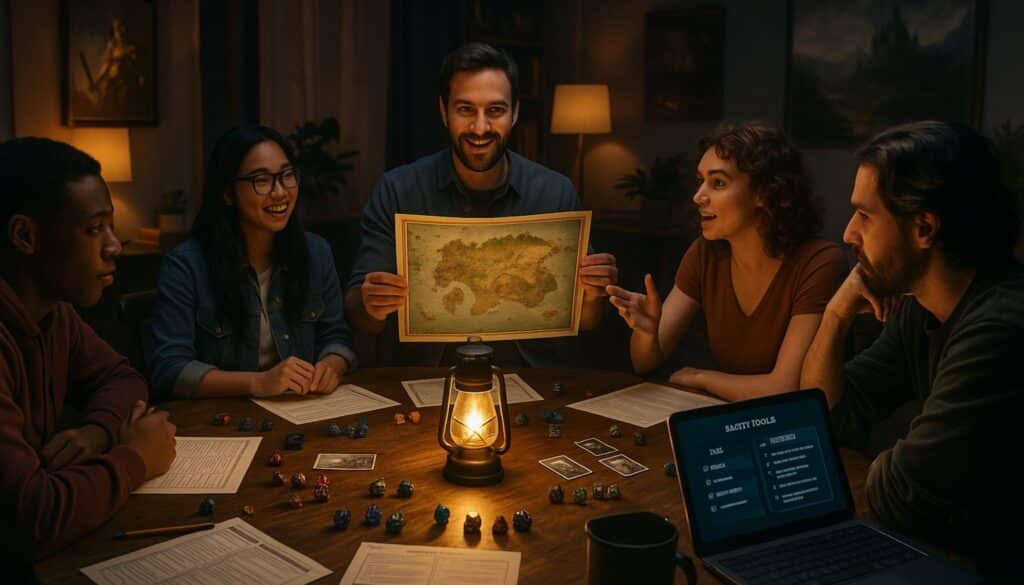
Instead of replacing the DM, the most practical application is the AI dungeon master assistant. This is a tool that sits open on a laptop during the game, ready to answer questions and generate content on demand. “GPT, give me a description of a smells-bad tavern,” or “What are the grappling rules for a large creature?” This live-support model enhances the human DM’s ability to run the game smoothly without breaking immersion to flip through books.
This distinguishes table use from design use. At the table, speed is paramount. AI excels here. In design, depth is paramount. Humans excel here. The danger is when DMs rely on the AI for everything, effectively becoming a text-to-speech interface for the algorithm. The DM must remain the filter, the curator, and the final arbiter of reality.
Narrative Consistency Problems in AI D&D Campaigns
Long-term campaigns reveal the cracks in AI capabilities. Narrative consistency challenges plague current AI narrative design. LLMs have a finite “context window,” meaning they can only “remember” a certain amount of text. In a campaign spanning months, the AI will inevitably forget the name of the innkeeper from Session 1 or the specific promise the villain made in Session 3. This leads to a degradation of the story’s logic over time.
Consistency Problems and Human Intervention:
| Consistency Problem | Why AI Causes It | Required Human Intervention |
|---|---|---|
| Forgotten NPCs | Context window limits; data overflow. | Maintaining a separate “World Bible” or wiki. |
| Contradictory Lore | Hallucination; prioritizing new prompts over old data. | Fact-checking AI output against established canon. |
| Tone Drift | mimicking recent player inputs rather than overall campaign tone. | enforcing strict style guides in prompts. |
| Plot Holes | Lack of long-term planning capabilities. | Manually weaving plot threads together. |
| Economy Inflation | Generosity bias in reward generation. | Auditing loot and gold distribution. |
| Villain stupidity | Reacting only to immediate stimuli. | Designing grand strategies for antagonists. |
| Rule Hallucinations | Confusing different editions (3.5e vs 5e). | Verifying all mechanical rulings. |
Campaign longevity is the real test of a system. Until AI can maintain a coherent “state” over years of gameplay, human memory and notes remain superior.

Could AI Ever Truly Recreate a Classic Module?
Asking if AI can recreate classic D&D modules is asking if a synthesizer can recreate a live orchestra. It can emulate the sound, the structure, and the notes, but it cannot recreate the specific human energy of the performance. AI can create a dungeon that looks like Tomb of Horrors—deadly traps, liches, cryptic poems—but it creates it as a simulation of a style, not as an expression of a philosophy.
Classics are historical artifacts. They are snapshots of a specific moment in game design culture. Keep on the Borderlands is a product of 1979 wargaming culture. An AI generating a module in 2025 is creating a product of 2025 data. It is emulation vs creation. The AI is performing a cover song; it might be technically proficient, but it didn’t write the music.
The Future of AI-Generated D&D Adventures (2025 and Beyond)
Looking ahead to AI D&D modules 2025, we can expect significant evolution. We will likely see specialized “D&D Models” trained specifically on high-quality adventure data (legally sourced), reducing hallucinations and improving adherence to rules. We will see better tools for AI worldbuilding that integrate with Virtual Tabletops (VTTs), allowing a DM to generate a dungeon and have it instantly populated with maps and tokens.
⚔️ Fantasy RPG Random Tables Books
Make life as a Gamemaster easier…
If you play Dungeons & Dragons, Pathfinder, or other fantasy RPGs, this
RPG random tables series
is packed with encounters, NPCs, treasure, and more. Available in eBook or print—either way, you’ll have a wealth of adventure ideas at your fingertips.
Where AI Will Likely Excel:
- Accessibility: Lowering the barrier to entry for new DMs.
- Rapid Prototyping: Testing dungeon layouts quickly.
- Personalization: Tailoring adventures to specific PC backstories.
- Onboarding: Teaching rules through play.
- Solo Play: Acting as a DM for single players.
- Translation: Making modules available in all languages instantly.
- Asset Generation: Creating infinite art and maps.
- Crunch: Balancing math for homebrew monsters.
- Logistics: Tracking time, calendars, and supplies.
- Sandbox Fills: Populating the empty parts of the map.
Where Humans Will Remain Essential:
- Judgment: Knowing when to fudge a die roll.
- Taste: Curating the vibe of the table.
- Cultural Context: Understanding real-world references.
- Emotional Calibration: Managing player feelings.
- Subversion: Breaking the rules for dramatic effect.
- Originality: Creating truly new tropes, not just remixing old ones.
- Coherence: Keeping the story logical over years.
- The “Spark”: That ineffable quality of shared humanity.
Coexistence is the path forward. The best DMs will be “AI-Enhanced,” using tools to remove drudgery so they can focus on art.

The Uncanny Valley of Dungeon Logic: When AI Hallucinates Mechanics
While we often focus on narrative failures—clunky dialogue or generic plot hooks—the truly distinct “signature” of an AI-generated module is its structural and mechanical hallucinations. AI models operate as predictive text engines, not physics engines. They do not hold a 3D model of a dungeon in their “mind” while writing room descriptions; they simply predict which words likely follow the previous ones based on training data. This leads to a phenomenon best described as the “Uncanny Valley of Dungeon Logic,” where the adventure feels superficially functional but collapses under the slightest scrutiny, creating a dream-like, non-Euclidean nightmare that human designers rarely create by accident.
The most common manifestation is Spatial Hallucination. A human designer drawing a map knows that if you walk 30 feet North and then 30 feet West, you cannot be back in the same room unless the geometry is magical. An AI, however, frequently writes descriptions like, “The door on the north wall leads to a corridor turning south, which opens into the room you just left from the east.” In a classic module like Tomb of Horrors, spatial disorientation is a deliberate trap; in an AI module, it is a glitch. The resulting dungeon often resembles an M.C. Escher painting, where rooms overlap in impossible ways, stairs go up to basements, and rivers flow in circles.
Mechanically, this extends to Causal Hallucinations, particularly in puzzle design. AI struggles with the concept of “prerequisites.” It might generate a locked chest that contains the key to open itself, or a riddle where the answer is written on the wall next to the question because the AI associates “riddle” and “answer” as concepts that appear together in text. This destroys the fundamental game loop of “Challenge -> Solution -> Reward” because the AI often places the Reward before the Challenge, or makes the Solution unrelated to the Challenge entirely. It creates a “Fever Dream” gameplay loop where cause and effect are suggestions rather than laws.
Finally, there is Ecological Surrealism. Classic modules, even gonzo ones, usually adhere to a basic internal logic: if a giant beast lives in a room, there is a tunnel big enough for it to enter and a food source to sustain it. AI frequently places “Apex Predators” in sealed 10×10 rooms with no exits, simply because the data suggests “Dragons live in dungeons.” This creates a bizarre, static world where monsters act like furniture, existing in a vacuum until the players open the door. While this can unintentionally create a terrifying “horror” vibe, it erodes the immersive simulation that classic D&D strives for.
The Hallucination Matrix: Human Intent vs. Algorithmic Dream Logic
| Dungeon Element | Traditional Human Design Logic | AI “Dream Logic” (Hallucination) |
| Map Geometry | Euclidean (mostly). Grid-based. North is constant. Rooms fit within the building’s footprint. | Non-Euclidean/Escher. Rooms often overlap or occupy the same space. “North” is a relative concept. Hallways loop infinitely or dead-end into the room they started in. |
| Locked Doors | The key is hidden in a previous or harder area to force exploration. | Paradoxical Locking. The key is often inside the locked room, or inside the chest the key is meant to open. |
| Monster Ecology | Monsters have food, water, and waste areas. Predators are separated from prey. | “Pop-Up Book” Ecology. A T-Rex in a sealed 10×10 room. Goblins living next to a Beholder with no conflict. No bathrooms or food sources exist. |
| Trap Physics | Mechanical triggers (tripwire, pressure plate) with logical disarm methods. | Semantic Traps. Traps trigger based on “vibes” or narrative beats rather than physics. Disarm mechanisms often lack physical components (e.g., “Disarm by thinking happy thoughts”). |
| Secret Doors | Clues (scuff marks, drafts) hint at their existence. They connect meaningful areas. | Orphaned Secrets. Secret doors that lead to blank walls, or connect two public rooms for no reason. Clues are often non-existent or contradictory (“A fresh breeze from the solid stone”). |
| Loot Context | Treasure matches the occupant (e.g., a Wizard has scrolls, an Orc has coins). | Randomized Salad. A wolf drops a Scroll of Fireball. A skeleton holds a fresh apple. Loot is generated by “value tier,” not narrative context. |
| Puzzle Solutions | Deductive reasoning based on established lore or mechanics. | Association Games. The answer is a word association (e.g., Riddle: “Fire”, Answer: “Burn”) rather than a logical deduction. Solutions often ignore the puzzle’s constraints. |
| NPC Memory | NPCs remember past interactions and react to player reputation. | Goldfish Memory. NPCs forget they met you five minutes ago, or forget their own name/quest if the conversation drifts too far. |
| Lighting | Light sources are defined; darkness is a tactical obstacle. | Schrödinger’s Light. Rooms are described as “pitch black” but then detail visual elements like “faded tapestries” without players lighting a torch. |
| Verticality | Stairs, pits, and balconies connect levels logically. | The Infinite Basement. Stairs going “down” might lead to the roof. Pits might drop players into the room they fell from. |
| Faction Politics | Alliances are based on goals (e.g., “We hate the Orcs”). | Mood Swing Politics. Factions declare war or peace based on the last sentence spoken, ignoring centuries of lore generated in the previous paragraph. |
| Acoustics | Sound travels; loud fights alert nearby rooms. | Soundproof Bubbles. A Fireball explosion in Room A goes unnoticed by guards in Room B (open archway), because the AI treats rooms as isolated instances. |
This “Dream Logic” creates a unique problem for the DM. You aren’t just running a module; you are constantly debugging reality. However, for a specific type of campaign—one set in the Far Realm, a chaotic dreamscape, or a glitching simulation—this flaw becomes a feature. The AI unintentionally masters the genre of Surrealist Horror better than most human writers because it genuinely does not understand the rules of reality it is breaking.
Final Thoughts: AI Can Remix D&D, But It Can’t Remember Why It Matters
The thought experiment of AI-generated classic adventures reveals that while AI is a powerful engine for content, it is a poor substitute for authorship. AI can replicate the mechanics of Tomb of Horrors or the layout of Keep on the Borderlands, but it cannot replicate the specific intent that made those modules endure. It cannot decide to be cruel to teach a lesson, or be sparse to encourage imagination. It can only predict the next likely room.
Classic modules endure because they are conversations across generations. When we play them, we are engaging with the minds of Gygax, Arneson, and Moldvay. Replacing that with an algorithm turns the conversation into a monologue. As we embrace AI D&D campaigns and procedural tools, we should use them to experiment and expand our games, but we must remember that the magic of D&D happens in the human connection, something no machine can generate. D&D is not just content; it is a shared dream, and dreams require dreamers, not just processors.