

Designing a D&D mega-dungeon is the holy grail for many Dungeon Masters who want to capture the magic of exploration and danger. When you set out to create a mega-dungeon campaign, you are building more than just a deep hole in the ground full of monsters. This is a massive undertaking that requires a total shift in mindset from standard adventure writing to world-building. A typical dungeon is a sprint that lasts a session or two, but a long dungeon crawl is a marathon that tests player endurance and DM creativity over months of play.
The biggest challenge in D&D 5e dungeon design isn’t drawing enough rooms on graph paper or buying enough minis. The real difficulty lies in keeping the experience fresh over dozens of sessions without the environment feeling static, repetitive, or exhausting. To make this work, we need to look at old school mega-dungeon principles and specific OSR dungeon design philosophies. We have to adapt these grit-heavy concepts to the heroic fantasy style of Fifth Edition so the game remains fun rather than frustrating.
A dungeon that lasts whole campaign cannot just be a linear combat gauntlet or players will burn out by level five. It must function as a living ecosystem where factions vie for control, resources matter, and the layout offers meaningful choices. This guide explores the architecture of longevity rather than just architecture of stone. We are moving beyond simple room layouts to discuss social systems, exploration loops, and dynamic changes that occur while the players are away to rest.
- Designing a Mega-Dungeon Campaign: The Core Loop That Must Survive 1–20
- OSR Dungeon Design for D&D 5e
- Dynamic Dungeon Environments: Keeping a Long Dungeon Crawl from Going Static
- Dungeon Factions and Politics: Turning a Mega-Dungeon into a Sandbox
- Resource Management in Dungeons: Create Resource Loops, Not Just Drain
- Vertical Dungeon Progression: Making Levels Feel Distinct Across Tiers
- Tools for Creating a Mega-Dungeon Map Without Losing Your Mind
- Common Mega-Dungeon Mistakes in D&D 5e Dungeon Design
- The “Titan-Scale” Mega-Dungeon Campaign Bible Template
- Final Thoughts: A Mega-Dungeon Lasts When It Can’t Be “Solved”
Designing a Mega-Dungeon Campaign: The Core Loop That Must Survive 1–20
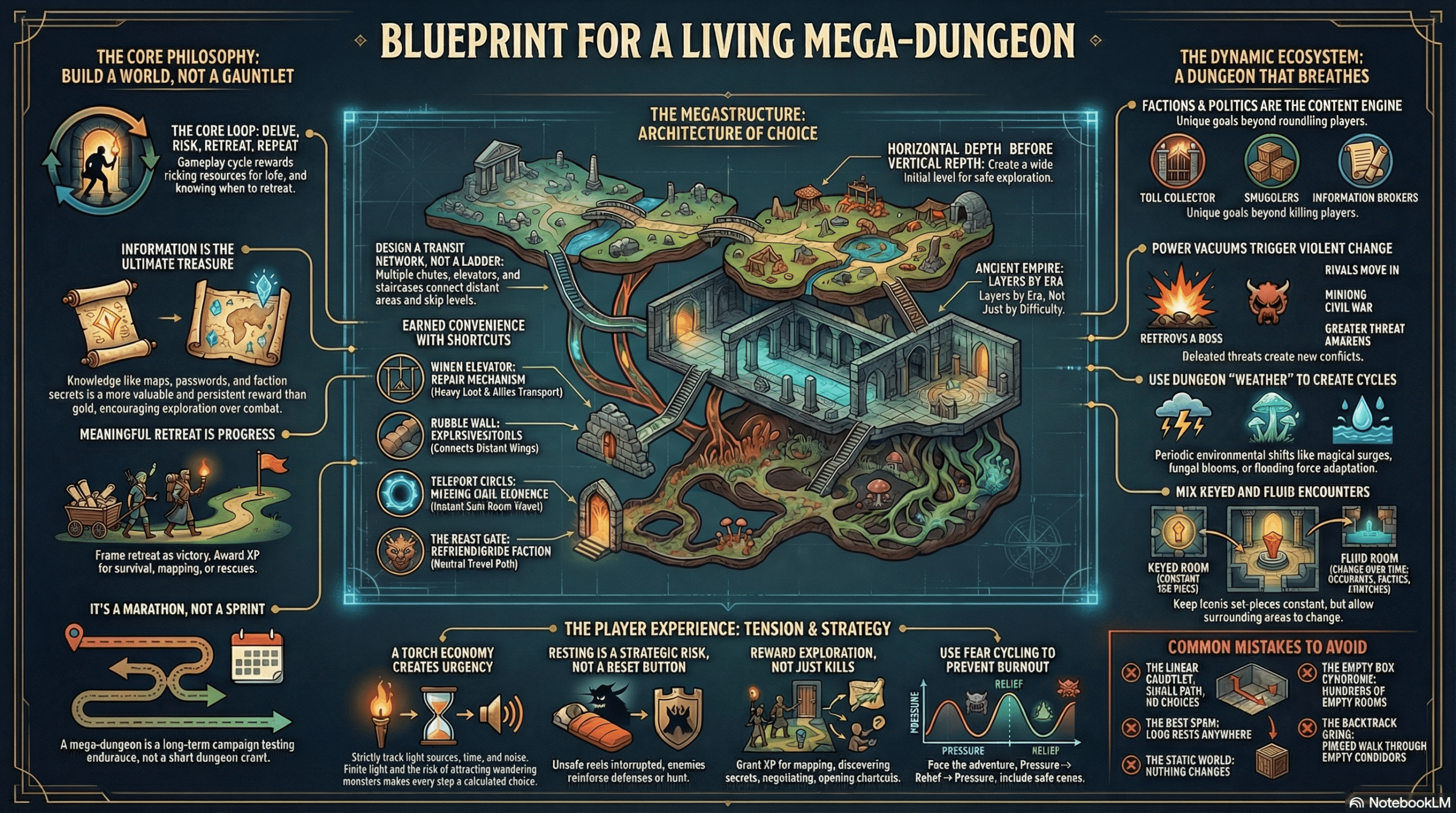
A successful mega-dungeon campaign lives or dies by the quality of its gameplay loop. Players need to understand that the goal isn’t just to clear a room and move to the next one like a video game level. The loop consists of entering the dark, risking limited resources to gain information or treasure, and knowing when to retreat to safety. This cycle allows you to run a mega-dungeon in D&D 5e without falling victim to the “five-minute adventuring day” problem where players blow all their spells on one fight. 5e dungeon crawl design works best when the players realize that every step deeper increases the difficulty of getting back out alive.
If this loop does not reward retreat and planning, the dungeon quickly becomes a mindless linear grind. You must design the experience so that returning to town with a map of a new sector feels just as victorious as slaying a boss. Knowledge is the only persistent resource in a dungeon that resets its monsters, so you must treat information as a high-value currency. When players learn that survival depends on smart logistics rather than just high AC, they become invested in the long game.
Mega-Dungeon Structure: How to Build a Dungeon Megastructure Without Railroading
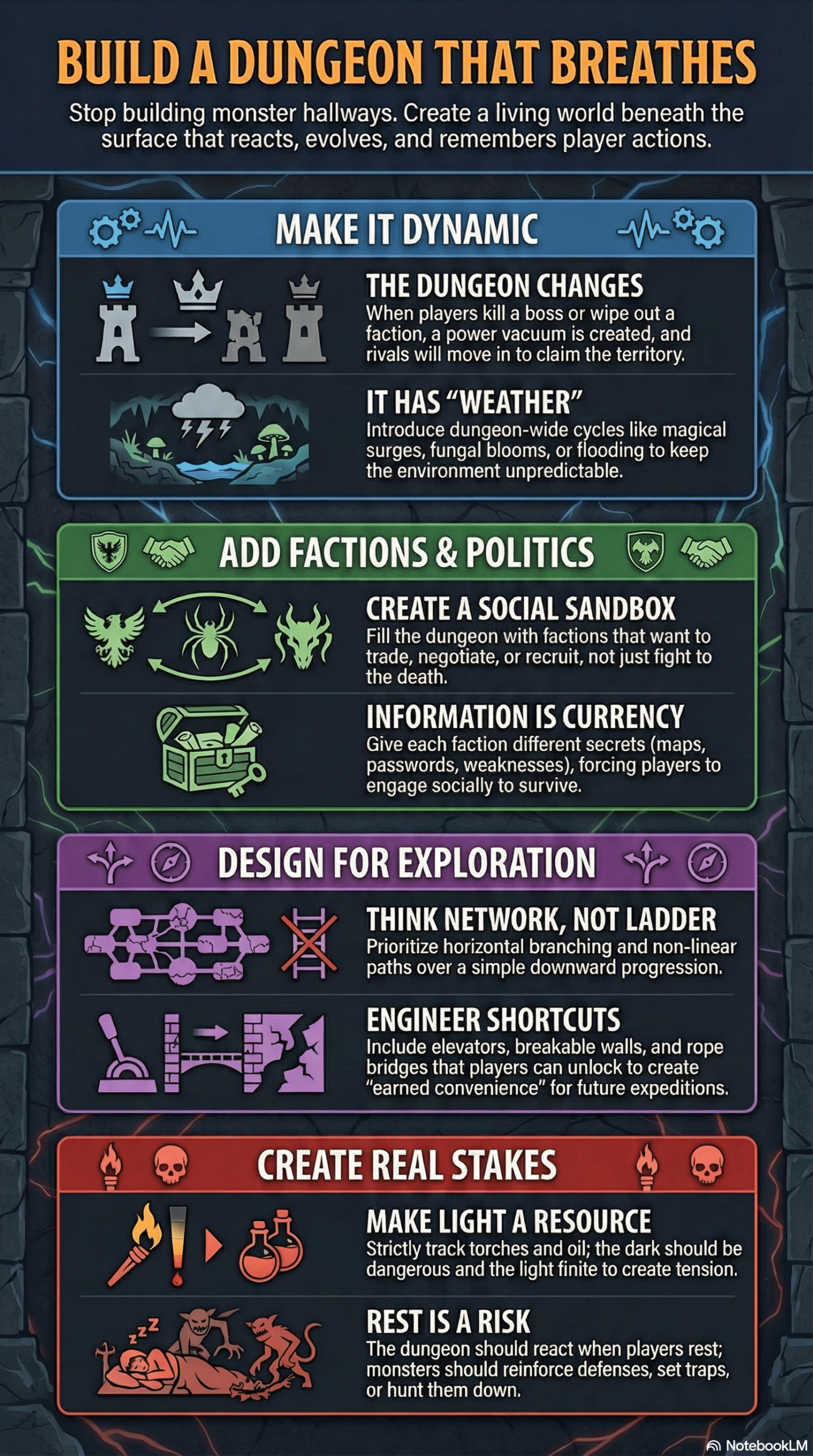
When you visualize your mega-dungeon structure, stop thinking of it as a ladder that goes down and start thinking of it as a transit network. A multi-level dungeon map should offer distinct choices at every single depth so players never feel trapped on a single path. If Level 1 only leads to Level 2, you are railroading your players through a very long tunnel. A true sandbox dungeon layout provides multiple staircases, chutes, and elevators that skip levels or connect distant wings. Choice must exist in three dimensions for the setting to feel real.
Try my AI Tabletop RPG generators...and an extensive library of content!
The dungeon should feel like a place players navigate and learn rather than a sequence of scenes they complete. By offering multiple routes to the same objective, you empower the players to choose their preferred type of risk. Maybe one route is guarded by constructs and requires stealth, while another is flooded and requires magic to traverse. This agency keeps the campaign engaging because the players are constantly making high-stakes navigation decisions.
Horizontal Depth Before Vertical Depth
The most common mistake in D&D is rushing players downward too quickly. You should prioritize horizontal branching early on to prevent railroading and keep the risk selection player-driven. In old-school D&D dungeon design, the first level often sprawls massively to allow low-level parties to explore safely before committing to the deeps. By using best practices for long-term dungeon crawls, you create a “shallow end” of the pool that is wide enough to support weeks of play.
- Spokes and Hubs: A central safe zone with multiple hallways radiating outward to different biomes.
- The Ring Road: A circular perimeter corridor that connects all outer rooms, allowing players to flank enemies.
- The Figure-Eight Loop: Two distinct circular paths that meet at a central chokepoint or bridge.
- The “Three Doors” Fork: A classic intersection offering three distinct sensory clues (smell of rot, sound of wind, total silence).
- Mirrored Wings: Two sections with identical layouts but vastly different inhabitants or environmental states.
- Faction Corridors: Areas controlled by specific groups that act as social buffers between hostile monster zones.
- Puzzle-Locked Shortcuts: Doors that are visible early on but require a key or cipher found in a distant wing.
- Secret Ventilation Routes: Small, dangerous crawlspaces that bypass major guard posts but require high dexterity.
- Collapsed Bypasses: Old tunnels that are treacherous terrain but offer a direct line past a blockade.
- The Sunken Atrium: A large vertical room that connects the first three horizontal levels visibly, tempting players with what lies below.
- Soft Gates via Rumors: Areas that are technically open but terrified NPCs warn players away from until they are stronger.
- Optional Sub-Levels: Small, contained dungeon pockets (like a crypt or prison) that don’t lead deeper but offer specific loot.
Sideways depth is crucial because it builds mastery over the environment and attachment to the setting. If players just keep going down, they never really learn the layout or care about the geography. Horizontal expansion lets them conquer territory and feel like they own a piece of the map before the difficulty spikes.
Reversible Progression Paths and Shortcut Engineering
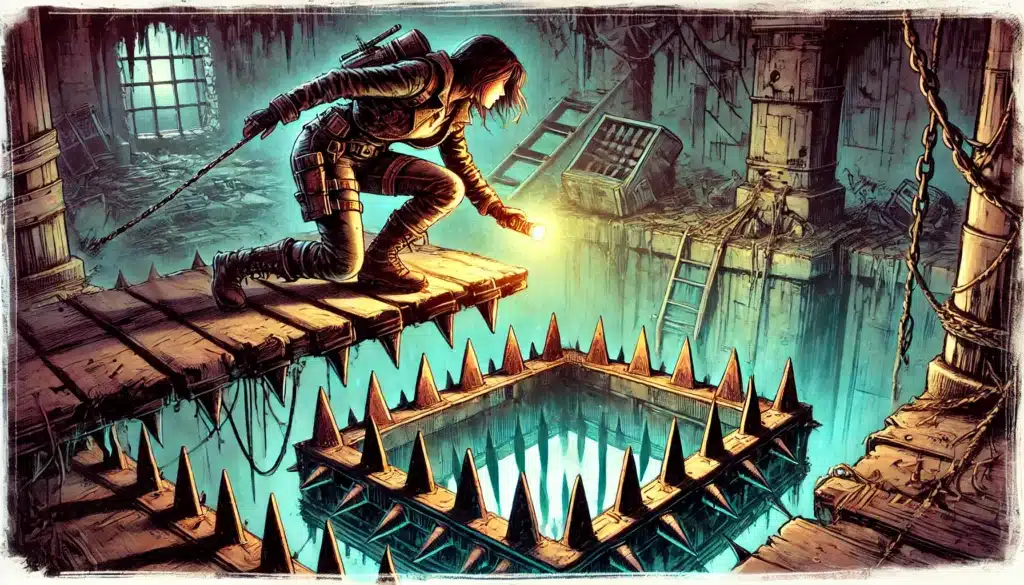
Reversible progression refers to permanent traversal changes that make moving through the dungeon easier over time. You need to fill your map with lifts, tunnels, gates, and breakable walls that serve as “earned convenience” for smart play. Effective dungeon mapping strategies rely on these shortcuts to keep the travel time manageable as the party goes deeper. Without these, the commute to the “front lines” of the adventure takes too long and becomes boring. Vertical dungeon progression isn’t just about depth; it is about how fast you can slide down a rope you secured three sessions ago.
⚔️ Fantasy RPG Random Tables Books
Make life as a Gamemaster easier…
If you play Dungeons & Dragons, Pathfinder, or other fantasy RPGs, this
RPG random tables series
is packed with encounters, NPCs, treasure, and more. Available in eBook or print—either way, you’ll have a wealth of adventure ideas at your fingertips.




| Shortcut Type | How Players Unlock It | How It Changes Gameplay |
|---|---|---|
| The Winch Elevator | Repairing a mechanism with parts found on two different levels. | Allows rapid transport of heavy loot and unconscious allies to the surface. |
| The One-Way Chute | Locating the top entrance of a garbage disposal or laundry shaft. | fast travel downward, but commits the party to the deeps with no easy return. |
| The Flooded Tunnel | Casting Water Breathing or destroying a dam to drain the water. | Opens a stealth route that bypasses the noisy main guard post. |
| The Rubble Wall | Using explosives or heavy mining tools over several hours of downtime. | Connects two distant wings, turning a U-shaped map into a circle. |
| The Teleport Circle | Finding the missing sigil sequence in a wizard’s journal. | Instant travel to a specific safe room, but might attract arcane predators. |
| The Beast Gate | Befriending or bribing a faction to open their territory. | Turns a hostile combat zone into a neutral travel highway. |
| The Rope Bridge | Casting Spider Climb or flying to secure a rope across a chasm. | Negates a dangerous climbing check that previously caused attrition. |
| The Ancient Tram | Clearing debris from tracks and fueling a magical engine. | Horizontal fast travel across a massive cavern level. |
These shortcuts turn the tedious act of backtracking into a victory lap for your players. Instead of feeling punished for having to return to town, they feel smart for opening a “back door” that saves them hours of travel. It tangibly demonstrates their impact on the dungeon megastructure.
Dungeon Layers by Era, Not Difficulty
To keep the environment from feeling like a generic cave system, you should design levels based on history rather than just Challenge Rating. “By era” level identity means distinct sections represent different times: ancient ruins, a fallen empire, a recent occupation, and new infestations. This approach helps you leverage key dungeon design philosophy concepts where the architecture tells a story. When players learn how to make dungeon levels feel distinct through archeology, they stay engaged with the lore.
- Architectural Materials: Smooth obsidian vs. rough-hewn mines vs. organic hive resin.
- Lighting Technology: Eternal magical flames vs. rusted torch sconces vs. bio-luminescent moss.
- Language Fragments: Walls covered in Infernal script vs. Dwarven runes vs. crude goblin graffiti.
- Trap Design: Mechanical clockwork saws vs. magical glyphs vs. crude pit traps with spikes.
- Religious Iconography: Statues of forgotten gods vs. defaced altars vs. simple mud idols.
- Burial Practices: Sarcophagi of kings vs. mass graves of slaves vs. bodies left where they fell.
- Food Sources: Ancient grain silos vs. fungus farms vs. piles of fresh bones.
- Door Mechanisms: Voice-activated stone doors vs. iron portcullises vs. rotting wooden planks.
- Magic Residue: Zones of wild magic vs. dead magic zones vs. lingering necrotic auras.
- Defensive Layout: Wide ceremonial halls vs. narrow murder holes vs. chaotic nest tunnels.
Using era layers allows you to mix danger and discovery naturally without it feeling like a video game difficulty curve. You might find a high-level ancient construct dormant on level one, or a weak scavenger infestation on level ten. This variety keeps players alert because they can’t simply assume depth equals danger.
OSR Dungeon Design for D&D 5e
Updating Old School Pressure Without Rewriting the Game
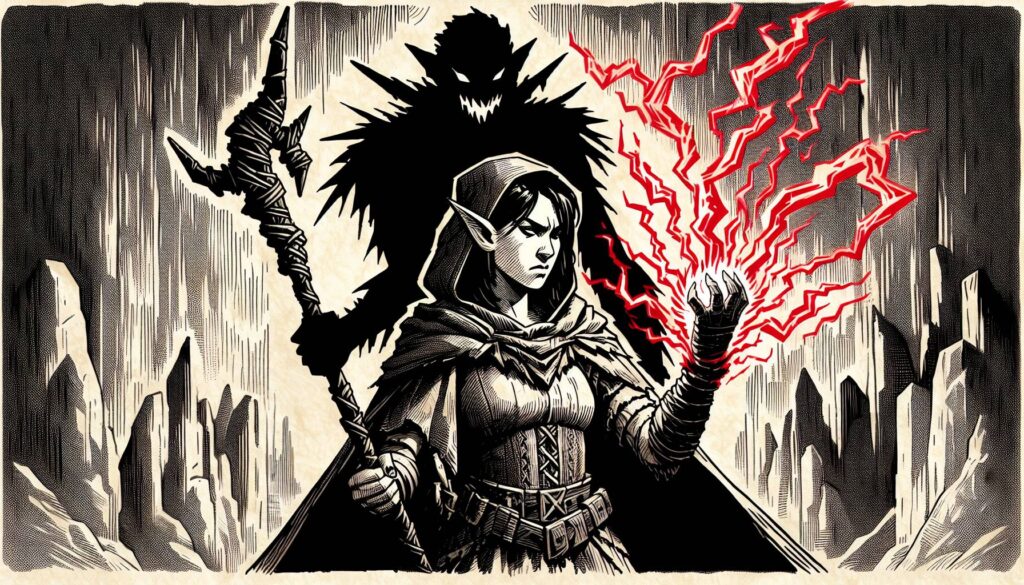
You can bring the tension of OSR dungeon design into 5e without banning character classes or changing the core math. The principles that matter most for a 5e mega-dungeon are time, noise, light, and meaningful risk. In an old school mega-dungeon, the environment is an antagonist that wears the party down slowly. By strictly applying D&D 5e exploration mechanics that are often ignored, you create a gritty atmosphere.
You don’t need harsher rules or homebrew misery to make the dungeon scary; you just need clearer consequences. When players know that wasting time triggers random encounters and making noise draws attention, they play smarter. This shifts the game from a series of tactical skirmishes to a strategic resource war.
Torch Economy in TTRPGs That Actually Matters
The torch economy in TTRPGs is the clock that dictates the pace of the adventure. When you track time and light sources strictly, light becomes a tactical choice rather than just flavor text. Resource management in dungeons falls apart if players have infinite light and infinite time. You must make the dark dangerous and the light finite.
- The Turn Clock: Advance a “dungeon turn” every 10 minutes; torches burn out after 6 turns.
- Noise Ticks: Every loud spell or smashed door adds a tick; at X ticks, roll for a wandering monster.
- Air Quality: Deep levels have thin air, causing exhaustion if players rush or fight too long.
- Wind Drafts: Certain corridors have drafts that blow out non-magical flames instantly.
- Wet Passages: Swimming or wading ruins torches and dampens lanterns, forcing reliance on magic.
- Light-Attracting Predators: Some monsters are drawn specifically to light sources, creating a risk for visibility.
- Ambush Chances: Monsters gain advantage on stealth checks against parties relying on darkvision in total darkness.
- Morale Drops: NPCs and hirelings may refuse to press on if the party runs out of light.
- Visibility Penalties: Dim light imposes disadvantage on Perception; remind players of this constantly.
- “Light Reveals You”: Carrying a torch means enemies see the party long before the party sees them.
- Fuel Weight: Oil and torches have weight; encumbrance forces players to choose between light and loot.
- Magical Darkness: Zones where Light cantrips fail, forcing reliance on mundane fire.
The goal of a strict torch economy is not punishment, but rather the creation of tension and planning. When a player asks, “Do we have enough torches to check that side room?” you know the system is working. It forces a cost-benefit analysis for every step taken.
Rest Mechanics in Dungeon Campaigns
Dungeon rest mechanics are the single biggest balance issue in D&D 5e dungeon design. If players can take a Long Rest whenever they want, the mega-dungeon loses all its teeth. You must frame resting as a strategic risk instead of a magical reset button. Managing rest and pacing in dungeon campaigns requires you to interrupt bad habits.
When players attempt to rest, the dungeon should react to their presence. A “safe” room is only safe if they have fortified it, hidden it, or negotiated for it. If they try to sleep in a goblin hallway, they should wake up in chains or a stew pot.
| Rest Type | Where It Is Possible | Dungeon Reaction | Player-Facing Warning Sign |
|---|---|---|---|
| Short Rest (1 hr) | Barricaded rooms, hidden alcoves. | Wandering Monster check (1 in 6). | “You hear scratching at the door.” |
| Long Rest (8 hr) | Only in “Secure” zones (Faction bases, magical sanctuaries). | Monster repopulation in adjacent rooms. | “The dungeon feels alive around you.” |
| Unsafe Long Rest | Any cleared room (High Risk). | Automatic interruption or ambush. | “This place smells of recent patrol.” |
| Tiny Hut Rest | Anywhere with space. | Monsters set up a siege/trap outside the dome. | “They are piling wood around the dome.” |
| Hidden Rest | Secret rooms or Rope Trick. | Enemies may seal the exit or set guards. | “Voices discuss the missing door.” |
| Sanctuary Rest | A holy shrine or purified zone. | No risk, but usually one-time use per week. | “A sense of peace fills the room.” |
| Campfire Rest | Open caverns. | Light attracts distant threats. | “Eyes reflect your firelight from the dark.” |
Rests should advance the dungeon’s agenda, not stop it. While the players sleep, the enemies are reinforcing defenses, moving loot, or hunting the intruders. This keeps the world dynamic and prevents the “five-minute work day.”
XP for Exploration Instead of Kills
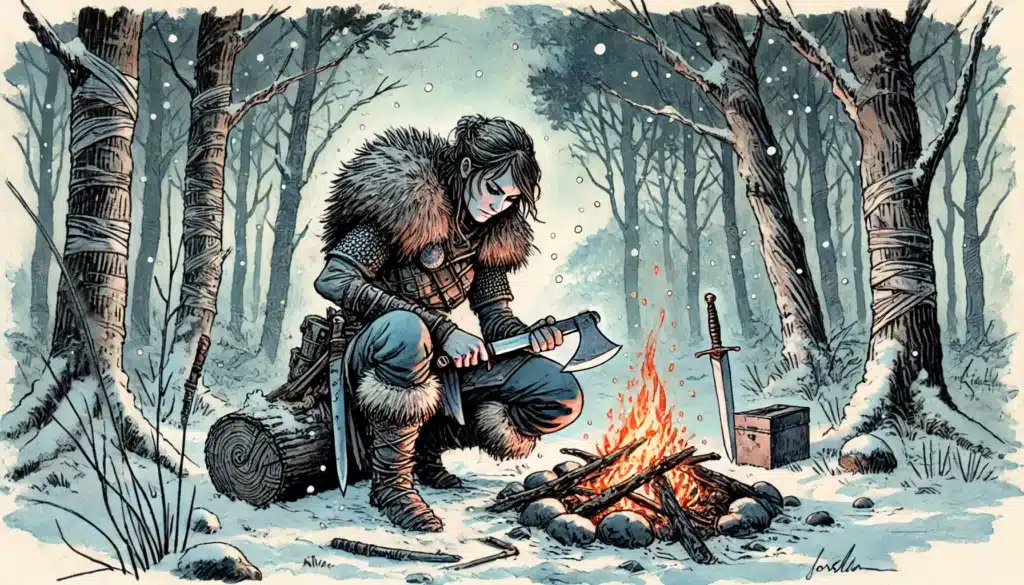
If you want players to engage with the mega-dungeon deeply, use XP for exploration to incentivize the behaviors you want. If you only give XP for killing monsters, players will treat the dungeon like an extermination mission. By using best practices for long-term dungeon crawls, you can reward mapping, discovery, negotiation, and smart retreat.
⚔️ Fantasy RPG Random Tables Books
Make life as a Gamemaster easier…
If you play Dungeons & Dragons, Pathfinder, or other fantasy RPGs, this
RPG random tables series
is packed with encounters, NPCs, treasure, and more. Available in eBook or print—either way, you’ll have a wealth of adventure ideas at your fingertips.
- Mapping Milestones: XP for completing the map of a specific sector or level.
- Discovering Secrets: Bonus XP for finding secret doors or hidden lore caches.
- Faction Deals: XP for establishing trade or truces, often worth more than the combat encounter.
- Retrieving Lore: Bringing books or tablets back to the surface for study.
- Opening Shortcuts: XP for repairing elevators or clearing rubble to connect levels.
- Neutralizing Hazards: Disarming a trap complex without triggering it.
- Securing Safe Rooms: Clearing and fortifying a forward operating base.
- Learning Dungeon “Rules”: Figuring out the pattern of a puzzle or patrol schedule.
- Identifying Monsters: Successfully using skills to learn a monster’s weakness.
- Returning Gold: The classic “Gold for XP” rule incentivizes looting over killing.
Reward structure is a steering wheel for player behavior. When players realize they level up faster by exploring and surviving than by fighting everything to the death, they become true dungeon delvers. This encourages a playstyle that supports a campaign-length duration.
Dynamic Dungeon Environments: Keeping a Long Dungeon Crawl from Going Static
A mega-dungeon must not be a static museum of monsters waiting to be hit. Dynamic dungeon environments serve as the anti-stagnation engine that keeps the game interesting. You need systems for migration, repopulation, repairs, vengeance, and changing hazards. Random encounters in mega-dungeons should reflect the changing state of the world based on player actions. Players shouldn’t be “clearing content” in a vacuum; they should be disrupting and changing an ecosystem. If they wipe out the goblins on Level 1, the giant spiders from Level 2 should move up to claim the empty territory. This makes the dungeon feel responsive and alive.
To achieve this level of dynamism, consider introducing factional movement that responds to the players’ intel and actions. If a faction is eliminated or weakened, its rivals will seize opportunities to strengthen their own positions in the hierarchical chaos. Perhaps a new band of marauders arrives in search of an unguarded treasure trove, leaving behind evidence like makeshift camps or markers. Such changes enrich the environment, providing players with new quests and challenges as the power dynamics shift around them.
Remember to track environmental hazards that can evolve over time, stemming from the characters’ actions. If players repeatedly make loud disturbances, perhaps a cave-in or gas leak occurs in their frequent paths, prompting them to reconsider their approach. Alternately, the dungeon may flood or dry out, morphing its geography and forcing players to adapt their strategies. This constant evolution means that every foray into the mega-dungeon feels different and allows players to engage with a living, breathing world where their choices hold weight.
Ultimately, by designing a responsive and adaptive dungeon ecosystem, you create an immersive experience that captivates players for the long haul. Understanding that their actions have monumental consequences reinforces their investment in the campaign, making the dungeon not merely a series of encounters but a vibrant realm that reacts to their every move. In this way, the mega-dungeon transforms into an evolving narrative tapestry woven with each unique adventure, rewarding players for their creativity and tactical thinking.
Keyed + Fluid Encounter Hybrid
The best approach is a hybrid of key vs keyed encounters. “Keyed” encounters are the iconic rooms that stay fixed—the boss throne, the wizard’s library, the dragon’s hoard. “Fluid” encounters are the surrounding spaces that change occupants and tactics over time. Procedural dungeon building techniques can help you manage these shifting zones.
| Room Type | What Stays Constant | What Changes Over Time |
|---|---|---|
| Guard Post | The furniture and fortifications. | The faction manning it and their alertness level. |
| Dining Hall | The tables and layout. | The food being eaten and the social hierarchy present. |
| Storage Room | The crates and barrels. | The contents (full vs. looted) and scavengers hiding inside. |
| Temple | The altar and statues. | The deity being worshipped (reconsecrated by rivals). |
| Corridor | The traps and dimensions. | The graffiti, debris, and patrol frequency. |
| Bedroom | The beds and chests. | Who is sleeping there and what traps they set. |
| Workshop | The heavy machinery. | What is being built (siege weapons vs. barricades). |
| Prison | The cells and keys. | Who is locked up (enemies vs. allied NPCs). |
This hybrid method preserves the memorable set-pieces you spent hours designing while keeping the exploration uncertain. Players can rely on the map for geography, but never for safety.
Dungeon “Weather” Systems
Dungeons should have their own internal weather systems that introduce repeating cycles capable of affecting the entire complex or large sectors within it. These dungeon weather events can range from environmental phenomena like toxic mists and temporary floods to shifts in biomes where an area might become magically twisted, causing areas to shift between frost and fire. Such dynamics create variety, forcing players to adapt their strategies based on the current “forecast.”
For instance, if a murky fog rolls in, it might obscure vision and heighten the risk of ambushes or traps, compelling characters to navigate more cautiously. Similarly, fluctuating temperatures could affect the abilities of certain creatures or even alter the potency of the players’ spells. Creating these atmospheric conditions enhances immersion and keeps players engaged, as they must remain vigilant and adaptive to the evolving challenges posed by the dungeon itself. Ultimately, this game mechanic reinforces the idea that the dungeon is a living entity, constantly responding to the players’ actions and the passage of time.
Try my AI Tabletop RPG generators...and an extensive library of content!
- Magical Surges: Spells have a chance to trigger Wild Magic effects for 1d4 hours.
- Curse Tides: Necrotic damage heals undead 5hp per round; living feel uneasy.
- Planar Bleed: Gravity becomes light; jumping distance doubles, falling damage halves.
- Fungal Blooms: Corridors fill with obscuring spores; visibility is reduced to 10 feet.
- Monster Migrations: A massive swarm (rats, bats) moves through main arteries, blocking travel.
- Tremors: Unstable ceilings collapse; Dex saves required in unworked tunnels.
- Flooding: Water levels rise 2 feet; some lower areas become submerged.
- Silence: A magical hush falls; verbal spell components fail 50% of the time.
- Heat Wave: Geothermal vents open; wearing heavy armor causes exhaustion.
- Echoing: Noise travels twice as far; stealth checks are made with disadvantage.
- Mana Drought: Spell slots cannot be recovered during rests this cycle.
- Bloodlust: All melee attacks deal +2 damage, but Wis saves are made with disadvantage.
Cycles create planning opportunities, rumors, and timing-based strategy. Players might wait for the “Flooding” to recede before attempting the lower levels, timing their expedition after the waters have drawn back, revealing hidden paths or submerged treasures. Similarly, when a “Silence” descends upon a sector, they can utilize that quiet to sneak past a previously daunting guard post, enhancing their stealth approaches.
Such environmental rhythms encourage players to strategize not just around enemies but around the very nature of the dungeon itself, fostering deeper engagement with the setting and their surroundings. By instilling a sense of urgency and anticipation, these cycles make every decision weighty, leading to thrilling moments where players decide whether to rush headlong into danger or bide their time for a more advantageous opportunity. This dynamic environment ensures that the mega-dungeon remains a place of excitement and discovery, rather than a predictable series of encounters.
Power Vacuums Trigger Dungeon Change
When players kill a boss or wipe out a faction, they create a power vacuum that sends shockwaves through the dungeon’s intricate web of alliances and rivalries. This vacuum triggers dungeon factions and politics to shift violently, as the remaining factions scramble to fill the void and assert their dominance. The absence of a once-powerful group not only changes the balance of power but also fosters a climate of uncertainty, intrigue, and potential conflict among the remaining players in the dungeon ecosystem.
Dynamic dungeon environments thrive on these consequences, as they provide fertile ground for new stories and challenges to emerge, driving the narrative forward in unexpected ways. Players will find themselves navigating a constantly evolving landscape, where their decisions reverberate, shaping alliances and rivalries, and ultimately determining their own survival and success within the mega-dungeon. This ensures that each expedition feels fresh and layered, as the consequences of their actions resound throughout the cavernous depths.
- Faction Expansion: The rival faction immediately moves into the cleared territory.
- Civil War: The leaderless minions fight amongst themselves, creating chaotic danger zones.
- Scavenger Swarms: Carrion crawlers and oozes move in to eat the corpses left behind.
- Resource Scarcity: Without the goblins farming mushrooms, the deeper levels starve and raid upward.
- New Toll Regimes: A new group takes over the bridge and charges double the price.
- Sealed Deeper Threat Awakens: The dead boss was actually guarding a door to something worse.
- Ghostly Hauntings: The violent deaths create a new zone of specters and shadows.
- Mercenary Intervention: A surface organization hears the boss is dead and sends a recovery team.
- Environmental Collapse: Without the boss’s magic maintenance, the level begins to flood or crumble.
- Monster Evolution: Surviving minions level up and adopt better tactics against the party.
Consequences are what make a mega-dungeon feel alive for months. The players are the agents of change, and the dungeon is the reaction. Each decision they make ripples through its myriad interconnected systems—factions realign, resources shift, and the environment morphs in response to their actions. When players realize that their choices influence the very fabric of the dungeon, they engage with it on a deeper level. This inter-connectedness fosters not just a sense of urgency, but also ownership over the narrative unfolding around them.
The mega-dungeon becomes a living entity, one that reacts to their triumphs and failures, while presenting new challenges that reflect the consequences of their previous escapades. As they delve deeper, players find themselves navigating a world where every victory is hard-fought, and every setback carries weight. This dynamic relationship ensures that the dungeon is never merely a backdrop for combat, but a brilliant tapestry of experiences woven by their explorations, pushing them to strategize and adapt in an ever-evolving adventure.
Dungeon Factions and Politics: Turning a Mega-Dungeon into a Sandbox
Dungeon factions are the primary content engine for a mega-dungeon campaign. Without them, you just have a lot of monsters to kill. Introducing factions transforms the dungeon into a complex web of interests where alliances can be forged, and enmities can lead to explosive confrontations. These groups come with their own goals, personalities, and resources, creating a rich landscape of potential interactions that enhance the depth of the players’ experience. Each faction should feel distinct, with unique cultures and motivations, enabling players to engage with them in varied ways, whether through negotiation, espionage, or outright usurpation.
Factions facilitate multiple pathways to success beyond combat, allowing players to explore creative problem-solving and strategic thinking. For instance, the players might find themselves negotiating trade deals to gain safe passage through an area controlled by a rival faction or uncovering a faction’s secrets to manipulate their standings. These non-combat solutions deepen player engagement, inviting them to think outside of their characters’ offensive capabilities. As players undertake repeatable quests that shift the balance of power, they begin to see themselves not just as adventurers but as pivotal players in the factional politics that govern the dungeon.
The presence of factions allows for emergent narratives that adapt to player actions, creating a sense of a living world. Players who craft plans to pit one faction against another can witness the ripple effects of their choices, seeing how power vacuums and shifting alliances can create unexpected obstacles and opportunities. This could lead to a former ally becoming a new adversary or an enemy deciding to ally with the party in the face of a greater threat. Such dynamics elevate the game from a simple hack-and-slash to a multifaceted narrative experience where the players’ actions reverberate through the dungeon, creating a richer tapestry of story.
Ultimately, factions are the dynamic heart of a mega-dungeon, serving as both a backdrop and a major driving force for your campaign. They provide hooks for player investment and emotional stakes that enrich the overall experience. By fostering relationships and rivalries within and between factions, you create a vibrant, immersive world that feels alive and responsive to player choices. In this way, the mega-dungeon becomes more than just a series of interconnected rooms; it becomes a nuanced environment where political maneuvering and social intrigue are just as crucial as combat prowess, ensuring long-lasting engagement throughout the campaign.
Dungeon Factions That Don’t Want You Dead
The best factions are the ones that prefer leverage over violence. They want trade, extortion, recruitment, and manipulation. Creating meaningful factions in mega-dungeons means giving them goals that the players can help with.
- Toll Collectors: Guard a bridge or elevator; they just want gold or food, not blood.
- Smugglers: Move contraband through secret tunnels; they want discretion and cleared paths.
- Hostage Brokers: Capture NPCs for ransom; they want negotiation, not a fight to the death.
- Information Merchants: Sell maps and passwords; they want secrets from other levels.
- Cult Recruiters: Want to convert the strong; they offer buffs in exchange for “listening.”
- Mercenary Contracts: Hired guards who will switch sides if paid more.
- Neutral Shrine Keepers: Heal anyone who respects their strict rules of peace.
- Blackmailers: Watch from the shadows; they want the party to do dirty work or they spill secrets.
- Rival Delvers: Another adventuring party; they want the same loot but might team up for a boss.
- Monster Truce Enclave: A zone where intelligent monsters meet; violence is punished by all.
- Scavengers: Kobolds or goblins who loot bodies; they will trade gear for safety.
- Exiles: Outcasts from deep factions; they want revenge and know the layout.
Diplomacy is the dungeon’s replayability engine. A combat encounter happens once; a faction relationship evolves over the entire campaign.

Asymmetric Faction Knowledge
Each faction should know different routes, truths, or weaknesses, creating a rich tapestry of knowledge to be uncovered. This makes social interaction not just flavor text but a vital pathfinding tool; players must engage with these factions to navigate the dangers lurking within the mega-dungeon. If the players want to find the secret stairs that lead to hidden treasures or shortcuts, they have to talk to the Rat King, who might offer cryptic hints or require favors in return.
Perhaps the Goblin Merchant holds the key to understanding the hidden traps, while the Cult of Shadows knows how to bypass the sentinels guarding a crucial threshold. By establishing this web of connections, you encourage players to forge alliances, negotiate terms, and gather intel that significantly impacts their exploration strategy. The pursuit of valuable information transforms into a journey of discovery, enriching their experience as they weave through the intricacies of faction relations rather than relying solely on brute force to advance.
| Faction | What They Know | What They Want | What They Will Trade |
|---|---|---|---|
| The Kobold Miners | The location of gas vents and structural weak points. | Fresh tools and protection from the Ogre. | A map of the ventilation shafts. |
| The Cult of Silence | The true name of the demon on Level 4. | A specific relic held by the Paladin Ghost. | A scroll that opens the sealed library. |
| The Goblin Market | The patrol schedules of the Hobgoblins. | Exotic surface food and shiny trinkets. | Safe passage codes for the main gate. |
| The Lost Mages | The logic behind the teleportation circles. | Magic components and scrolls. | Access to a fast-travel circle. |
| The Myconids | The location of invisible poisonous spores. | Fertilizer (bodies) and water. | Potions that grant poison resistance. |
| The Iron Golems | The history of the dungeon’s creators. | Magical energy or repairs. | They will open a heavy vault door. |
Information becomes the dungeon’s real currency. Players will seek out factions not to fight them, but to learn how to survive the next level.
Player-Created Factions Inside the Mega-Dungeon
To truly hook players, let them found cults, safehouses, trade routes, or protectorates. This shifts the mega-dungeon campaign into territory control and politics. A dungeon that lasts whole campaign allows players to leave a permanent mark.
⚔️ Fantasy RPG Random Tables Books
Make life as a Gamemaster easier…
If you play Dungeons & Dragons, Pathfinder, or other fantasy RPGs, this
RPG random tables series
is packed with encounters, NPCs, treasure, and more. Available in eBook or print—either way, you’ll have a wealth of adventure ideas at your fingertips.
- Safe Room Network: Establishing a chain of fortified rooms with supplies.
- Delver Guild: Recruiting low-level NPCs to run logistics and map areas.
- Shrine Consecration: Cleaning a temple and assigning a priest to maintain it.
- Black Market: Setting up a shop to sell dungeon loot to other monsters.
- Rescue Service: A designated area where lost travelers are guided to safety.
- Map-Selling Operation: selling their maps to rival parties or surface scholars.
- Monster Truce Enclave: Negotiating a peace treaty between two warring levels.
- Toll Road: Clearing a main route and charging NPCs to use it safely.
- Monster Zoo: Capturing rare beasts to study or sell.
- Mining Operation: Reopening a mine to extract ore for profit.
When players build inside the dungeon, they stop treating it like a disposable level. They start defending it. It becomes their home, and they will fight harder to protect it than any random village.

Resource Management in Dungeons: Create Resource Loops, Not Just Drain
Resource management in dungeons often feels like a slow drain that punishes players. You need to create resource loops where players can partial refill their supplies through clever play. 5e dungeon crawl design works best when attrition is a challenge, not a death sentence. Long dungeon crawls need these loops to stay playable without constant trips to town.
Information as the Primary Reward
Information rewards prevent “loot plateau,” where players have enough gold and stop caring. Knowledge keeps sessions engaging. Maps, passwords, true names, schedules, and faction secrets are weightless but invaluable.
- Partial Maps: Reveals layout but not dangers.
- Patrol Schedules: Allows players to avoid combat entirely.
- Passwords: Bypasses magic mouths or guardian constructs.
- True Names: Grants power or leverage over a specific demon or spirit.
- Recipe Formulas: Allows crafting of specific potions using dungeon flora.
- Key Locations: Reveals where a specific key is hidden.
- Trap Disarm Codes: Specific sequences to bypass complex mechanisms.
- Secret Command Words: Activates dormant golems or lifts.
- Teleporter Sigils: Unlocks fast travel to new zones.
- Boss Weaknesses: Reveals a vulnerability to a damage type.
- Faction blackmail: Dirt on a leader that forces their cooperation.
- Lore of the Architects: Explains why the dungeon was built, hinting at the end game.
Knowledge scales across tiers better than gold. A password works at level 1 and level 20, whereas 50 gold pieces becomes irrelevant quickly.
Meaningful Retreat as Progress
You must reframe retreat as success. If players feel that leaving the dungeon is a failure, they will push until they die. In a how to keep players engaged in a mega-dungeon guide, retreat is a tactical extraction.
- Escape XP: Award XP for getting a wounded ally out alive.
- Faction Respect: NPCs are impressed the party survived the “Deep Dark.”
- Rumor Leverage: The party brings back news that helps the town prepare.
- Shortcut Unlocks: The retreat allowed them to open a gate for next time.
- Recovered Relic Fragments: Even a piece of the objective is a win.
- Map Data: Bringing back a completed map is worth gold.
- Sample Collection: Bringing back monster parts for research.
- Rescued Prisoners: Saving one person is a victory, even if the boss lives.
- Stashed Loot: Hiding heavy loot in a safe spot to recover later.
- Survival: Simply living to fight another day is the ultimate OSR reward.
If retreat is shameful, players will die or quit. If retreat is a valid phase of the mission, the long dungeon crawl becomes a thrilling series of raids.
Vertical Dungeon Progression: Making Levels Feel Distinct Across Tiers
Vertical dungeon progression is about a shift in rules and physics, not just higher monster stats. As players descend, the very nature of the reality should shift. How to scale a mega-dungeon for levels 1–20 involves changing the environment. Each depth should feel like entering a different world. Level 1 is a cave; Level 5 is a city; Level 10 is an alien geometry; Level 20 is a metaphorical hellscape.
Vertical Combat as Core Identity
Shafts, balconies, chasms, climbs, and falls are the dungeon’s signature language of danger. Combat should happen in three dimensions.
- Rope Bridge Battles: Fighting while balancing over a void.
- Lift Fights: Defending a moving elevator from flying enemies.
- Falling Debris: Combat where the ceiling is collapsing every round.
- Spiral Stairs: Fighting on a narrow stairwell with no rails.
- Collapsing Catwalks: Floors that give way under heavy armor.
- Underwater Shafts: Combat while holding breath and swimming down.
- Reverse Gravity Zones: Fighting on the ceiling.
- Climbing Wall Ambush: Enemies attacking while the party is climbing.
- Multi-Tiered Mezzanines: Archers firing from three levels up.
- Floating Islands: Jumping between drifting platforms over lava.
- Vertical Wind Tunnels: Fighting while flying or levitating in a draft.
- Spider Web Networks: Fighting on sticky strands suspended in the dark.
Three-dimensionality makes “more rooms” unnecessary. A single vertical shaft can host five different memorable encounters.
Fear Cycling: Pressure → Relief → Pressure
Fear cycling is the emotional pacing required for mega-dungeons to prevent burnout. Constant terror is numbing. Dungeon design philosophy dictates you need valleys of relief to make the peaks of terror feel real.
- Shrines: Holy ground where monsters cannot enter.
- Neutral Markets: A noisy, bright bazaar run by a powerful merchant.
- Truce Halls: Areas where violence is culturally forbidden.
- Quiet Ruins: Empty sections that are eerie but safe.
- Hidden Gardens: Underground nature preserves with fresh water.
- Fragile Sanctuaries: A barricaded room that will hold for only 1 hour.
- Comedy Encounters: A confused ghost or a drunk goblin offering comic relief.
- Beautiful Vistas: A stunning view of an underground sea that inspires awe.
- Hot Springs: A natural restorative zone.
- Friendly Hermit Caves: A quirky NPC who offers tea and cryptic advice.
Sustainable tension is a pacing skill, not a monster count. You need to let players breathe so they can scream again later.
Tools for Creating a Mega-Dungeon Map Without Losing Your Mind
You need practical dungeon building tools and workflows. Do not draw the whole thing at once. Use modular tiles, level templates, and incremental expansion. A multi-level dungeon map is built in layers over time, not “finished” before session one. Mega-dungeons are organic. They grow as you play. Sketch the connections, define the zones, and detail only what the players will see next week.
Dungeon Mapping Strategies: Zones, Not Perfection
Use zone-based mapping: rough connections first, detail later. Keep navigation legible.
| Mapping Method | Best Use Case | Common Failure Mode |
|---|---|---|
| Point-Crawl (Flowchart) | Tracking travel between major landmarks and regions. | Hard to run tactical combat without zooming in. |
| Grid Mapping | Tactical combat areas and specific puzzle rooms. | Takes too long to draw for large empty areas. |
| Isomorphic Projection | Vertical levels with lots of bridges and overlooks. | confusing for players to map themselves. |
| Zone Text Description | “Theater of the Mind” travel between setpieces. | Players lose track of exactly where they are. |
| Procedural Generation | Filling in “commute” areas between key rooms. | Can feel generic and nonsensical if not curated. |
| Jacquays-Style Loops | Creating complex, non-linear layouts. | DM gets confused about which stairs lead where. |
Clarity beats realism. A simple flowchart that the DM understands is better than a masterpiece map that creates confusion.
Common Mega-Dungeon Mistakes in D&D 5e Dungeon Design
Mega-dungeons often collapse due to monotony, rest abuse, faction absence, and meaningless rooms. Understanding D&D 5e dungeon design pitfalls helps you avoid them. 5e mega-dungeon tips often focus on what not to do.
- The Linear Gauntlet: One path forward, no choices.
- The Empty Box Syndrome: Hundreds of rooms with nothing in them.
- The Rest Spam: Allowing Long Rests anywhere removes all tension.
- The HP Sponge: Increasing difficulty only by adding hit points.
- The Silent Dungeon: No factions, no NPCs to talk to.
- The Teleport Problem: High-level magic bypassing the dungeon entirely (block this!).
- The Loot Pinata: Too much gold, making rewards meaningless.
- The Disconnected lore: History that doesn’t affect gameplay.
- The Solo Biome: 20 levels of just “stone corridors” is boring.
- The Trap Gotcha: Traps that kill instantly with no warning signals.
- The Backtrack Grind: No shortcuts, forcing hours of boring walking.
- The Static World: Nothing changes when the players leave.
Treat these problems as systems tuning. If players are resting too much, tweak the random encounter rate. If they are bored, add a faction.
The “Titan-Scale” Mega-Dungeon Campaign Bible Template
You cannot run a multi-year mega-dungeon campaign on loose scraps of paper and hope for the best. You need a centralized “Campaign Bible” that tracks the macro-logistics of the dungeon while you focus on the micro-tactics of the session. This template is designed to be the skeleton of your entire campaign, forcing you to define the mega-dungeon structure and the rules of engagement before players ever roll initiative. Copy this entire section into your preferred note-taking app (OneNote, Notion, Obsidian) and fill it out to create a dungeon that lasts whole campaign.
This template goes deep into D&D 5e dungeon design specifics, moving beyond simple geography into the social and mechanical systems that keep the game alive.
Phase 1: The Core Identity & Logistics
This section defines the “Why” and the “How” of your mega-dungeon campaign. It establishes the fundamental rules that prevent the game from becoming a generic superhero simulator.
The Hook and The Truth
You need a public face for the dungeon (the rumors) and a private reality (the deep truth) that players uncover over time. This separation ensures that information is a primary reward.
- Dungeon Name: [Enter Name]
- The Public Rumor: What do the taverns say? (e.g., “The tomb of a mad alchemist filled with gold.”)
- The Deep Truth: What is actually down there? (e.g., “A bio-mechanical engine keeping the sun alive, currently failing.”)
- The Surface Hub: Where do players sleep safely? [Town Name]
- The “Gate” Mechanism: What physically prevents level 1 characters from walking to level 20? (e.g., Magical wards, physical keys, required items).
The “House Rules” of Attrition
To make old school mega-dungeon principles work in 5e, you must codify your attrition mechanics here. These rules change the genre from “Heroic Fantasy” to “Survival Horror.”
| Mechanic | The Rule (Customize for your table) |
|---|---|
| The Light Clock | Example: 1 Torch = 1 hour real-time. If the timer rings, lights go out. |
| Resting Constraints | Example: Short Rests take 10 minutes but require a “Security Check” (DC 15). Long Rests only in Fortified Rooms. |
| Resource Scarcity | Example: Rations and Water consume 1 “Slot” of inventory each. Ammo is tracked strictly. |
| Resurrection Cost | Example: Revivify works, but the character loses a level or gains a permanent madness. |
Phase 2: The Vertical Megastructure (The “Layer Cake”)
This is your master map. Do not draw every room yet; simply define the “zones” and how they connect. This ensures you have horizontal depth before vertical depth and that your dungeon levels and ecosystems are distinct.
The Connectivity Matrix
Use this table to plan your vertical dungeon progression. A “Connection” is a standard stair; a “Shortcut” is a reversible progression path (elevator, chute, portal) that must be unlocked.
| Tier | Level Range | Biome/Theme | Primary Enemy | Connection Down | Shortcut Back Up |
|---|---|---|---|---|---|
| 1 | 1–3 | The Upper Ruins (Bandits/Vermin) | Goblins/Rats | Stone Staircase | Winch Elevator (Needs Repair) |
| 1 | 3–4 | The Fungal Caverns | Myconids | Natural Chasm | One-way Chute (to Lvl 6) |
| 2 | 5–7 | The Ancient Foundry | Constructs | Maglev Train | Teleport Circle (Needs Sigil) |
| 2 | 8–10 | The Flooded Depths | Aboleths/Kuo-Toa | Whirlpool | Water-Breathing Statue |
| 3 | 11–14 | The Crystal Matrix | Elementals | Gravity Well | Mirror Portal |
| 4 | 15–20 | The Void Core | Aberrations | None (One Way) | The “God Gate” |
The Shortcut Engineering Plan
Plan your shortcuts now so you can foreshadow them early. In a long dungeon crawl, players need to see the “locked door” on session 1 that they finally open on session 20.
- The “Spine” Transport: (e.g., A massive central elevator shaft that connects levels 1, 5, 10, and 15, but requires separate keys for each depth.)
- The Ventilation Network: (e.g., Small, dangerous tunnels that Druids/Rogues can use to bypass entire levels.)
- The River: (e.g., An underground river that flows from Level 2 down to Level 9, allowing rapid one-way travel.)
Phase 3: The Social Sandbox (Factions & Politics)
Dungeon factions and politics are what prevent combat burnout. You need at least three active factions that have agendas independent of the players. This creates a sandbox dungeon layout where social manipulation is as powerful as a fireball.
The Faction Relationship Table
Use this to track how the factions view each other and the players. This powers your dynamic dungeon environments.
| Faction Name | Core Desire | Fear/Weakness | View on Players | Enemy Faction |
|---|---|---|---|---|
| Faction A (Dominant) | Total control of the Mine | Bright Light | “Slaves/Food” | Faction B |
| Faction B (Rebels) | Escape to surface | Lack of weapons | “Potential Allies” | Faction A |
| Faction C (Neutral) | Trade/Profit | The “Deep Truth” | “Customers” | None (yet) |
| Faction D (Monster) | Spread corruption | Fire | “Hosts” | Everyone |
The “Rival Party” Generator
Nothing motivates players like a rival adventuring party. They are competing for the same resource management in dungeons pool (loot and glory).
- Rival Party Name: (e.g., The Iron Hounds)
- Their Leader: (A distinct personality, e.g., an arrogant Paladin)
- Their Advantage: (e.g., They have better maps, or they are sponsored by the Duke)
- Current Status: (Where are they right now? e.g., “Looting Level 3 before you get there.”)
Phase 4: The Dynamic Ecosystem Tracker
The dungeon must breathe. Use this section to run the “Dungeon Turn” between sessions. This is critical for procedural dungeon building and maintaining the illusion of a living world.
The “While You Were Gone” Checklist
Run this checklist after every Long Rest or return to town.
- Power Vacuum: Did a boss die? If yes, who moved into their room? (Roll on Faction Table).
- Repopulation: For every week absent, restore 10% of the “Trash Mobs” in cleared areas.
- The “Weather” Shift: Change the global dungeon condition (e.g., “The water level has risen,” or “The Goblins have barricaded the main stair”).
- Rival Progress: Roll 1d6. On a 5–6, the Rival Party cleared a room or stole a key item the players wanted.
Random Encounter “Vibe” Matrix
Don’t just list monsters. List sensory inputs to create OSR dungeon design tension.
| d6 | Encounter Type | Specific Detail (Flavor) | Mechanical Consequence |
|---|---|---|---|
| 1 | Direct Combat | Patrol of [Level Mob] in formation. | Fight or flee immediately. |
| 2 | Ambush/Trap | Monsters waiting in ceiling/floor. | Surprise round likely. |
| 3 | Traces/Spoor | Fresh blood, warm campfire, dung. | Insight check reveals enemy numbers. |
| 4 | Noise/Echo | Distant drums, screaming, grinding. | Stealth DC increases by +2. |
| 5 | Faction Conflict | Two groups fighting each other. | Opportunity to third-party or negotiate. |
| 6 | Strange Merchant | A wanderer selling rare items. | Chance to offload heavy loot. |
Phase 5: The “Keyed” Room Template
When you actually design the rooms, use this format to ensure you capture D&D 5e exploration mechanics and interactive environments. Do not write blocks of text; use bullet points for scannability.
Room [Number]: [Name]
- First Look (Read Aloud): 2 sentences max. Smell, sound, light.
- The Problem: The immediate threat (Monster, Trap, Hazard).
- The “Clickable” Objects: What happens if they investigate?
- Statue: (Investigate DC 15 to find the hidden switch).
- Bookshelf: (Contains a scroll of info about Level 5).
- Corpse: (Has a key to the next door).
- The Hidden Layer: What is not immediately obvious? (Secret doors, false bottoms).
- The Faction Link: How does this room connect to the politics? (e.g., “This room was recently sacked by Faction B”).
- Treasure: Break it down by type.
- Coin: (Gold/Silver)
- Information: (Map fragment, Password)
- Gear: (Consumables, Weapons)
Phase 6: Player “Buy-In” Agreement
Finally, print this out and have your players read it. A mega-dungeon campaign fails if expectations aren’t set.
“Welcome to [Dungeon Name]. This campaign is about exploration, logistics, and survival. You cannot kill everything. You must map the environment. You must manage your light and food. Retreat is a valid and often necessary tactic. The dungeon is alive and will change based on your actions. Good luck.”
Final Thoughts: A Mega-Dungeon Lasts When It Can’t Be “Solved”
A campaign-length dungeon survives by staying alive. It shifts factions, evolves routes, and uses information-driven progression to keep players engaged. A D&D mega-dungeon guide can give you the tools, but you must breathe life into the stone. The best mega-dungeons reward memory, planning, and negotiation just as much as they reward a high attack roll.
⚔️ Fantasy RPG Random Tables Books
Make life as a Gamemaster easier…
If you play Dungeons & Dragons, Pathfinder, or other fantasy RPGs, this
RPG random tables series
is packed with encounters, NPCs, treasure, and more. Available in eBook or print—either way, you’ll have a wealth of adventure ideas at your fingertips.
The dungeon that lasts whole campaign is one that players respect. It is an adversary that learns, reacts, and remembers their actions. When they realize that the dungeon is playing back, they will stay to finish the game. Don’t build a bigger dungeon—build a dungeon that has a memory.
