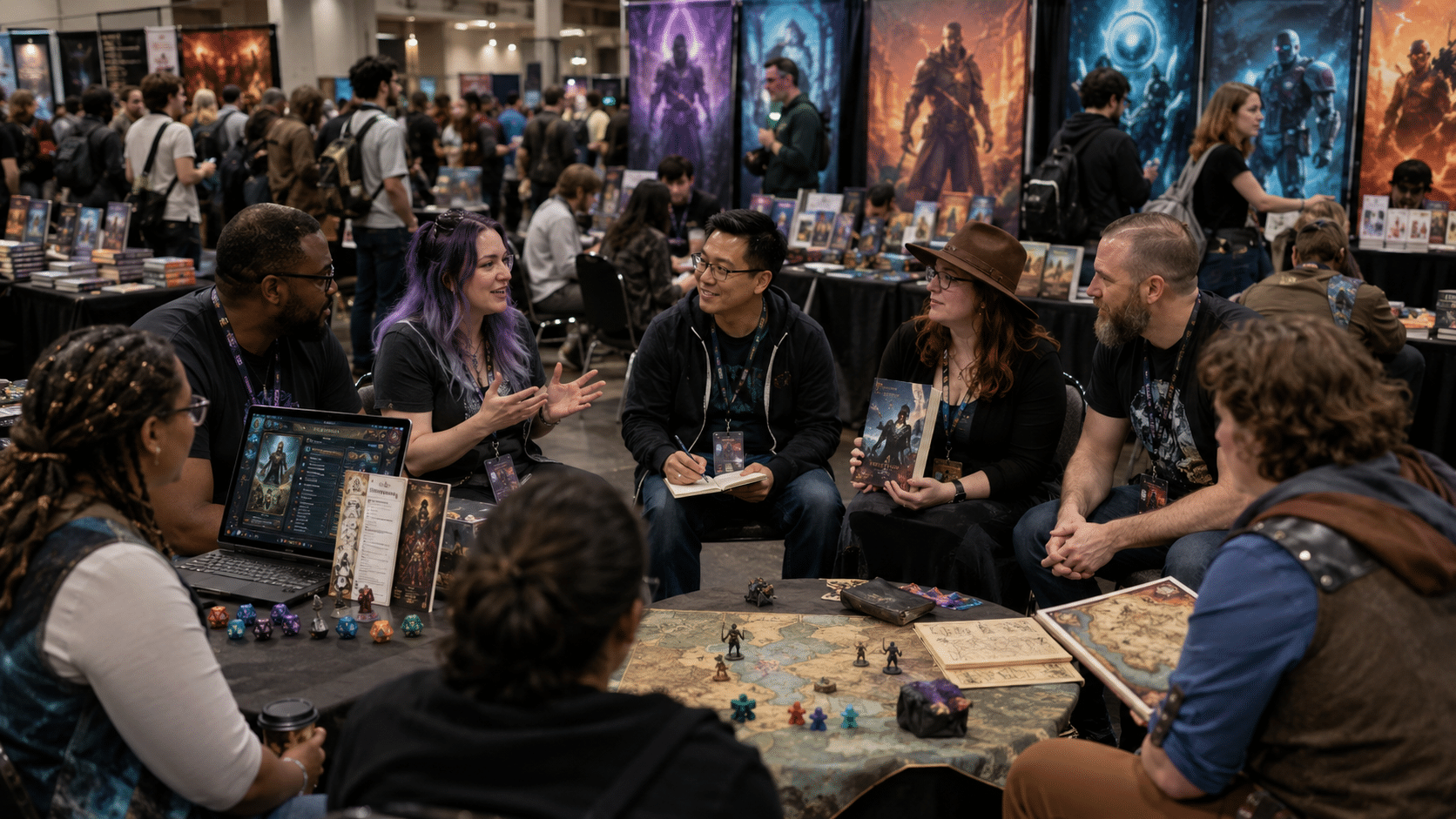
Two fantasy readers sit in a tavern. One slams a mug of suspiciously glowing ale onto the table and shouts, “If the hero doesn’t get a blue stat window, it doesn’t count!” The other points dramatically at a nearby bard trapped inside a magical chessboard and yells, “It’s clearly game fiction!” Somewhere in the corner, a wizard quietly mutters, “Can we just read the book?”
Welcome to the delightfully messy conversation around LitRPG and GameLit, two labels that are related, often overlapping, and occasionally treated as if they were sacred guild ranks bestowed by an ancient dragon wearing reading glasses. They are not. No dragon needs to stamp your library card.
At their simplest, LitRPG usually means fiction where RPG mechanics—levels, stats, skills, classes, quests, experience points—appear explicitly in the story. GameLit is broader: fiction shaped by games, game logic, virtual worlds, competitive play, simulations, or game-like structures, whether or not the book shows you the hero’s Strength score.
This article is here to clarify the difference, show where the categories blur, and help readers find books they actually enjoy without needing a certification in imaginary leveling systems. No gatekeeping. No genre courtroom. Just vibes, labels, and maybe one tasteful goblin accountant.
- Why These Labels Exist in the First Place
- The Short Version: LitRPG vs GameLit
- What Makes Something LitRPG?
- What Makes Something GameLit?
- The Overlap Zone: Where the Labels Hug Awkwardly
- Crunchy vs Soft Mechanics
- Common Subgenres and Flavor Packs
- Reader Expectations: What People Usually Want From Each
- Writer Considerations: Choosing the Right Label
- Misconceptions, Gatekeeping, and Genre Goblin Behavior
- How to Tell What a Book Is Before You Buy It
- The Point Is the Adventure, Not the Badge
Why These Labels Exist in the First Place
Genre labels exist because readers have only so much time, money, and emotional stamina to spend on books where people are possibly trapped in a death game run by a sarcastic interface. Labels like LitRPG and GameLit help readers quickly identify what kind of experience they’re probably getting.
For writers, reviewers, publishers, and bookstores, these terms are useful signals. They say, “This story may contain stats, quests, game worlds, character progression, virtual realities, portals, systems, combat mechanics, skill trees, or someone yelling about optimal build synergy while being eaten by a slime.”
Try my AI Tabletop RPG generators...and an extensive library of content!
They also help sort expectations. A reader searching for LitRPG may want crunchy progression, visible stat screens, loot drops, and a system that matters. A reader searching for GameLit may want a game-inspired adventure, virtual reality stakes, tournament arcs, puzzle rooms, respawns, or a world that behaves like a game without pausing every ten pages for spreadsheet yoga.
But labels are tools, not prison cells. They should help readers discover stories, not trap books in tiny genre cages while someone pokes them with a taxonomy fork.
Think of genre labels like sorting snacks into “chips,” “crackers,” and “things you eat at midnight while pretending it’s dinner.” The categories are helpful. They are not legally binding. Sometimes the snack is both crunchy and emotionally complicated.
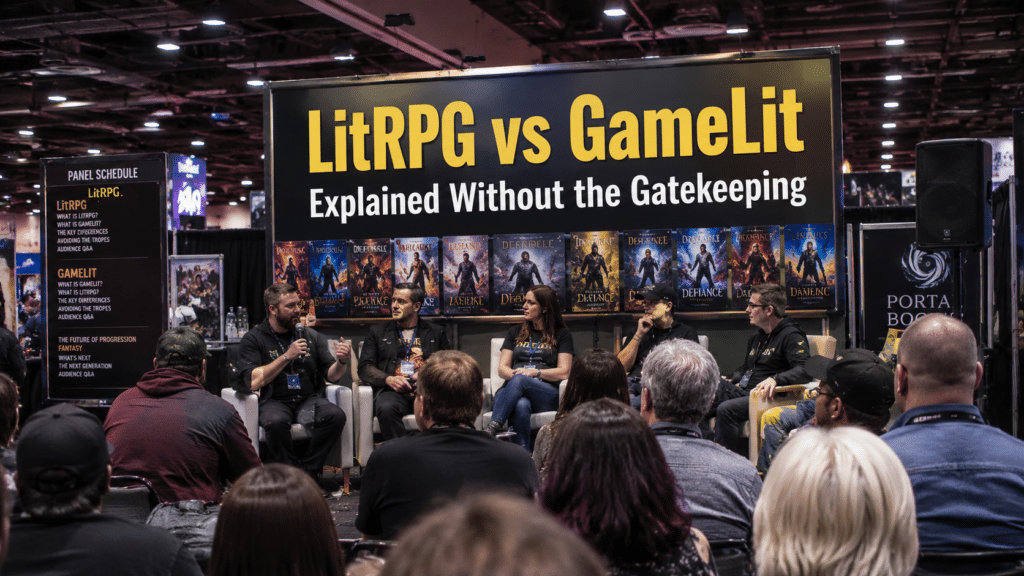
The Short Version: LitRPG vs GameLit
The cleanest distinction is this: LitRPG usually includes explicit RPG mechanics as part of the text and story. You see stats. You see levels. You see skill descriptions. The system is not just background flavor; it affects decisions, conflict, pacing, and character growth.
⚔️ Fantasy RPG Random Tables Books
Make life as a Gamemaster easier…
If you play Dungeons & Dragons, Pathfinder, or other fantasy RPGs, this
RPG random tables series
is packed with encounters, NPCs, treasure, and more. Available in eBook or print—either way, you’ll have a wealth of adventure ideas at your fingertips.



GameLit is broader. It includes fiction inspired by games, game worlds, game logic, virtual realities, competitions, simulations, campaigns, puzzles, or avatars. It can include LitRPG, but it does not have to. If LitRPG is a very specific potion with visible stat bubbles, GameLit is the whole enchanted beverage cart.
| Category | LitRPG | GameLit | Vibe Check |
|---|---|---|---|
| Core Definition | Fiction with explicit RPG mechanics | Fiction influenced by games or game structures | LitRPG has numbers; GameLit has game energy |
| Mechanics | Stats, levels, skills, classes, XP | May have mechanics, but not required | “Show me the character sheet” vs “I understand the rules” |
| World Type | Often system-governed, VR, portal, apocalypse, dungeon | VR worlds, competitions, simulations, game-like realities | Both may involve suspiciously tutorial-shaped danger |
| Progression | Usually central and measurable | May be thematic, structural, or competitive | Level-up ladder vs game-shaped journey |
| Reader Promise | Crunch, builds, rewards, optimization | Adventure, play, strategy, immersion | Loot dopamine vs playful architecture |
| Borderline Cases | Light stats, rare system screens | Strong game logic but no numbers | The goblin judge shrugs and orders nachos |
This table is a helpful map, not a holy tablet carried down from Mount Tutorial. It will not glow, hum, or smite you if you disagree with it.
The important thing is that labels describe tendencies. They do not define the moral worth of a book, reader, or author. Nobody gets extra hit points for being pedantic at parties.
What Makes Something LitRPG?
LitRPG usually centers on visible game mechanics. A character might open a stat screen, choose a class, earn experience points, assign skill points, receive system messages, complete quests, equip loot, and watch their build evolve over time. The mechanics are not decorative wallpaper; they are part of the engine.
These systems often shape the plot. A hero might need to grind levels before fighting a dungeon boss, choose between a healing class and a forbidden necromancer baker subclass, or optimize their build to survive a tournament. The story’s conflict may depend on how the system works—and how characters exploit, misunderstand, or break it.
LitRPG also changes pacing. Progression creates milestones: level-ups, skill unlocks, rare drops, class evolutions, quest completions, and boss fights. Each reward can function like a tiny fireworks show in the reader’s brain. Sometimes the fireworks are tasteful. Sometimes they are launched from a spreadsheet cannon.
Character growth in LitRPG is often both emotional and mechanical. The hero may become braver, wiser, kinder, or more self-aware—but they may also gain +3 Strength, unlock “Dragon Punch II,” and learn that dumping all points into Charisma does not help when the skeletons do not respect networking.
Common LitRPG features include:
- Stat screens
- Skill trees
- Leveling systems
- Character classes
- System messages
- Quests
- Loot rarity
- Cooldowns
- Resource bars
- Experience points
- Achievements
- Build optimization
- Damage numbers
- Boss encounters
- Class evolutions
- Skill ranks
- Party roles
- Dungeon rewards
- Inventory screens
- Titles and passive bonuses
LitRPG can be crunchy or light, serious or silly, epic or cozy. Some stories lovingly display every stat increase like a proud parent showing vacation photos. Others include only enough mechanics to remind you the world has rules.
On one end, you have spreadsheet goblin mode, where readers happily track DPS, cooldown rotations, and optimal mana expenditure. On the other, you have “just enough stats to season the soup.” Both are valid meals. One simply comes with more goblin accounting.
What Makes Something GameLit?
GameLit is the wider umbrella for stories shaped by games without requiring detailed RPG mechanics. A GameLit story might take place inside a virtual world, revolve around a game tournament, follow characters using avatars, or structure its plot around levels, puzzles, campaigns, survival rules, or respawn mechanics.
The key is that the story feels influenced by games. It may use game-like challenges, boss arenas, dungeon layouts, team strategy, competitive rankings, or simulation rules. But it does not have to stop and say, “Congratulations, you have gained 45 XP and mild emotional damage.”
⚔️ Fantasy RPG Random Tables Books
Make life as a Gamemaster easier…
If you play Dungeons & Dragons, Pathfinder, or other fantasy RPGs, this
RPG random tables series
is packed with encounters, NPCs, treasure, and more. Available in eBook or print—either way, you’ll have a wealth of adventure ideas at your fingertips.
GameLit can be playful, cinematic, strategic, or weird. It can feel like an MMO, a tabletop campaign, a battle royale, a puzzle platformer, a survival sandbox, a roguelike, or a haunted arcade cabinet that definitely should have been unplugged in 1997.
GameLit elements that may appear without making a book strictly LitRPG include:
- Game worlds
- NPC-like characters
- Level-like challenges
- Game tournaments
- Survival rules
- Respawn mechanics
- Achievements
- Dungeon structures
- Puzzle rooms
- Avatar identities
- Competitive rankings
- Simulation environments
- Save points
- Campaign arcs
- Boss arenas
- Team-based strategy
- Game-inspired economies
- Rule-based magic systems
GameLit may feel very “gamey” even if nobody calculates their Dexterity modifier while being chased by a lava goose. The goose can still be clearly designed as a level hazard.
In other words, GameLit cares about the influence of games. LitRPG cares more specifically about RPG mechanics appearing directly in the fiction. The lava goose, tragically, cares only about violence.

The Overlap Zone: Where the Labels Hug Awkwardly
Many books are both LitRPG and GameLit. In fact, many readers consider LitRPG a subcategory within GameLit: all LitRPG is GameLit, but not all GameLit is LitRPG. Like how all dragons are reptiles in spirit, but not all reptiles have treasure hoards and tax opinions.
That said, not everyone uses the terms identically. Some readers use GameLit as a polite broad term. Others use it for game-inspired fiction that lacks explicit stats. Some authors use both labels for discoverability. Some readers arrive carrying a magnifying glass and a suspiciously intense opinion about whether “Level 3” counts if no XP bar appears.
The overlap is real because stories often mix elements. A virtual reality novel might include stat screens. A portal fantasy might have a system interface. A dungeon story might use game logic but avoid numbers. A tournament arc might feel like esports, progression fantasy, and LitRPG all got trapped in the same elevator.
| Story Feature | Leans LitRPG, GameLit, or Both | Why |
|---|---|---|
| Visible stat sheets | LitRPG | Explicit RPG mechanics are on-page |
| Virtual reality MMO setting | Both | Game world plus likely mechanics |
| Tournament between professional players | GameLit | Competitive game structure may not use RPG stats |
| XP and level-up notifications | LitRPG | Progression is quantified |
| Puzzle dungeon with no numbers | GameLit | Game-like structure without RPG interface |
| Skill unlocks and class choices | LitRPG | Build progression is central |
| Avatar identity and online guilds | Both | Game setting with possible RPG mechanics |
| Respawn rules in a simulated world | GameLit or Both | Depends on whether RPG mechanics are explicit |
A borderline case might feature a hero in a magical tower with floors, bosses, rewards, and achievements—but no stat screen. Is it GameLit? Probably. LitRPG? Maybe not, unless the mechanics get more explicit.
Another case might have one lonely blue window at the beginning saying “Welcome, Traveler,” then never mention stats again. Is that LitRPG? Some readers will say yes. Others will clutch their pearls, polish their d20, and whisper, “Insufficient crunch.”
Genre overlap is normal and not evidence of a literary crime scene. Books have always crossed boundaries. Fantasy romances can have mysteries. Space operas can have political thrillers. Game-inspired fiction can wear several hats, even if one hat has a tooltip.
Crunchy vs Soft Mechanics
A major reason people argue about LitRPG and GameLit is the difference between crunchy mechanics and soft mechanics. Crunchy stories show the numbers: stats, formulas, skill descriptions, cooldowns, damage values, resource bars, progression paths, and sometimes enough math to make a wizard reach for reading glasses.
Crunchy LitRPG readers often enjoy the visible machinery. They want to understand the build. They want to know why a skill matters. They want the hero’s choices to have mechanical consequences. If the protagonist invests five points in Agility, the reader expects those points to someday matter, preferably during a dramatic rooftop chase involving knives.
Soft mechanics, by contrast, use game-like progression without showing every calculation. A character may grow stronger, clear challenges, unlock abilities, or move through staged environments, but the story does not constantly display numbers. The mechanics exist, but they are more mist than spreadsheet.
Neither approach is better. Crunchy mechanics create precision and reward optimization. Soft mechanics create flow and accessibility. One lets you inspect the gears. The other lets you ride the dragon without first reading the maintenance manual.
Examples of crunchy and soft mechanics:
- Crunchy: Full stat screens with Strength, Dexterity, Intelligence, etc.
- Soft: The hero “feels faster” after a trial.
- Crunchy: Skill descriptions with cooldowns and mana costs.
- Soft: Abilities improve through use without numerical detail.
- Crunchy: Damage numbers appear during combat.
- Soft: Combat follows game-like rules but stays cinematic.
- Crunchy: XP totals track level progress.
- Soft: Characters advance after major milestones.
- Crunchy: Loot has rarity tiers and exact bonuses.
- Soft: Magical gear is clearly better but not quantified.
- Crunchy: Build choices require tradeoffs and optimization.
- Soft: Characters develop roles naturally over time.
- Crunchy: Quest logs list objectives and rewards.
- Soft: Story arcs feel like quests without formal menus.
- Crunchy: Resource bars track health, mana, stamina, rage, etc.
- Soft: Fatigue and power limits exist narratively.
- Crunchy: Formulas determine crafting, damage, or success rates.
- Soft: Crafting and challenges operate by intuitive rules.
If you love crunchy mechanics, you may be the sort of noble soul who reads tooltips for fun and has opinions about whether +2% crit chance is secretly better than it looks. Bless you. The kingdom needs auditors.
If you prefer soft GameLit, you may be the player who mashes “skip tutorial” but still wants adventure, stakes, clever rules, and maybe a boss fight where the music definitely gets louder. Also valid. Your inventory may be chaos, but your heart is free.
Common Subgenres and Flavor Packs
Game-inspired fiction comes in many flavor packs. Some stories take place inside VRMMOs. Some drop a modern person into a fantasy world with a system interface. Some turn the protagonist into a dungeon. Some make Earth itself receive an apocalypse update, which is generally considered poor customer service.
There are also tower climbing stories, progression fantasy crossovers, isekai-inspired adventures, cultivation blends, cozy LitRPG villages, esports dramas, roguelike death loops, survival games, and stories where the system may or may not be sentient, evil, bored, or all three.
These categories often overlap. A book can be a portal fantasy, LitRPG, tower climber, apocalypse system, and cultivation crossover. At that point, the cover may need a seatbelt.
| Subgenre/Flavor | Typical Setup | LitRPG/GameLit Leaning | Reader Appeal |
|---|---|---|---|
| VRMMO | Characters enter a virtual online game | Both | Immersion, guilds, quests, avatars |
| Portal Fantasy with Systems | Hero enters another world with RPG rules | LitRPG | Discovery, survival, leveling |
| Dungeon Core | Protagonist becomes or controls a dungeon | LitRPG/Both | Strategy, base-building, monsters |
| Tower Climbing | Characters ascend floors with trials | GameLit/Both | Challenges, bosses, progression |
| Apocalypse System | Earth gets game mechanics during collapse | LitRPG | Survival, power growth, chaos |
| Progression Fantasy | Power growth is central | Adjacent/Both | Training arcs, mastery, advancement |
| Isekai-Inspired | Person transported/reborn into another world | Both | Reinvention, exploration, wish fulfillment |
| Cozy LitRPG | Low-stakes leveling, crafting, community | LitRPG | Comfort, charm, gentle progression |
| Cultivation Crossover | Martial/spiritual advancement meets systems | Both | Power tiers, discipline, epic growth |
| Esports Fiction | Competitive gaming scene | GameLit | Rivalries, tournaments, teamwork |
| Roguelike/Loop Story | Death resets progress or changes runs | GameLit/Both | Experimentation, mystery, tension |
| Survival Game | Characters follow strict game-like rules | GameLit | Strategy, danger, alliances |
Think of these as mix-and-match ingredients. You can blend dungeon core, cozy crafting, apocalypse system, and cat familiar drama into one genre smoothie if you know what you’re doing.
But beware: add too many tropes without balance and you may summon the Blender Demon of Confusion, who speaks only in keywords and demands a sacrifice of coherent pacing.
Reader Expectations: What People Usually Want From Each
Readers who seek LitRPG often want measurable progression. They like watching characters gain levels, unlock skills, choose classes, optimize builds, collect loot, complete quests, and learn how the system works. The mechanics are part of the pleasure.
They may also want tactical combat, system reveals, clever exploitation of rules, satisfying rewards, and meaningful advancement. If the story introduces a skill tree, many LitRPG readers expect the branches to matter. You cannot simply show them “Inferno Hamster Summoning” and never return to it. That is emotional vandalism.
Readers who seek GameLit may want game-inspired adventure without necessarily wanting math homework. They might enjoy virtual worlds, tournaments, puzzle logic, campaigns, team play, avatar drama, competitive stakes, or worlds that run on clear rules. The game influence matters, but it does not always need to appear as an invoice.
Try my AI Tabletop RPG generators...and an extensive library of content!
⚔️ Fantasy RPG Random Tables Books
Make life as a Gamemaster easier…
If you play Dungeons & Dragons, Pathfinder, or other fantasy RPGs, this
RPG random tables series
is packed with encounters, NPCs, treasure, and more. Available in eBook or print—either way, you’ll have a wealth of adventure ideas at your fingertips.
Reader expectation signals include:
- “I want stat screens.”
- “I want game logic but not math homework.”
- “I want loot dopamine.”
- “I want tournament arcs.”
- “I want the system to matter to the plot.”
- “I want character builds and optimization.”
- “I want a virtual world that feels real.”
- “I want quests and rewards.”
- “I want clever rule exploitation.”
- “I want progression I can measure.”
- “I want game-inspired stakes without constant numbers.”
- “I want party roles and teamwork.”
- “I want boss fights with mechanics.”
- “I want cozy crafting and gentle leveling.”
- “I want competitive rankings and rivalries.”
- “I want the interface to be mysterious, funny, or terrifying.”
Preference is not superiority. Wanting crunchy LitRPG does not make someone more serious, and wanting softer GameLit does not mean someone fears arithmetic like a vampire fears sunrise.
Some readers want a full character sheet, three skill trees, and a breakdown of mana regeneration under moonlight. Others just want the dragon punched in an emotionally meaningful way. Literature is large enough for both.
Writer Considerations: Choosing the Right Label
For authors, the question is not “Which label sounds cooler?” The question is “What promise am I making to readers?” If you market a book as LitRPG, many readers will expect explicit mechanics. If you market it as GameLit, they may expect game influence, but perhaps not full stat screens.
Be honest about how much mechanics appear on-page. If your protagonist checks stats every chapter, chooses classes, completes quests, and plans builds, LitRPG is probably a good label. If your story takes place in a competitive VR arena but never shows RPG progression, GameLit may be more accurate.
Also consider whether progression is central. A story can have one game-like scene and still not be GameLit in a meaningful marketing sense. Likewise, a fantasy novel can have ranks, powers, and training arcs without being LitRPG if there is no RPG-style system.
The “game” rules should shape the plot if you use these labels. Readers are not just looking for decorative menus. They want the rules to create choices, consequences, tension, and reward. If the interface appears once and then goes on vacation, do not promise a full system experience unless you enjoy angry review goblins.
Practical questions writers should ask before labeling their work:
- Are stats visible on-page?
- Do characters have levels?
- Are experience points tracked?
- Do skill trees or skill descriptions appear?
- Are classes, subclasses, or builds important?
- Does the system affect major plot decisions?
- Are quests formalized with objectives or rewards?
- Is progression central to the story?
- Does the game-world logic shape conflict?
- Are mechanics explained clearly enough for readers?
- Would readers expecting LitRPG feel satisfied?
- Would readers expecting GameLit understand the promise?
- Are keywords like “LitRPG,” “GameLit,” “progression,” or “VRMMO” accurate?
- Is the book more about game structure than RPG mechanics?
- Are there loot drops, achievements, cooldowns, or resource bars?
- Does the marketing blurb mention the right elements?
Accurate labeling helps readers find the book they want. It is less about obeying genre police and more about putting the right lantern in the right window.
It also prevents review-section goblins from sharpening their tiny complaint forks. They will still find something to poke, of course, but at least you did not hand them a whetstone.
Misconceptions, Gatekeeping, and Genre Goblin Behavior
A few misconceptions haunt these conversations like cursed pop-up ads. One is that “all LitRPG is shallow,” which is nonsense. Mechanics do not prevent emotional depth any more than chapters prevent dragons. A story can have stat screens and still explore grief, identity, ambition, trauma, friendship, power, and whether the slime familiar deserves a tiny crown.
Another misconception is that “GameLit means no stats.” Not necessarily. GameLit can include stats because it is broad. The real distinction is that GameLit does not require them. It is a big tent, and some tents contain goblin merchants selling +1 socks.
Then there is the gatekeeping classic: “If it doesn’t have numbers every chapter, it doesn’t count.” Count for what? A tax audit? A summoning ritual? Readers can discuss preferences without declaring one definition supreme and banishing all dissenters into the Pit of Incorrect Subgenres.
Gatekeeping phrases and better versions:
- “That’s not real LitRPG.” → “This is lighter on mechanics than I personally expect from LitRPG.”
- “GameLit means no stats.” → “Some GameLit has stats, but the label is broader than LitRPG.”
- “If there aren’t numbers every chapter, it doesn’t count.” → “I prefer frequent, visible mechanics.”
- “All LitRPG is shallow.” → “Some LitRPG emphasizes mechanics more than character, but the genre varies.”
- “Only my definition is correct.” → “Different communities use these labels differently.”
- “This book lied to me.” → “The marketing led me to expect more explicit mechanics.”
- “Soft mechanics are lazy.” → “I prefer detailed systems with clear rules.”
- “Crunchy stats ruin stories.” → “I prefer fewer interruptions and smoother pacing.”
- “Game-inspired books are just for gamers.” → “GameLit often appeals to readers who enjoy rule-based worlds.”
- “Fun books must apologize for existing.” → “Entertainment and craft can happily share a wagon.”
- “No stat screen, no value.” → “Stat screens are one feature I enjoy, not the only path to a good story.”
- “People who like this don’t understand fantasy.” → “This style is not for me, but others enjoy it.”
Genre communities are healthier when readers explain preferences instead of declaring themselves Supreme Magistrate of Level-Up Fiction. The robe is itchy, and the hat is too tall.
Useful discussion sounds like: “I wanted more system depth,” or “I enjoyed the game feel but didn’t need stats,” or “The mechanics were too frequent for my taste.” Less useful discussion sounds like a goblin banging a ladle on a shield and yelling, “INVALID!”
We can be funny, opinionated, and specific without turning every label into a drawbridge. Let people like their numbers. Let people skip the numbers. Let the lava goose chase everyone equally.
How to Tell What a Book Is Before You Buy It
Before buying a book, check the blurb. Words like “level up,” “stat screen,” “system,” “class,” “XP,” “skill tree,” and “quest reward” strongly suggest LitRPG. Words like “virtual world,” “game tournament,” “avatar,” “simulation,” “players,” or “escape the game” may suggest GameLit.
Reviews are also useful, especially when readers mention the amount of crunch. Look for phrases like “heavy stats,” “light LitRPG,” “more GameLit than LitRPG,” “progression fantasy,” “no visible numbers,” or “lots of system screens.” Reviewers may be chaotic, but they often leave breadcrumbs.
Preview pages can reveal a lot. If chapter one includes a blue interface, class selection, and goblins dropping uncommon boots, congratulations, you have likely found LitRPG. If it opens with a pro gamer entering a championship simulation, it may be GameLit. If it opens with a monk training for eight years under a waterfall, you may have wandered into progression fantasy, possibly damp.
| Clue/Source | What to Look For | What It Probably Means |
|---|---|---|
| Book blurb | “Stats,” “levels,” “XP,” “system” | Likely LitRPG |
| Book blurb | “Virtual game,” “avatar,” “simulation” | Likely GameLit or VRMMO |
| Keywords | “LitRPG,” “RPG progression,” “system apocalypse” | Explicit mechanics expected |
| Keywords | “GameLit,” “game-inspired,” “esports” | Broader game influence |
| Reviews | “Crunchy,” “lots of stat screens” | Mechanics-heavy LitRPG |
| Reviews | “Light on numbers” | Soft LitRPG or GameLit |
| Preview pages | Character sheet appears early | Strong LitRPG signal |
| Cover clues | Interfaces, health bars, loot, VR helmets | Game-inspired fiction |
| Series description | “Book 1 of a tower/system/dungeon saga” | Progression or LitRPG/GameLit overlap |
| Reader tags | “Progression fantasy,” “isekai,” “dungeon core” | Adjacent or blended category |
Sampling is allowed. You may read a preview, decide the stat screens are too frequent, and leave peacefully. No horn will sound. No guild will revoke your cloak.
Abandoning a book is not a moral failure. DNF respectfully. Place the book back in the digital pasture, pat it gently on the cover, and whisper, “May you find your reader.”

The Point Is the Adventure, Not the Badge
The basic distinction is simple enough: LitRPG usually means explicit RPG mechanics, while GameLit is the broader umbrella of game-influenced fiction. LitRPG tends to show the system. GameLit may simply be shaped by game worlds, rules, structures, competitions, or logic.
But the border is fuzzy. Some books sit confidently in LitRPG territory with stat screens waving like flags. Others lounge in GameLit with puzzle rooms, avatars, and tournaments. Many build a small cottage directly on the border and invite both labels over for soup.
⚔️ Fantasy RPG Random Tables Books
Make life as a Gamemaster easier…
If you play Dungeons & Dragons, Pathfinder, or other fantasy RPGs, this
RPG random tables series
is packed with encounters, NPCs, treasure, and more. Available in eBook or print—either way, you’ll have a wealth of adventure ideas at your fingertips.
The debate can be fun when it helps readers find what they like. It becomes less fun when people turn terminology into a boss fight, especially if the boss has three phases and one of them is “arguing about definitions in comment sections.”
If everyone gets snacks afterward, fine, have the boss fight. Otherwise, maybe just say, “This is crunchy,” “This is soft,” “This has game logic,” “This has visible stats,” or “This contains one emotionally unstable dungeon and I love it.”
Use labels as discovery tools, not weapons. They are signposts, not swords. They should point people toward books, not bonk them on the helmet for enjoying the wrong flavor of imaginary interface.
Whether you love stat screens, hate stat screens, or only want one tasteful stat screen wearing a little hat, there is probably a game-inspired story waiting for you. May your next read be fun, your loot be rare, and your genre conversations remain mercifully free of dragon-certified gatekeeping.