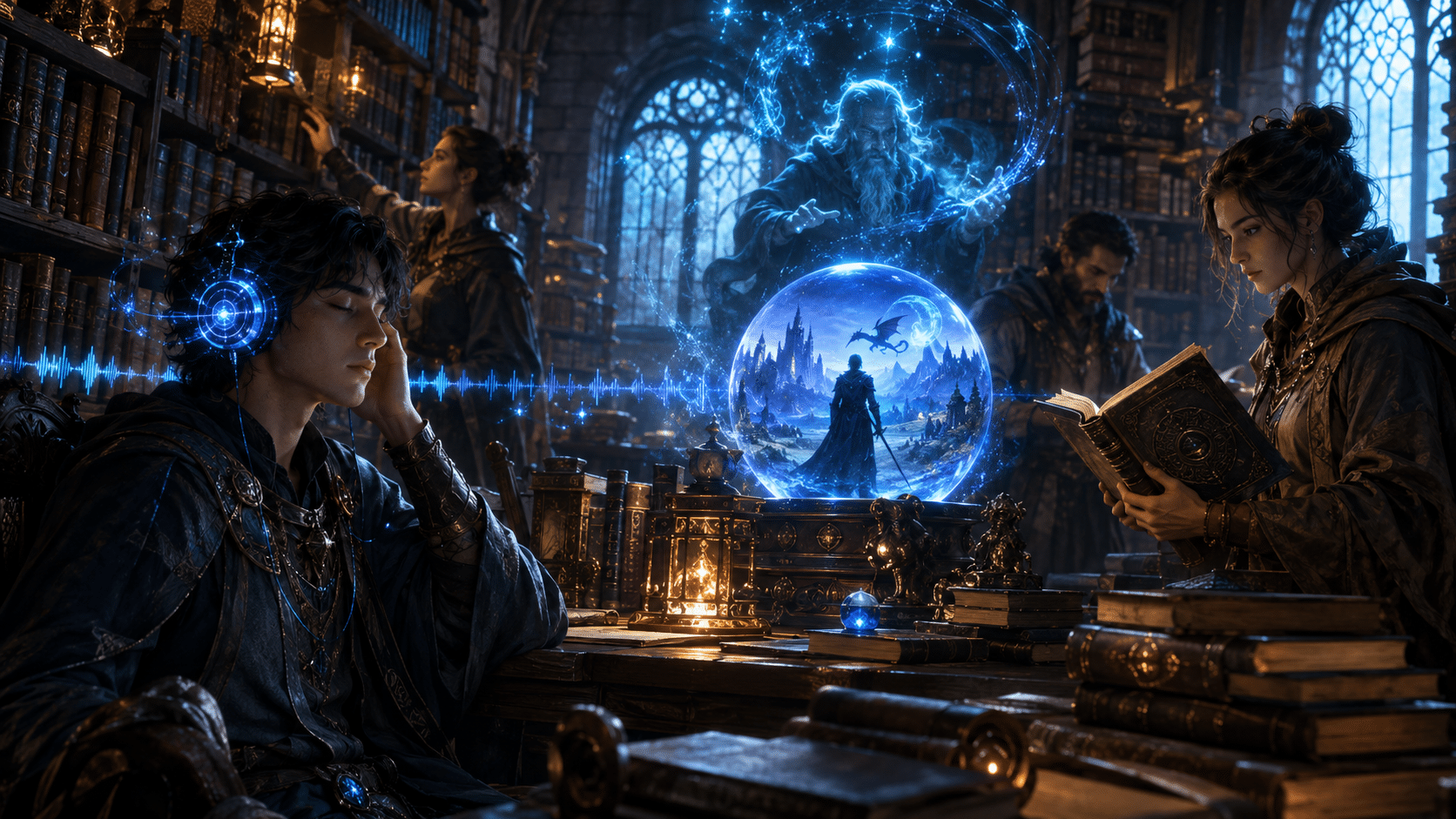
LitRPG audiobooks are the glorious collision of fantasy novels, video game logic, stat screens, loot goblins, narrator theatrics, and innocent commuters trying not to swerve into a mailbox because a calm celestial voice just announced, “You have achieved Level 12: Bone Accountant.” They are novels with mana bars, boss phases, questionable inventory management, and enough “Strength plus one” moments to make a gym bro weep into his protein potion.
On the page, LitRPG tropes can be skimmed, admired, or politely ignored like a side quest from an NPC named Kevin. In audio, however, every trope becomes performance. Pacing matters more. Repetition becomes louder. Voice acting can transform a goblin shopkeeper into a national treasure. Comedy timing can make a system notification land like divine slapstick. And if the listener hears “Agility increased by one” seventeen times in a chapter, they may begin bargaining with dark gods for a summary.
That is the central tension of LitRPG fandom: readers often love the exact same tropes they complain about. A level-up is thrilling—unless it interrupts the climax. A stat sheet is satisfying—unless it becomes an audiobook hostage situation. A snarky system is hilarious—unless it out-snarks the entire cast and starts auditioning for protagonist. We roast because we care. Beneath the cloak, many of us are absolutely wearing a guild badge.
This article explores beloved tropes, hated tropes, divisive tropes, narration-specific quirks, stat-block sins, power fantasy cravings, and the sacred art of making numbers sound dramatic. Consider it a balanced guide for authors, narrators, publishers, and fans who want to understand why one listener cheers at a skill evolution while another mutters, “Not another ten-minute character sheet.”
- The Beautifully Absurd Appeal of LitRPG Audiobooks
- The Tropes Listeners Absolutely Love
- The Tropes Listeners Secretly—or Loudly—Hate
- Loved vs. Hated: The Execution Makes the Loot
- Stat Blocks: Sacred Math or Audio Purgatory?
- System Voices: Divine Interface, Snark Goblin, or Corporate HR Demon?
- Narration Tropes That Make or Break the Experience
- Progression Addiction: Why “Number Go Up” Still Works
- Combat Tropes: Cooldowns, Crits, and “He Dodged Left Again”
- Character Build Tropes: From Trash Class to Apocalypse Roomba
- Side Characters, Party Dynamics, and the Mandatory Goblin Friend
- Romance, Harems, and Relationship Side Quests
- Humor Tropes: Puns, Patch Notes, and Goblin OSHA Violations
- Worldbuilding Tropes: Game Logic in a World That Still Needs Plumbing
- Pacing Problems: When the Tutorial Becomes the Final Boss
- Divisive Tropes: The “Depends Who You Ask” Dungeon
- How Authors Can Make Loved Tropes Feel Fresh
- How Narrators Can Save—or Slay—a Trope
- Final Thoughts on LitRPG Audiobook Tropes Readers Love and Hate
The Beautifully Absurd Appeal of LitRPG Audiobooks
LitRPG works absurdly well in audiobook form because it lets game mechanics become myth. A narrator can read a quest notification like an angel carving destiny into the sky, even if the quest is technically “Collect Ten Suspicious Mushrooms Behind the Latrine.” There is sensory pleasure in hearing the structure of progression: the ding, the reward, the skill unlock, the ominous menu option that definitely will not cause problems.
The genre also has an addictive rhythm: quest, combat, reward, upgrade, repeat. It is cozy and dangerous at the same time, like drinking tea in a dungeon gift shop. Listeners enjoy the sense that effort produces visible results. Training matters. Choices matter. Punching a slime for six hours may be emotionally questionable, but by the gods, it produces measurable growth.
Try my AI Tabletop RPG generators...and an extensive library of content!
Audio makes familiar tropes feel alive through character voices, system announcements, combat pacing, and comedic delivery. A good narrator can turn a basic loot drop into an event worthy of fireworks, chanting goblins, and one suspiciously emotional blacksmith. But the format also magnifies flaws. A stat screen that looks skimmable on the page can become an endurance dungeon when read aloud in full, especially if the listener is trapped in traffic with no escape portal.
The Tropes Listeners Absolutely Love
The tropes listeners love are the ones that make them smash the “next audiobook” button like it owes them experience points. These tropes deliver progression, agency, humor, discovery, vindication, cleverness, and occasionally revenge against smug nobles with names like Lord Veltrian Smirkblade III.
Beloved LitRPG tropes often work because they promise transformation. The weak become strong. The overlooked become terrifying. The useless skill becomes the cornerstone of civilization. The goblin everyone distrusted becomes the emotional center of the party and possibly the only one with financial sense.
- Satisfying level-ups that arrive after real effort, danger, or creative problem-solving.
- Clever skill combinations where two mediocre abilities combine into glorious nonsense.
- Underdog builds that make “bad” classes shine through grit and loopholes.
- Snarky system voices that roast the protagonist with divine professionalism.
- Loot reveals delivered with the reverence of opening a cursed birthday present.
- Dungeon cores that build, scheme, decorate, and accidentally develop ethics.
- Found-family parties where misfits become emotionally codependent murder accountants.
- Class evolutions that feel like graduation, rebirth, and a wardrobe malfunction at once.
- Overpowered-but-earned protagonists who become monsters because we watched them suffer for it.
- Ridiculous crafting breakthroughs involving spoons, mushrooms, dragon toenails, and ambition.
- Monster taming where the hero befriends something with too many teeth and names it Muffin.
- Base building that turns survival into real estate management with traps.
- Secret achievements for doing something clever, stupid, or both.
- Boss fights with mechanics that require strategy instead of repeated heroic shouting.
- “Trash skill becomes god-tier” moments where “Minor Moisture Control” ends the war.
- Party synergy where everyone’s build matters and nobody is just decorative armor.
- Rare titles that reward personality, sacrifice, or extremely specific bad decisions.
- Rival adventurers who push the hero without becoming cardboard sneer machines.
- Skill evolutions with consequences where power changes how the character thinks or acts.
- Creative use of inventory systems because nothing says heroism like weaponized storage abuse.
These tropes succeed when they feel earned, paced well, and performed with energy. A level-up should not merely arrive because the plot wandered past a milestone and picked up a badge. It should feel like a payoff, a release valve, a tiny parade in the listener’s brain.
⚔️ Fantasy RPG Random Tables Books
Make life as a Gamemaster easier…
If you play Dungeons & Dragons, Pathfinder, or other fantasy RPGs, this
RPG random tables series
is packed with encounters, NPCs, treasure, and more. Available in eBook or print—either way, you’ll have a wealth of adventure ideas at your fingertips.



Listeners love predictability when it delivers emotional payoff rather than mechanical paperwork. We know the boss will drop loot. We know the class will evolve. We know the “useless” skill is secretly illegal in seven kingdoms. The joy is in how the story gets there—and whether the narrator sounds delighted, horrified, or contractually obligated to announce it.
The Tropes Listeners Secretly—or Loudly—Hate
Then there are the tropes that make listeners sigh hard enough to lower their Constitution score. These are not always bad ideas. Often, they are beloved ideas that have been overfed, under-edited, and released into the wild without adult supervision.
Hated tropes usually involve repetition, shallow wish fulfillment, lazy conflict, or mechanics that interrupt the story instead of supporting it. The listener came for adventure, not an unabridged spreadsheet doing squats in the middle of a duel.
Some of these tropes are especially dangerous in audio because there is no easy skimming. A reader can glance past a dense stat block. A listener must endure every attribute, resistance, modifier, pet bonus, temporary buff, shoe enchantment, and allergy debuff as if trapped in a magical DMV.
- Endless stat readouts repeated every chapter like a sacred punishment.
- Instant overpowered protagonists who become gods before anyone earns pants.
- Meaningless numbers that never affect tactics, choices, or consequences.
- Tutorial chapters that never end and begin to feel like onboarding for a job nobody applied for.
- Flat side characters whose only personality is “Wow, protagonist, you are amazing.”
- Forced romance where chemistry is replaced by proximity and plot glue.
- Random harem padding that treats people like collectible equipment slots.
- Villains who exist only to sneer and explain their evil business model.
- Convenient skill unlocks that appear exactly when needed with suspicious customer service speed.
- Repetitive combat descriptions where every fight is dodge, slash, grunt, repeat.
- “As you know” exposition delivered to people who absolutely already know.
- Fake choices where the protagonist has three options but the plot has already picked one.
- Quest rewards that solve every problem like a divine vending machine.
- Narrators forced to read menus for five minutes while listeners age in real time.
- Training arcs with no emotional movement except biceps.
- Inventory lists that include everything except why we should care.
- Side quests that stall the main story without adding character, comedy, or stakes.
- Power creep so extreme the original conflict becomes a decorative napkin.
Of course, many “hated” tropes can work when handled cleverly. A long tutorial can be funny if the protagonist argues with it. A harem plot can work if the relationships are actual relationships. A villain can sneer if they also have motives, charisma, and perhaps a tragic backstory involving competitive cheese magic.
Even a 47-line stat block can be forgiven if it arrives after a dragon suplex. Timing is mercy. Context is king. If the listener is already cheering, they will accept more math than they would under ordinary courtroom conditions.
Loved vs. Hated: The Execution Makes the Loot
LitRPG tropes are rarely inherently good or bad. A level-up can be thrilling or tedious. A dungeon crawl can feel tense or like someone narrating a hallway simulator. A pet companion can be adorable or become a plush toy with dialogue privileges.
The difference is execution: timing, narration, stakes, character relevance, and whether the listener has heard the same notification twelve times in one chapter. Tropes are tools. A hammer can build a house or hit the reader repeatedly with “Mana plus two.”
| Trope | Why Readers Love It | Why Readers Hate It | How to Make It Work in Audio |
|---|---|---|---|
| Level-ups | Clear reward and dopamine sparkle | Too frequent or unearned | Give them emotional timing and brisk delivery |
| Stat screens | Visible progression | Audio slows to a crawl | Summarize changes instead of reading full sheets |
| System messages | Flavor, comedy, structure | Constant interruptions | Use distinct tone and limit repetition |
| Dungeon crawls | Exploration, danger, loot | Repetitive rooms and mobs | Vary encounters, pacing, and atmosphere |
| Crafting | Creativity and problem-solving | Menu-heavy tinkering | Focus on breakthroughs and character choices |
| Respawns | Strategic risk-taking | Removes stakes | Add costs, trauma, limits, or consequences |
| Hidden classes | Discovery and identity shift | Feels like author favoritism | Foreshadow and attach trade-offs |
| Skill trees | Customization and agency | Too many options, no drama | Highlight meaningful decisions |
| Pet companions | Humor, heart, chaos | Becomes gimmicky mascot | Give the pet purpose and personality |
| Guild politics | Social stakes and intrigue | Bureaucratic drag | Tie politics to action and character goals |
| Boss fights | Climactic mechanics | Damage-number soup | Make phases clear and tactical |
| Romance subplots | Emotional grounding | Forced or distracting | Let relationships affect choices and stakes |
Execution is the true final boss. Not the lich, not the raid dragon, not the goblin union leader with a clipboard. Execution determines whether a trope feels like treasure or cursed inventory clutter.
Writers should treat tropes like ingredients. A pinch of snarky system? Delicious. A cup of underdog progression? Excellent. Twelve gallons of uninterrupted stat recaps dumped into the stew? Congratulations, you have invented soup that files taxes.

Stat Blocks: Sacred Math or Audio Purgatory?
Stats are sacred math. They are the glowing bones of LitRPG. Attributes, skills, resistances, buffs, debuffs, cooldowns, titles, affinities, crafting bonuses, passive abilities, and that one mysterious luck stat nobody understands but everyone fears—these are part of the genre’s crunchy charm.
⚔️ Fantasy RPG Random Tables Books
Make life as a Gamemaster easier…
If you play Dungeons & Dragons, Pathfinder, or other fantasy RPGs, this
RPG random tables series
is packed with encounters, NPCs, treasure, and more. Available in eBook or print—either way, you’ll have a wealth of adventure ideas at your fingertips.
Readers enjoy visible progression because it proves the journey matters. A character was weak; now they are less weak. They were slow; now they dodge knives with ballet-adjacent panic. Numbers give shape to growth. They make effort tangible. They let listeners feel the tiny electric joy of improvement.
But audio changes the equation. A stat sheet on the page can be skimmed. In audiobook form, it becomes a ceremonial reading. If every number is narrated repeatedly, listeners may begin to hallucinate interface windows in their windshield. The difference between meaningful stats and decorative stats matters enormously. If Dexterity rises from 18 to 19, the story should eventually show why that matters—or else the number has the emotional weight of a soggy tutorial biscuit.
Audiobook-friendly stat presentation means summarizing changes, emphasizing important upgrades, avoiding full-sheet repetition, and using tone or sound cues carefully if applicable. Numbers should serve drama, comedy, strategy, or character growth—not merely prove the author owns a calculator.
System Voices: Divine Interface, Snark Goblin, or Corporate HR Demon?
System voices are one of LitRPG audio’s greatest pleasures. On the page, a notification is text. In audio, it becomes a character—or at least an entity with opinions, formatting standards, and possibly unresolved divine trauma.
A narrator’s performance can make system messages hilarious, ominous, bureaucratic, celestial, glitchy, or deeply unhinged in the best possible way. The phrase “Achievement Unlocked” can sound like a heavenly choir, a bored accountant, or a murder robot pretending to be friendly.
The danger is overuse. If the system comments on everything, the story can start to feel like the protagonist is adventuring with a magical group chat that refuses to mute itself.
- Deadpan cosmic receptionist who announces apocalypse events like calendar reminders.
- Overly cheerful tutorial fairy with the emotional restraint of a glitter cannon.
- Glitching apocalypse AI that makes every notification feel like a corrupted prophecy.
- Passive-aggressive dungeon announcer who judges everyone’s footwork.
- Bureaucratic quest clerk obsessed with forms, categories, and stamp placement.
- Ancient god pretending to be software and fooling absolutely no one.
- Sarcastic achievement bot that rewards stupidity with applause.
- Horror-game whisper interface that makes inventory management feel haunted.
- Military tactical assistant barking cooldowns like battlefield scripture.
- Chaotic goblin notification voice that may or may not understand the rules.
- Emotionless machine intelligence for maximum clinical dread.
- Fake-helpful “customer support” system that apologizes while ruining lives.
- Celestial judge interface dripping with divine disappointment.
- Game-show announcer system turning death matches into prize events.
- Corporate HR demon offering “growth opportunities” during mortal peril.
System voices should have personality without hijacking the book. They are seasoning, not the entire stew, unless the premise is specifically “the interface has become self-aware and needs therapy.”
If the interface gets more character development than the protagonist, something has either gone very wrong or wonderfully weird. LitRPG, being LitRPG, may accept both outcomes and award a title for it.
Narration Tropes That Make or Break the Experience
Audiobook-specific tropes do not exist the same way on the page. Character voices, pacing, pronunciation, combat energy, comedic timing, emotional range—all of these shape how tropes land. A narrator can make “Fireball” sound like a desperate last resort or like someone ordering soup.
There is also the danger of voice sameness. If every orc sounds like the same tired pirate, every elf sounds like a smug candle, and every dwarf sounds legally required to discuss ale, the listener may lose track of the cast and start ranking them by throat gravel.
| Narration Trope | Why It Works | Why It Fails | Listener Reaction |
|---|---|---|---|
| Exaggerated monster voices | Adds fun and texture | Can become unintelligible | “I love him, but what did he say?” |
| Dramatic system announcements | Makes mechanics feel epic | Overdone for tiny updates | “Why is +1 Fishing so intense?” |
| Monotone stat reading | Clear and neutral | Becomes audio oatmeal | “Wake me when Dexterity ends.” |
| Musical chapter intros | Creates brand identity | Interrupts immersion | “Nice tune, but the goblins are attacking.” |
| Dual narration | Great for POV contrast | Inconsistent voices or pacing | “More of this—or less, depending.” |
| Mispronounced game terms | Sometimes charming | Breaks trust with genre fans | “Did they say ‘mana’ like banana?” |
| Whispery villains | Creepy atmosphere | Hard to hear in cars | “The dark lord needs subtitles.” |
| Anime-style battle cries | High energy | Can become cringe lava | “Either glorious or illegal.” |
| Comedic sidekick voices | Memorable and fun | Too cartoony for emotional scenes | “Gobbo deserves an award.” |
| “Radio drama” production effects | Immersive and cinematic | Distracting or inconsistent | “Cool explosion; where did the story go?” |
Narrators become part of the LitRPG brand. Fans often follow narrators across series because a great voice actor can make ability cooldowns sound like Shakespeare found a mana potion.
A beloved narrator can turn a mediocre trope into comfort food. The right delivery makes stat changes brisk, system messages funny, monsters distinct, and combat readable. The wrong delivery makes even a legendary sword sound like it came from a training manual.
In LitRPG especially, narrators are not merely reading the story. They are voicing the game layer, the fantasy layer, the comedy layer, and the emotional layer—sometimes all in the same sentence, while a goblin accountant screams about tax exemptions.

Progression Addiction: Why “Number Go Up” Still Works
“Number go up” is funny because it is true. LitRPG taps into the primal joy of visible advancement: levels, titles, achievements, rare drops, class evolutions, cultivation-adjacent power jumps, and the dopamine sparkle of a well-timed notification.
Audiobooks make this especially satisfying because progression becomes rhythmic. The listener hears the struggle, the effort, the breakthrough, and then the reward. A level-up can feel like a drumbeat. A rare item reveal can feel like a stage magician pulling a flaming sword out of a hat labeled “poor impulse control.”
Listeners love steady growth when it is connected to effort, cleverness, sacrifice, or hilarious failure. The best progression arcs are emotional as well as mechanical. A hero should not merely gain +5 Strength; they should become someone who knows what strength costs. Progression without challenge becomes empty. If the hero wins every fight by blinking aggressively, listeners may begin rooting for the tutorial slime.
Combat Tropes: Cooldowns, Crits, and “He Dodged Left Again”
Combat in LitRPG audiobooks is at its best when it blends tactics with momentum. Listeners love battles where mechanics matter: cooldowns, positioning, party roles, weak points, boss phases, environmental hazards, and skill synergy that makes everyone shout “Oh, that was clever” while merging onto the freeway.
Clear mechanics make combat satisfying because the audience understands the problem. The boss has armor plates. The healer is out of mana. The floor is lava, legally and thermally. The rogue has one shot. The protagonist has a terrible idea and three seconds to execute it.
But combat can become exhausting if every fight sounds the same. If the hero dodges left, slashes, activates skill, watches numbers float, and repeats until the monster politely expires, listeners may begin craving a courtroom drama.
- Boss phase transformations that escalate stakes mid-fight.
- Cooldown juggling where timing matters more than raw power.
- Last-second mana recovery for delicious panic.
- Tank/healer/DPS teamwork that gives everyone a role.
- Weak-point exploitation rewarding observation.
- Repetitive dodge-and-slash fights that make combat blur together.
- Over-described damage numbers turning action into accounting.
- Status effect stacking that can be tactical or incomprehensible.
- Clever terrain use like collapsing bridges, lava vents, or weaponized furniture.
- One-hit victories that are satisfying only if earned or funny.
- Skill combo discoveries during desperate improvisation.
- Friendly fire chaos because parties are family and family miscasts Fireball.
- Enrage timers that force urgency.
- Combat banter that reveals relationships under pressure.
- Boss mechanics puzzles where the solution is not “hit harder.”
- Sacrificial plays that make victory cost something.
Audio combat needs rhythm and clarity. Short sentences can speed up action. Longer sentences can create dread. Repetition should be intentional, not accidental copy-paste from the goblin fight three chapters ago.
Writers should vary sentence structure and avoid turning every battle into a narrated patch note. “He dealt 37 slashing damage” is useful sometimes. “The blade bit under the troll’s guard, and the creature finally staggered” is often easier on the soul.
Try my AI Tabletop RPG generators...and an extensive library of content!

Character Build Tropes: From Trash Class to Apocalypse Roomba
Class and build tropes are the fashion show of violence. LitRPG readers love the underdog class, broken exploit build, rare hidden class, hybrid class, cursed class, joke class, crafter class, summoner class, and support class that accidentally becomes terrifying.
A great build is more than a combat kit. It is identity. It tells us how the protagonist solves problems, what risks they take, what they value, and whether they are the sort of person who sees “Rat King Infestation” and thinks, “Finally, a crafting opportunity.”
⚔️ Fantasy RPG Random Tables Books
Make life as a Gamemaster easier…
If you play Dungeons & Dragons, Pathfinder, or other fantasy RPGs, this
RPG random tables series
is packed with encounters, NPCs, treasure, and more. Available in eBook or print—either way, you’ll have a wealth of adventure ideas at your fingertips.
| Build Trope | Why Readers Love It | Common Failure Point | Best Audio Presentation Tip |
|---|---|---|---|
| Trash class | Underdog satisfaction | Becomes secretly OP too fast | Let frustration and ingenuity come through |
| Necromancer | Dark flair, minions, moral tension | Edgelord overload | Balance menace with personality |
| Crafter | Creativity and problem-solving | Too many recipes | Highlight key breakthroughs |
| Healer | Support heroism | Passive role boredom | Emphasize pressure and triage decisions |
| Tank | Protection and sacrifice | Just absorbs hits | Make impact and pain audible |
| Rogue | Sneaky tactics and precision | Endless backstabs | Use pacing for tension |
| Summoner | Variety and chaos | Too many minions to track | Give summons distinct identities |
| Beast tamer | Emotional bonds and monster fun | Cute pet gimmick | Let the creature affect scenes |
| Spellblade | Stylish hybrid combat | Generic coolness | Clarify physical/magical flow |
| Bard | Humor, buffs, social power | Joke-only treatment | Sell both comedy and competence |
| Dungeon core | Strategy from a strange POV | Too detached emotionally | Give the core desires and quirks |
| Noncombat strategist | Clever victories | Too much planning, no payoff | Make plans dramatic and clear |
Great builds reveal personality. A protagonist’s class should not just determine how they fight, but how they think, panic, improvise, and insult goblins under pressure.
The build is the character’s argument with the world. A healer says, “I refuse to let people die.” A rogue says, “I refuse to enter through doors.” A crafter says, “What if trauma, but artisanal?”
Side Characters, Party Dynamics, and the Mandatory Goblin Friend
Supporting casts are vital in LitRPG audiobooks because they create banter, tactical variety, emotional stakes, and opportunities for narrators to show range. A solo protagonist can be fun, but a party gives the story friction, warmth, comedy, and someone to say, “Please do not test the cursed lever with your face.”
Readers love loyal tanks, chaotic rogues, grumpy healers, adorable monsters, rival party members, mentor NPCs, and goblins who absolutely should not be trusted but somehow become beloved. The mandatory goblin friend is often a tiny green lawsuit with teeth, yet listeners will defend him with their lives by book three.
Party dynamics also make mechanics more interesting. A healer changes risk. A tank changes positioning. A rogue changes planning. A bard changes the emotional legality of everything. When each build matters, combat becomes a team puzzle instead of the protagonist performing violence while friends applaud politely.
Listeners hate flat companions, characters who only praise the protagonist, sidekicks reduced to skill explanations, disposable love interests, and entire parties that vanish whenever the hero needs solo glory. Give side characters goals, flaws, builds, and voices distinct enough that listeners can recognize them without a dialogue tag wearing a name badge.
Romance, Harems, and Relationship Side Quests
Romance in LitRPG audiobooks is a wildly variable potion. Some listeners love romantic tension, some enjoy cozy party bonds, and others want the kissing to stop interrupting the dungeon boss. There is no universal answer, except perhaps “please make everyone involved feel like an actual person.”
The genre can support romance beautifully because danger intensifies emotion. Shared battles, healing scenes, rivalries, betrayals, respawns, and terrible campfire meals can all build intimacy. But romance can also feel awkward if it appears only because the protagonist completed the “existing near attractive person” requirement.
Relationship side quests work best when they affect character decisions, party dynamics, and stakes. They fail when love interests become rewards, accessories, or stat bonuses with hair.
- Slow-burn party romance that grows through trust.
- Battle couple dynamics where love and tactics overlap.
- Forced attraction that feels like the plot grabbed two dolls and mashed them together.
- Harem collection plots that can be fun for some, exhausting for others.
- Awkward flirting during apocalypse because timing is a dump stat.
- Rival-to-lover progression powered by competition and grudging respect.
- NPC romance complications involving agency, memory, or system rules.
- Relationship stat jokes that lovingly mock game logic.
- Emotional intimacy after combat when vulnerability matters.
- Jealousy subplots that either add tension or devour the plot.
- Love interest with no agency who exists only to admire the hero.
- Romance that affects strategy and stakes in meaningful ways.
- Party banter about obvious crushes because everyone knows except the protagonist.
- Resurrection/respawn grief romance where death still has emotional cost.
Romance works best when characters remain people, not rewards. Attraction should create choices, complications, tenderness, and risk.
Affection should not feel like loot automatically equipped after completing Quest: Be Nice Twice.
Humor Tropes: Puns, Patch Notes, and Goblin OSHA Violations
Humor lands especially well in LitRPG audio because timing is everything. A narrator can pause before a ridiculous achievement title, deadpan a cursed item description, or make a goblin safety inspector sound like the most important bureaucrat in the multiverse.
The genre is naturally absurd. World-ending events are treated like customer service tickets. Dungeons have interfaces. Gods issue patch notes. A hero may be bleeding out while arguing with a menu about whether “mild dismemberment” counts as a debuff.
Listeners often love snarky systems, genre-savvy heroes, absurd item descriptions, incompetent villains, monster bureaucracy, achievement jokes, and party banter after catastrophic decisions. But humor needs contrast. If every character is sarcastic all the time, the emotional stakes may quietly uninstall themselves.
Worldbuilding Tropes: Game Logic in a World That Still Needs Plumbing
LitRPG worlds must balance mechanics with believable cultures, economies, politics, religion, ecology, and infrastructure. Listeners may accept respawns and mana crystals, but they will still wonder who cleans the dungeon.
Game logic creates fascinating implications. If classes exist, society changes. If healing magic exists, medicine changes. If rats drop copper coins, economic theory files a complaint.
| Worldbuilding Trope | Reader Appeal | Potential Problem |
|---|---|---|
| Adventurer guilds | Clear structure for quests and ranks | Can feel generic |
| Dungeon economies | Loot loops and local industry | Raises questions about sustainability |
| Respawn temples | Interesting death mechanics | Can reduce stakes |
| Monster zones | Easy adventure geography | Artificial-feeling ecology |
| Skill-based societies | Mechanics shape culture | Overly rigid social systems |
| Class discrimination | Built-in conflict | Heavy-handed allegory |
| System religions | Divine mystery and institutions | Theology becomes menu worship |
| Magic item markets | Fun gear progression | Inflation of wonder |
| Tutorial islands | Controlled learning environment | Delays main story |
| Leaderboard politics | Competition and status | Can become scoreboard drama only |
Strong worldbuilding makes tropes feel grounded. Mechanics should affect everyday life, not just combat. Farmers would care about stamina skills. Merchants would care about inventory magic. Nobles would absolutely weaponize class access because nobles in fantasy are required by law to be problems.
Authors should think through how game mechanics shape labor, crime, education, worship, dating, war, and plumbing. Especially plumbing. Ignore plumbing too long and your epic city becomes a smell-based dungeon.
And if rats drop copper coins, someone in the kingdom has built an economy around suspicious basement pest control. There are probably unions. There are definitely tax forms.
Pacing Problems: When the Tutorial Becomes the Final Boss
Pacing problems hit harder in LitRPG audiobooks because audio is linear. A reader can skim a long tutorial. A listener must walk through it at narrator speed, barefoot, uphill, while the interface explains inventory sorting for the fourth time.
Long tutorials, repeated explanations, training arcs, stat recaps, crafting menus, and travel grinding can feel much longer in audio than on the page. Even fans who love mechanics need story oxygen.
The challenge is not removing crunch. The challenge is giving crunch rhythm, relevance, and emotional flavor. Mechanics should create momentum, not park the plot in a loading screen.
- Summarize repeated stat changes instead of reading the whole sheet.
- Cut redundant system messages after the listener understands the format.
- Alternate mechanics with emotion so upgrades affect character.
- Use training montages sparingly and with clear outcomes.
- Make tutorials interactive through conflict, humor, or danger.
- Keep combat objectives clear so listeners know what matters.
- Avoid back-to-back menu scenes unless the menu is actively dramatic.
- Put character conflict inside mechanics to merge plot and system.
- Vary scene length to prevent rhythm fatigue.
- Let upgrades have immediate consequences in action or relationships.
- Trim repeated ability descriptions once established.
- Use cliffhangers carefully without abusing listener trust.
- Balance cozy downtime with plot movement so comfort does not become molasses.
- Condense travel grinding unless something meaningful happens.
- Make crafting scenes about decisions, not ingredient roll call.
Good pacing lets listeners enjoy mechanics without feeling trapped in an unskippable cutscene. The audiobook should feel like an adventure, not a mandatory software tutorial narrated by a wizard.
⚔️ Fantasy RPG Random Tables Books
Make life as a Gamemaster easier…
If you play Dungeons & Dragons, Pathfinder, or other fantasy RPGs, this
RPG random tables series
is packed with encounters, NPCs, treasure, and more. Available in eBook or print—either way, you’ll have a wealth of adventure ideas at your fingertips.
Even fans who love crunchy systems need narrative snacks between math meals. A little character conflict, comedy, mystery, or looming doom helps the numbers digest.
Divisive Tropes: The “Depends Who You Ask” Dungeon
Some tropes split the audience like a cursed axe through a tavern table. One listener’s comfort food is another listener’s instant refund. That does not make the trope bad; it makes it specialized.
Some fans adore crunchy stat detail, slice-of-life crafting, OP protagonists, harem dynamics, dungeon core narration, or cozy town-building. Others flee like a level-one villager spotting a raid boss. Taste matters. Expectations matter more.
Divisive tropes often succeed when marketed clearly. If someone wants a tactical dungeon crawl and receives 14 hours of cozy slime bakery management, confusion is inevitable—even if the muffins are enchanted.
| Divisive Trope | Fans Say | Critics Say | Best Use Case |
|---|---|---|---|
| Overpowered protagonists | “Power fantasy, yes please.” | “Where are the stakes?” | When challenges scale emotionally or socially |
| Long crafting sequences | “Cozy and clever.” | “Please exit the menu.” | When crafting reveals character |
| Detailed stat sheets | “Crunchy satisfaction.” | “Audio purgatory.” | When summarized intelligently |
| Dungeon cores | “Fresh perspective.” | “Too detached.” | When the core has personality and stakes |
| Slice-of-life arcs | “Comforting.” | “Nothing is happening.” | Between major conflicts |
| Grimdark systems | “High stakes.” | “Exhausting misery.” | With hope or purpose |
| Harem plots | “Fun relationship fantasy.” | “Shallow collection mechanics.” | With agency and emotional depth |
| Comedy-heavy narration | “Hilarious.” | “Undercuts tension.” | With tonal control |
| Permadeath | “Real danger.” | “Too stressful.” | When loss has thematic weight |
| Reincarnation openings | “Classic hook.” | “Not another truck.” | With a fresh identity twist |
| Town building | “Progression at scale.” | “Civic planning simulator.” | When politics and resources matter |
| Real-world-to-game portals | “Relatable entry point.” | “Overused setup.” | When Earth knowledge creates real conflict |
Divisive tropes are not flaws by default; they are audience signals. They tell readers what kind of meal is being served.
Writers and publishers should be clear about subgenre promises so listeners know whether they are entering a tactical dungeon crawl or a cozy slime bakery simulator. Both are valid. Only one comes with frosting-based progression.
How Authors Can Make Loved Tropes Feel Fresh
Freshness does not require rejecting tropes. LitRPG readers often arrive because they want the trope. They want the level-up, the class evolution, the ridiculous loot reveal, the skill synergy, the goblin with suspiciously specific legal knowledge.
The trick is delivering the expected moment with sharper stakes, better jokes, cleaner pacing, or a stranger monster wearing an inexplicable hat. Familiarity is not the enemy. Laziness is. A trope feels fresh when it is personal to the character and specific to the world.
Authors can use mechanics as storytelling tools. A skill tree can reveal trauma, ambition, morality, insecurity, or the protagonist’s deeply questionable priorities. Does the hero choose damage, defense, healing, stealth, crafting, leadership, or “Summon More Bees”? That choice says something.
Readers return to LitRPG for both comfort and surprise. Give them the loot chest they came for while hiding something unexpected inside—preferably not another tutorial fairy.
How Narrators Can Save—or Slay—a Trope
Narrators have enormous power in LitRPG. Delivery can transform repetitive mechanics into entertaining rhythm or make them feel like someone reading tax documents inside a wizard tower.
A narrator must balance clarity, energy, humor, and restraint. Not every notification needs thunder. Not every goblin needs to sound like gravel in a blender. Not every villain should whisper like they are afraid of waking the baby dragon.
Great narration understands when the game layer matters and when the story layer needs the spotlight.
- Give system messages a distinct tone so listeners recognize them immediately.
- Keep stat reads brisk and avoid theatrical overextension.
- Differentiate party voices clearly without turning everyone into a cartoon parade.
- Avoid overacting every notification or tiny upgrades become melodrama.
- Emphasize important upgrades so listeners know what changed.
- Use pacing to clarify combat and distinguish action beats.
- Make humor conversational rather than forcing every joke.
- Preserve emotional seriousness when needed even in crunchy scenes.
- Keep terminology consistent to maintain listener trust.
- Avoid making monsters unintelligible no matter how many tusks they have.
- Signal menu sections without dragging through them.
- Treat boss fights like scenes, not spreadsheets.
- Let silence or pauses help big reveals land.
- Maintain vocal stamina across long series because fans notice everything.
Great narration respects both the game layer and the story layer. The listener should understand the mechanics without feeling buried beneath them.
The narrator should sound like they understand why “+2 Wisdom” matters emotionally, spiritually, and possibly tax-wise.
Final Thoughts on LitRPG Audiobook Tropes Readers Love and Hate
LitRPG audiobook fans love progression, clever builds, funny systems, loot, tactics, party dynamics, and the addictive promise that the next level might solve everything except the protagonist’s emotional damage. We love watching characters grow from confused nobodies into terrifying specialists with inventory problems.
Readers hate tropes when they become lazy, repetitive, shallow, or poorly paced. Audio magnifies both pleasure and irritation. A great trope becomes unforgettable in a narrator’s hands. A bad one becomes a ten-minute stat recital echoing through the listener’s soul like a cursed spreadsheet.
Authors, narrators, and publishers should think of tropes as tools rather than shortcuts. Used well, they create comfort, comedy, tension, and triumph. Used badly, they become cursed items with no resale value and a passive debuff called “Listener Fatigue.”
In the grand dungeon of LitRPG audiobooks, the true legendary drop is balance—plus maybe a narrator who can say “Legendary Vorpal Spoon of Goblin Regret” without breaking character.