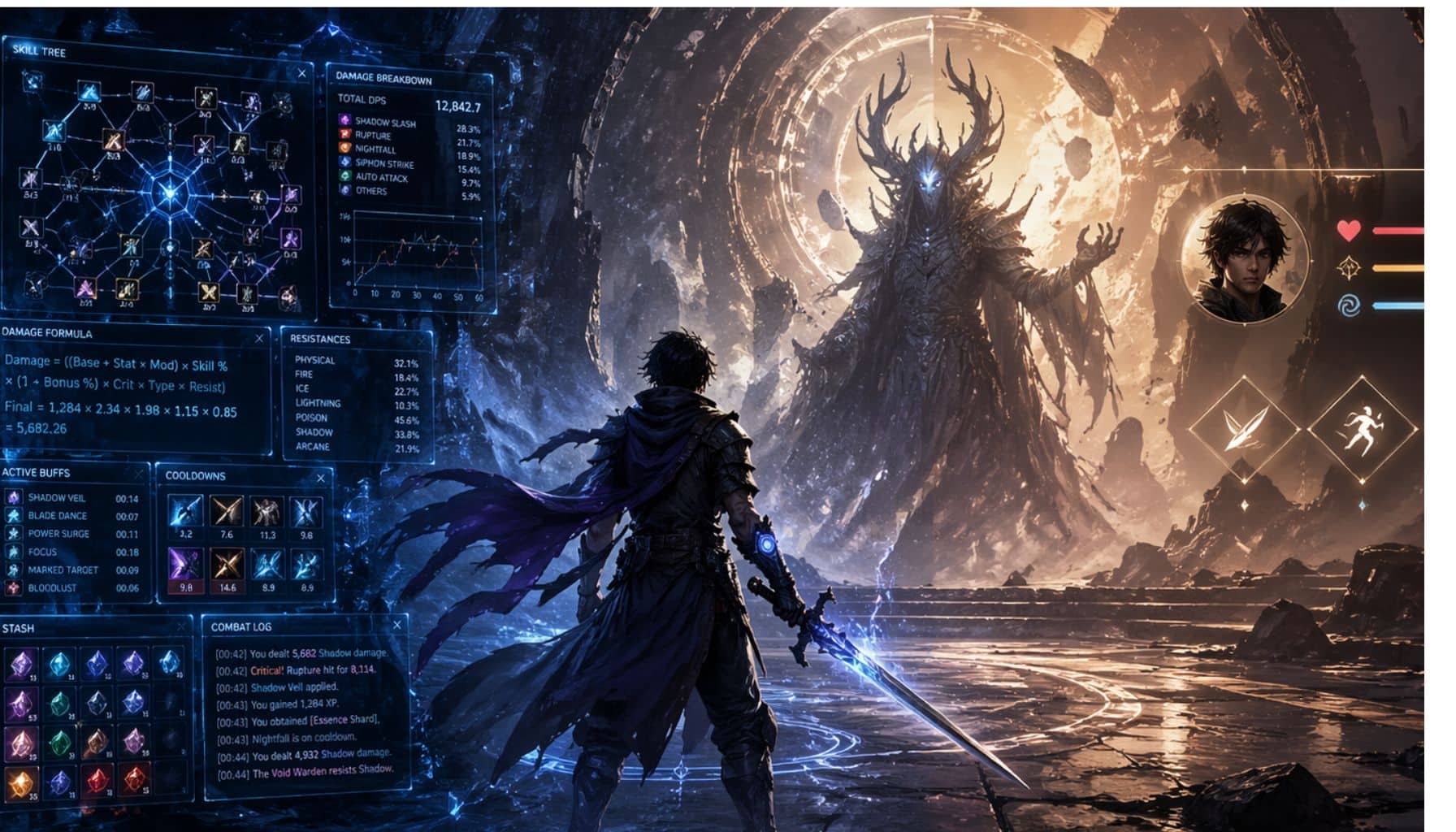
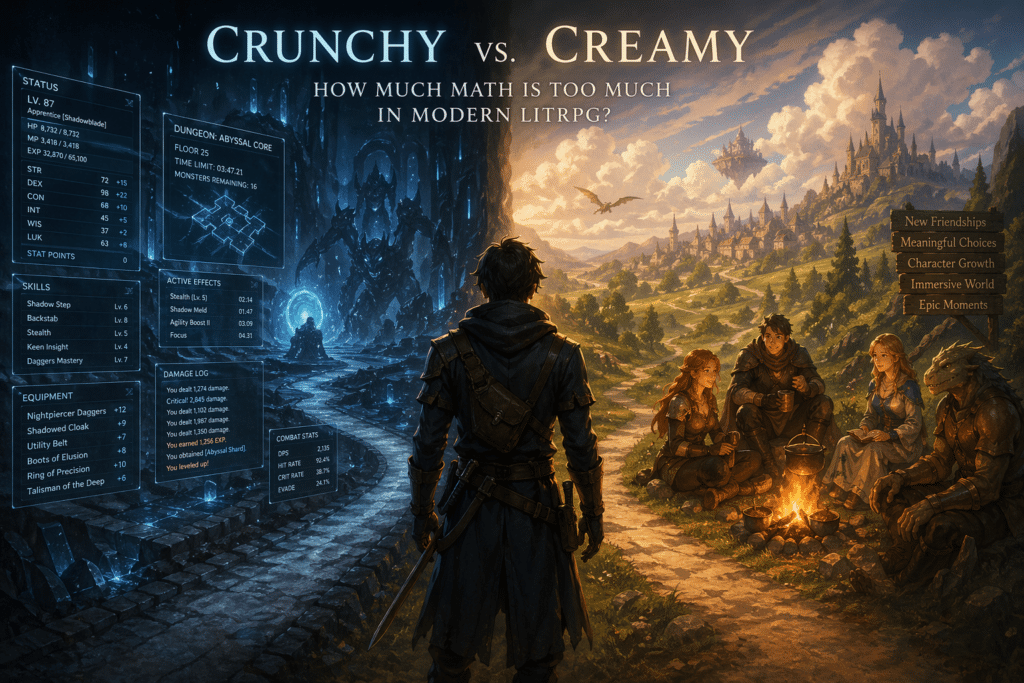
LitRPG has always lived in a gloriously weird neighborhood: one house over from epic fantasy, across the street from game design, and directly above that friend who insists they can explain armor penetration formulas at a dinner party. It is a genre built on a dangerous promise: what if stories had visible systems? What if growth could be measured, quantified, and lovingly displayed in stat blocks large enough to frighten a copy editor? For some readers, this is catnip. For others, it is being trapped in an elevator with a calculator.
The great debate, then, is not whether numbers belong in LitRPG. Of course they do. The question is how many numbers can be invited to the party before they begin drinking all the narrative punch and explaining the economy of crafting shards to the curtains. “Crunchy” LitRPG revels in detail, precision, and rules you could probably run in a spreadsheet. “Creamy” LitRPG keeps the game flavor but lets the story slide down easy, with less arithmetic and more momentum. Neither approach is wrong. Both can be wonderful. Both can also go spectacularly off the rails.
What follows is a tour through the decimal-dusted battlefield between system lovers and story gremlins: where stat sheets become furniture, buff stacking becomes a mild form of tax law, and readers begin to suspect they may need to show their work. The goal is not to banish math from modern LitRPG, but to ask a more practical question: when does useful crunch become narrative chewing gravel? Let us open the character menu and regret everything together.
- Dice, Damage, and Decimal-Point Drama
- When Stat Sheets Start Eating the Story Whole
- Critical Hits, Critical Math, Critical Headaches
- XP, HP, and Why Is There Algebra in My Soup?
- The Fine Art of Not Showing Every Single Roll
- Spreadsheet Sorcery vs. Smooth Narrative Butter
- How Many Percent Buffs Before Readers Revolt?
- Between Crunch and Cream: Finding the Sweet Spot
- Level-Ups, Log Tables, and Other Plot Goblins
- Keeping the Game Feel Without Assigning Homework
Dice, Damage, and Decimal-Point Drama
LitRPG inherited a deep affection for numbers from tabletop games, MMORPGs, and the sort of people who think “damage variance” is pillow talk. There is undeniable pleasure in watching a hit land for 437 damage instead of “a lot.” Numbers create texture. They transform vague improvement into measurable achievement. A sword swing is nice; a sword swing that crits because of a dexterity threshold, weapon mastery perk, and temporary moonlight buff is a whole event.
The problem begins when precision stops serving drama and starts auditioning for the role of main character. Not every combat exchange benefits from being broken into damage types, resistance calculations, penetration modifiers, and a suspiciously enthusiastic decimal. If a goblin gets hit for 34.82 fire damage, many readers will not feel immersed. They will feel like they have accidentally opened patch notes.
There is a difference between concrete and cluttered. A little numerical specificity can make a world feel game-like in the best way. Too much turns every action into a receipt. Readers generally want to know that the hero is improving, that choices matter, and that combat has stakes. They do not necessarily want a front-row seat to the entire hidden equation unless that equation itself is the fun.
Try my AI Tabletop RPG generators...and an extensive library of content!
Good crunch often uses numbers as punctuation rather than as a full replacement for prose. The damage value should support the scene, not elbow it aside. If the villain’s final blow lands with emotional force, it rarely matters whether the exact total was 1,204 or 1,204.5. The half point is where readers begin to wonder whether the dragon was reduced by tax.
When Stat Sheets Start Eating the Story Whole
There is a magical moment in many LitRPGs when the first stat sheet appears. The reader leans in. Oho, they think. We are doing this. The numbers gleam with possibility. Strength means something. Intelligence means something. There are skills, classes, bonuses, and mysterious locked slots that whisper of future power. It is delightful.
Then, if the author is not careful, the stat sheet returns. And returns again. And once more for luck. Soon it is no longer a magical artifact but a recurring houseguest sleeping on the narrative couch and eating all the characterization. Every chapter opens with a five-page system recap, as if the story fears readers may have forgotten that Vitality: 23 still exists.
A stat sheet is useful when something important changes, when a comparison matters, or when a reveal carries dramatic weight. It is less useful when it appears every time the protagonist sneezes near a tutorial zone. Repetition can flatten excitement. The very device meant to signal progress starts feeling static, because the reader is asked to parse the same columns over and over with only one number changed from 14 to 15, and frankly that one point in Perception may not deserve a parade.
⚔️ Fantasy RPG Random Tables Books
Make life as a Gamemaster easier…
If you play Dungeons & Dragons, Pathfinder, or other fantasy RPGs, this
RPG random tables series
is packed with encounters, NPCs, treasure, and more. Available in eBook or print—either way, you’ll have a wealth of adventure ideas at your fingertips.



A few warning signs that the stat sheet is becoming the story’s dominant life-form:
- Readers are skimming system windows to get back to the scene.
- Character development is happening mostly as numerical increments.
- The emotional climax of a chapter is interrupted by twelve passive skill notifications.
- The protagonist has more listed resistances than visible personality traits.
Stat sheets work best when curated. Show the whole structure when it matters. Summarize when it does not. Trust the reader to remember the broad shape of the build. If the hero remains “the agile poison rogue with terrible impulse control,” that identity is more narratively useful than reproducing every substat like sacred scripture.
Critical Hits, Critical Math, Critical Headaches
Combat in LitRPG often lives or dies by clarity. The reader wants enough system logic to understand why an attack worked, why a gamble failed, and why the hero is now running from a slime the size of a cathedral. Crunch can create that clarity. It can make victories feel earned because the protagonist wins through smart build choices rather than the ancient plot-based martial art known as “trying really hard.”
But there is a point where tactical detail becomes tactical smog. The fight no longer reads as action; it reads as an accountant being chased down a hallway by modifiers. The issue is rarely math itself. The issue is density. If every turn requires stacking five conditions, three cooldown interactions, two range penalties, and one weird exception inherited from a prestige class unlocked during a mushroom incident, momentum begins to leak out of the scene.
One useful question for authors is simple: what does the reader need to track right now?
| Combat Element | Helpful to Show? | Why |
|---|---|---|
| Current HP danger | Yes | Stakes are instantly legible |
| Cooldown on signature ability | Yes | Creates tension and planning |
| Exact stamina regen decimal | Usually no | Rarely changes emotional reading |
| Major resistance interaction | Yes | Explains strategy |
| Every passive modifier | No | Turns combat into wallpaper math |
The best combat math creates anticipation. The worst combat math creates homework. If the hero’s critical chance climbed from 18% to 27%, that matters when a risky all-in attack depends on it. If the scene pauses to explain how seven hidden variables transformed a normal hit into a critical graze with bonus rupture damage rounded down after armor soak, the reader may suffer a crit to the forehead.
A good rule of thumb: if the action feels slower than the calculation that produced it, too much of the calculation is on the page. Let the reader experience the fight, not merely audit it.
XP, HP, and Why Is There Algebra in My Soup?
Experience points and health bars are among the friendliest concepts in LitRPG. Even readers who have never min-maxed a build at 2 a.m. understand the primal beauty of numbers going up and numbers trying very hard not to go down. XP promises progress. HP promises jeopardy. Together they are the peanut butter and jelly of game logic, if peanut butter occasionally exploded into wolves.
Trouble enters when these simple abstractions develop a graduate thesis. Gaining experience is satisfying because it is intuitive: overcome challenge, get stronger. Health is suspenseful because it is legible: low HP means panic time. But if XP gain requires a lecture on proportional scaling across enemy rarity tiers, and HP is modified by nested vitality coefficients, class multipliers, zone suppression, and rage-state conversion efficiency, readers begin to feel that maybe soup should not contain algebra after all.
This is especially noticeable when progression systems become so mathematically ornate that they obscure their own dramatic function. If a level-up happens and the reader cannot tell whether the hero is now slightly better, dramatically better, or merely differently burdened by percentages, the emotional payoff weakens. Numbers should illuminate change. They should not hide it behind a curtain labeled “formula pending.”
A creamy approach does not mean dumbing things down. It means prioritizing readable consequences over visible machinery. The protagonist can absolutely operate in a sophisticated system while the reader is given the outcomes that matter most:
- What new options exist now?
- What old threats are no longer scary?
- What new costs or vulnerabilities appeared?
- Why does this level-up matter in the next scene?
If a system is elegant enough to inspire fan wiki arguments, wonderful. If understanding breakfast requires solving for x, perhaps it is time to take the calculator out of the consommé.
The Fine Art of Not Showing Every Single Roll
Dice are dramatic little goblins. They bring uncertainty, surprise, and the delicious possibility that a plan will fail at the funniest possible moment. In game-inspired fiction, simulated rolls can give scenes a sense of fairness. The world does not bend merely because the protagonist is special; sometimes the world checks the number and says, “Absolutely not.”
⚔️ Fantasy RPG Random Tables Books
Make life as a Gamemaster easier…
If you play Dungeons & Dragons, Pathfinder, or other fantasy RPGs, this
RPG random tables series
is packed with encounters, NPCs, treasure, and more. Available in eBook or print—either way, you’ll have a wealth of adventure ideas at your fingertips.
Yet one of the oldest traps in game-based storytelling is believing that because a roll happened in the system, it must also happen on the page. It must not. Fiction is not a session transcript. Readers do not need every stealth check, every resistance save, every partial success, and every tiny fluctuation in initiative order unless those moments shape the experience in a meaningful way.
Selective visibility is not cheating. It is craft. Authors already summarize travel, skip routine shopping, and avoid chronicling every time a hero ties their boots. Rolls can be treated the same way. Show the ones with consequence. Compress the ones that merely maintain process. If the narrative stops six times during a hallway infiltration to report that the rogue successfully remained sneaky, the tension drains away one mathematically verified footstep at a time.
There is an art to implying system without clogging the scene. A few well-placed references can do enormous work: a skill activation, a narrow success, a failed save at the worst moment. The reader gets the game feel while the prose remains alive. The trick is to spotlight volatility, not bureaucracy.
In practical terms, it often helps to think of rolls in three categories:
- Essential rolls: They change the direction of the scene and deserve direct attention.
- Support rolls: They maintain tension but can be grouped or summarized.
- Administrative rolls: They matter in simulation but not in storytelling, and should usually be invisible.
If every roll is sacred, none of them are special. Save the spotlight for the moments when chance feels like fate wearing novelty dice.

Spreadsheet Sorcery vs. Smooth Narrative Butter
Some LitRPGs are unabashedly spreadsheet-coded, and this can be part of their charm. There is a genuine thrill in optimization stories where build theory matters, synergies click into place, and obscure mechanics become glorious engines of triumph. Watching a protagonist break a system through clever planning scratches the same itch as solving a puzzle box with a flamethrower: technically dubious, spiritually satisfying.
But optimization is not the same as storytelling. A perfect build is not automatically a compelling arc. Readers may admire a hero’s 4D chess with talent trees while still wanting to know whether this person has fears, flaws, goals, or any conversational topic not involving cooldown reduction. Spreadsheet sorcery works best when system mastery reveals character rather than replacing it.
The danger of the ultra-crunchy mode is that every choice begins to sound equally important because every choice is framed in numerical language. A 3% efficiency gain can receive the same page weight as a friendship breaking apart, and while min-maxers may salute, many readers will wonder why the emotional stakes are losing to tooltips.
A smoother narrative style does not erase mechanics; it emulsifies them. It turns separate ingredients into something cohesive. The build matters because it affects behavior. The system matters because it shapes the world. The strategy matters because failure hurts. We do not need to taste the raw flour in every bite to know a cake happened.
That sweet emulsification often looks like this:
| Crunchy Emphasis | Creamy Emphasis |
|---|---|
| Detailed stat optimization | Meaningful tactical choice |
| Full system transparency | Selective system clarity |
| Frequent data display | Timely data display |
| Numerical progress | Felt progress |
| Rule explanation | Consequence explanation |
A story can absolutely be both smart and smooth. The trick is remembering that readers came for a narrative meal, not a naked spoonful of crafting interface.
How Many Percent Buffs Before Readers Revolt?
Buff stacking is one of LitRPG’s great comic arts. There is something inherently delightful about a protagonist becoming absurdly powerful through a daisy chain of blessings, consumables, auras, stances, moon phases, bloodline quirks, temporary titles, and one deeply suspicious soup. It scratches the same itch as assembling an impossibly efficient machine out of spare parts and optimism.
Unfortunately, percentages have a habit of breeding in captivity. A modest combat enhancement can become an avalanche of modifiers, each perfectly logical on its own and utterly unreadable in aggregate. Once the hero is juggling +15% attack speed, +20% poison efficacy, +12% from flanking, +8% from morale, +30% from berserk mode, and a post-midnight conditional +5% if damp, readers start to lose the shape of what any of it means.
The problem is rarely that buffs exist. The problem is that too many small buffs produce a blur instead of a tactical picture. Human brains are not naturally built to feel dramatic tension over six simultaneous percentage increases unless they are shopping during a suspicious holiday sale. In fiction, readers need to understand impact quickly. Is the hero mildly stronger, significantly stronger, or currently operating as a one-person natural disaster?
Try my AI Tabletop RPG generators...and an extensive library of content!
Too many overlapping buffs also create maintenance prose. The author must keep reminding the reader what is active, what expired, what stacks multiplicatively, and what was sadly canceled by anti-cheese field effects. This can turn a battle into a haunted spreadsheet where every paragraph is followed by the whisper: do not forget the conditional haste bonus.
The simplest cure is hierarchy. Not all buffs deserve equal billing. Treat them according to dramatic relevance:
- Core buffs: The ones that define the scene’s strategy.
- Flavor buffs: Nice to mention once, then let fade into the background.
- Invisible math buffs: Real in the system, omitted in the prose unless they suddenly matter.
Readers do not revolt at percentages because percentages are evil. They revolt when the percentages stop producing a clear emotional image. Tell us the hero is moving like lightning and hitting like a siege engine. Then, if needed, let one or two key buffs explain why. The rest can remain happily in the goblin drawer labeled “backend nonsense.”
Between Crunch and Cream: Finding the Sweet Spot
The best LitRPG rarely lives at either extreme. Pure crunch can become dense, self-admiring, and exhausting. Pure cream can lose the distinctive pleasure of systems, progression, and game logic. The sweet spot is not a fixed point on a universal chart. It depends on audience, subgenre, pacing, and what kind of promise the story made in chapter one.
A dungeon-core optimization saga can sustain far more visible mechanics than a character-driven portal fantasy with romantic subplots and occasional boss fights. A serial audience may tolerate, even celebrate, more system detail than a casual bookstore browser who was just hoping for swords, monsters, and emotionally available necromancy. The right amount of math is contextual. It should fit the story’s identity rather than obey an imaginary genre constitution.
Finding balance often means varying texture instead of choosing one permanent setting. Some scenes can be crunchy because they benefit from tactical granularity: a build decision, a crafting breakthrough, a boss encounter where exact thresholds matter. Other scenes should breathe. Let character interaction, atmosphere, mystery, and consequence carry the chapter without system windows bursting through the wall like Kool-Aid with patch notes.
One surprisingly effective balancing principle is this: show complexity where choice happens, and simplify where consequence lands. If the protagonist is choosing between builds, more detail helps. If they are using the chosen build in a desperate sprint through burning ruins, the reader mostly needs results. The system can be deep under the hood while the dashboard remains legible.
The sweet spot is less about reducing math than about assigning it a job. Every visible rule, number, and modifier should earn its place by increasing tension, understanding, satisfaction, or flavor. If it does none of these, it is not crunch. It is clutter wearing gamer glasses.
Level-Ups, Log Tables, and Other Plot Goblins
Level-ups are among the most addictive dopamine devices in fiction. They arrive with fanfare, reward, and the intoxicating sense that hard work has become immediately billable. Few things match the pleasure of a hero scraping through disaster and emerging stronger, shinier, and newly qualified to terrify local wildlife.
That said, level-ups can be sabotaged by overcomplication. If every advancement triggers an avalanche of derived attributes, scaling equations, hidden breakpoints, logarithmic resistance curves, and ten simultaneous unlocks, the emotional clarity of “I got stronger” dissolves into a technical support ticket. The level-up scene should feel like triumph, not software onboarding.
This is where plot goblins creep in. Plot goblins are the little monsters created by systems so intricate that they begin interfering with pacing, character logic, and stakes. They ask questions like: if the protagonist can gain exponentially from this combo, why have they not already broken the world economy? If resistances scale this way, why does anyone use swords? If leveling requires a log table and a ceremonial abacus, why is anyone in this village calm?
A few common plot goblins include:
- The Runaway Scaling Gremlin, who turns every future enemy into a statistical absurdity.
- The Notification Imp, who interrupts dramatic scenes with seventeen unlock banners.
- The Optimization Poltergeist, who makes any suboptimal choice look irrational.
- The Exposition Kobold, who appears whenever a mechanic needs three paragraphs of apology.
Good system design in LitRPG is partly about goblin control. The cleaner the progression language, the easier it is to preserve wonder. Readers should be able to feel the significance of a level-up without consulting a chart engraved on a wizard accountant.
And if there actually is a chart engraved on a wizard accountant, it should at least be funny.
Keeping the Game Feel Without Assigning Homework
The heart of LitRPG is not math for its own sake. It is the sensation of inhabiting a world with rules that can be learned, bent, tested, and occasionally exploited by raccoons in human form. The game feel comes from progression, feedback, strategy, and the delicious promise that knowledge matters. Readers want to feel the system pressing back against the characters. They do not necessarily want to sit for an exam on resistance layering.
⚔️ Fantasy RPG Random Tables Books
Make life as a Gamemaster easier…
If you play Dungeons & Dragons, Pathfinder, or other fantasy RPGs, this
RPG random tables series
is packed with encounters, NPCs, treasure, and more. Available in eBook or print—either way, you’ll have a wealth of adventure ideas at your fingertips.
Keeping that game feel means translating mechanics into drama. A cooldown is really delayed hope. A mana shortage is desperation with blue lighting. A build path is identity under pressure. When the system is framed through desire, risk, and consequence, readers experience the pleasure of game logic without needing to manage every hidden variable personally.
One practical approach is to preserve the language of games while trimming the data load. Use level-ups, classes, skills, rarity tiers, quest structures, and occasional stat reveals as flavor anchors. Let these remind readers that the world runs on intelligible mechanics. Then let the prose do what prose does best: compress, emphasize, and make outcomes emotionally legible.
Writers aiming for this balance often succeed by doing a few simple things well:
- Repeating only the numbers readers truly need.
- Converting calculations into vivid consequences.
- Making system choices reveal personality.
- Treating interfaces as dramatic tools, not mandatory furniture.
- Remembering that surprise, tension, and payoff matter more than exhaustive transparency.
In the end, no reader closes a beloved LitRPG and says, “At last, the coefficient documentation was complete.” They remember the impossible boss fight, the satisfying build payoff, the moment a weak character became dangerous, the joke that landed in the middle of disaster, and the glorious chime of progress. The math matters. But only insofar as it helps the magic hit.
So how much math is too much in modern LitRPG? Exactly one line beyond the point where the reader stops feeling clever and starts feeling assessed. Crunch is wonderful when it sharpens stakes, rewards attention, and makes progression deliciously tangible. Cream is wonderful when it keeps the narrative moving, the characters alive, and the reader from needing a pencil tucked behind one ear. The real art lies in knowing when to hand over the stat block and when to quietly close the menu.
Modern LitRPG does not need to choose between being mechanically rich and narratively smooth. It simply needs to remember that systems are servants, not sovereigns. Let the numbers sing, by all means. Let them clang, flash, crit, and level up. Just do not let them drag the story into a back alley and demand everyone calculate haste scaling before sunrise. That way lies madness, or worse: appendices.
In the eternal battle between crunchy and creamy, the winners are the books that understand texture. A little bite, a little melt, a little glorious game nonsense. Enough math to make progress satisfying. Not so much that readers require protective eyewear. That, surely, is the sweet spot—and unlike a 2.5% conditional dungeon aura, everyone can actually enjoy it.