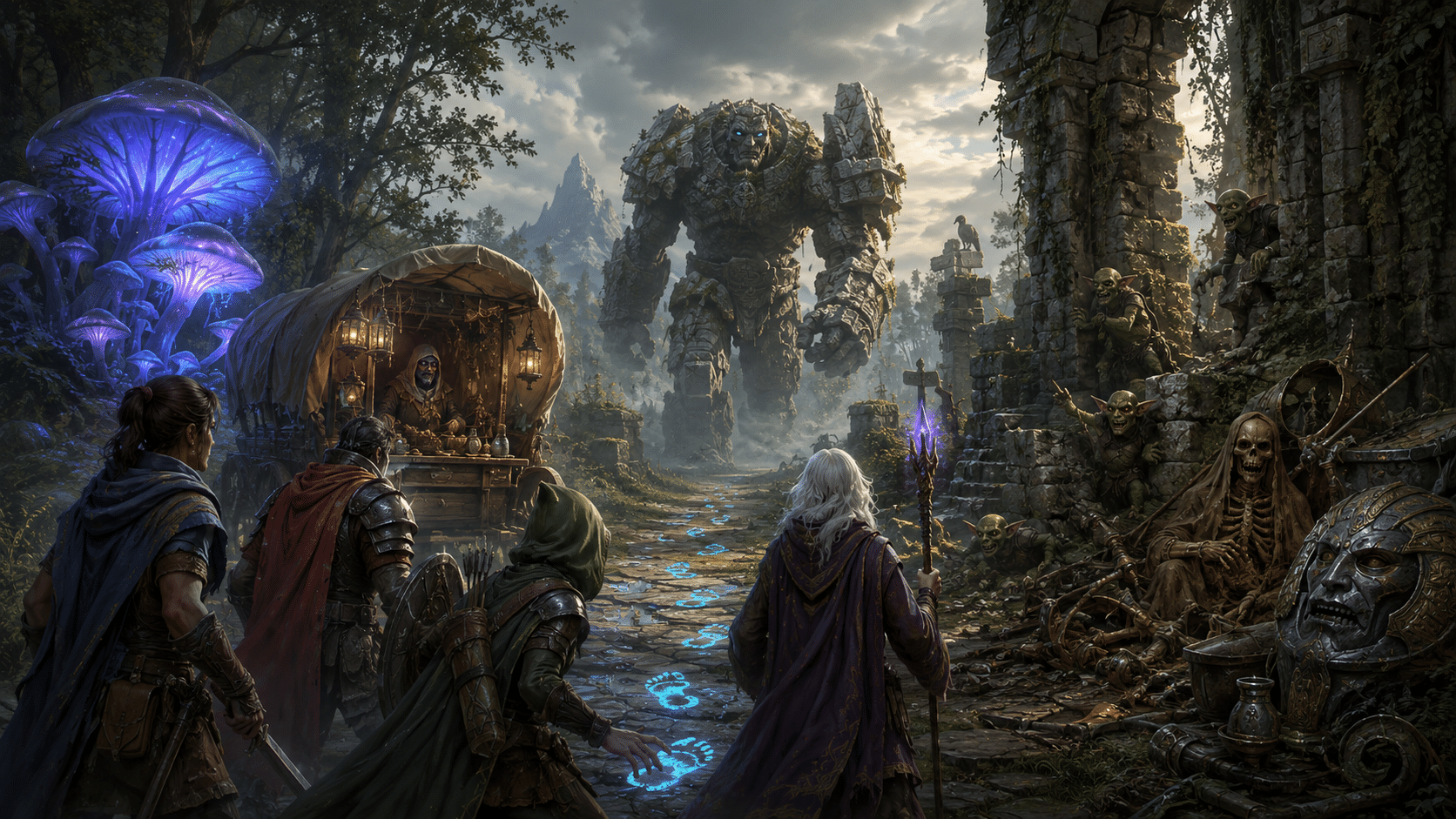
D&D random encounter tables have a tragic habit of becoming the fantasy equivalent of reheated soup: technically nourishing, spiritually suspicious, and somehow always containing wolves. The party leaves town, the GM rolls dice, and—behold—the bushes begin growling for the third time this week. At some point, the ranger stops tracking footprints and starts asking whether the entire kingdom is built on a wolf migration corridor.
The problem is not that wolves are bad. Wolves are excellent: dramatic silhouettes, teamwork, teeth, the works. The problem is repetition. If every road trip produces wolves, bandits, or the dreaded wolf-bandits—men in cloaks who howl before demanding your coin—the players stop feeling surprised and start preparing invoices for routine pest removal.
Random encounters can also become unintentionally hilarious when they arrive without context. Six goblins are eating soup in a blizzard. A bear attacks in the middle of a royal parade. A merchant appears in a dungeon selling “lightly cursed” lemons. These moments can be delightful, but if they do not connect to anything, the world begins to feel less like a living place and more like a toy chest that has been shaken violently.
Good random encounters create story momentum. They reveal the world, complicate choices, drain resources, introduce mysteries, and occasionally make players ask, “Wait, is the mushroom negotiating?” That is the dream: not another speed bump with hit points, but a strange little door opening in the road.
- Why Random Encounters Deserve Better Than Filler
- The Core Ingredients of a Good Random Encounter Table
- Replacing “1d6 Wolves” With Encounter Categories
- Building Tables Around Location Flavor
- The Combat Encounter That Isn’t Just a Bag of Teeth
- Noncombat Encounters That Still Make Players Sweat
- Weird Encounters: The Secret Sauce of Memorable Tables
- Faction-Based Random Encounters
- Scaling Random Encounters Without Making Everything Level-Appropriate Mush
- Consequences: Making Random Encounters Matter Later
- Sample Random Encounter Table Formats
- Final Thoughts on Random Encounters That Aren’t Just Wolves Again
Why Random Encounters Deserve Better Than Filler
Random encounters should not exist merely because the party walked six miles and the forest got bored. They can serve narrative purposes: hinting at the villain’s influence, showing the aftermath of war, introducing a future ally, or revealing that the local baron’s “peaceful reforms” involve suspiciously many gallows.
They can also serve mechanical purposes without feeling like chores. A storm may force resource decisions. A collapsed bridge may test problem-solving. A wandering patrol may pressure the party to hide, bluff, bribe, or fight. Even combat can be meaningful if it changes the group’s situation beyond “you now own twelve goblin socks.”
Try my AI Tabletop RPG generators...and an extensive library of content!
Atmosphere matters too. Random encounters are one of the best tools for making a setting feel alive. A haunted moor should interrupt travel differently than a wealthy trade road. One offers singing corpses in the fog; the other offers toll collectors, gossiping merchants, and a cheese cart guarded like a holy relic.
Treat random encounters as tiny adventure seeds. Some will bloom immediately. Others will lie in the dirt until three sessions later, when the players suddenly remember the one-eyed crow that stole their map and realize it was working for someone.
They are not filler. They are seasoning. Use too little, and travel is bland. Use too much, and the campaign tastes like oregano and panic. But used well, random encounters make the road feel like part of the story rather than the loading screen between dungeons.
The Core Ingredients of a Good Random Encounter Table
A useful random encounter table needs variety. If every result is “creature attacks,” the table is not a table; it is a meat grinder with numbered settings. Mix combat, social scenes, discoveries, hazards, omens, opportunities, and weirdness. Players should not know whether a roll means danger, treasure, gossip, or a goat wearing a crown.
⚔️ Fantasy RPG Random Tables Books
Make life as a Gamemaster easier…
If you play Dungeons & Dragons, Pathfinder, or other fantasy RPGs, this
RPG random tables series
is packed with encounters, NPCs, treasure, and more. Available in eBook or print—either way, you’ll have a wealth of adventure ideas at your fingertips.



Tone is equally important. A grim survival campaign may want hunger, disease, desperate refugees, and distant drums. A whimsical fairy-road campaign may want offended flowers, riddling bridges, and aristocratic frogs with tax disputes. The table should reinforce the campaign’s mood, not smash into it wearing tap shoes unless tap shoes are the point.
Stakes and choice are the engine. An encounter becomes interesting when players can decide what to do and when the outcome matters. Not every encounter needs combat, treasure, or a suspiciously convenient corpse clutching a map. Sometimes the best encounter is a closed door, a frightened witness, or a merchant who knows too much and charges extra for nouns.
Core ingredients that make a random encounter table more interesting include:
- Mystery: Something unexplained invites investigation.
- Danger: A real threat, not necessarily a fair fight.
- Opportunity: The players can gain information, allies, shortcuts, or leverage.
- Humor: A ridiculous detail that does not derail the entire tone.
- Foreshadowing: Hints of future villains, disasters, or locations.
- Faction activity: Signs that groups in the world are making moves.
- Environmental pressure: Weather, terrain, hunger, exhaustion, or time.
- Weird NPCs: Memorable travelers, hermits, merchants, prophets, or fools.
- Meaningful choices: Multiple possible responses with different outcomes.
- Consequences: The result can echo later.
- Location relevance: The encounter belongs to the region.
- Resource tension: It affects supplies, spells, mounts, maps, or morale.
- Moral dilemma: The “right” answer is inconvenient.
- Clues and rumors: Useful information wrapped in personality.
- Escalation: The encounter can grow if ignored or mishandled.
- Player hooks: Something tied to backstories, goals, debts, or enemies.
The best encounter tables feel like they belong to the world. They smell like the local swamp, argue with the local politics, and track mud from the local haunted battlefield onto the party’s boots.
They should not feel like they escaped from a generic fantasy vending machine. “One owlbear, lightly used” is fine occasionally, but a table full of disconnected monsters starts to feel like the GM is shaking a bag labeled CONTENT until something bites.
Replacing “1d6 Wolves” With Encounter Categories
Instead of organizing encounters only by monster type, organize them by purpose. Categories help you decide what kind of scene the road needs: social tension, environmental trouble, strange discovery, faction movement, omen, merchant, consequence, or magical nonsense with excellent cheekbones.
This approach prevents the dreaded “combat again?” spiral. A roll might produce a traveling judge, a bridge washed out by unnatural rain, a wounded cultist begging for help, or a field where every scarecrow points toward the same hill. The question becomes not “what attacks?” but “what changes?”
| Encounter Category | What It Accomplishes | Example Prompt |
|---|---|---|
| Social Encounter | Introduces NPCs, rumors, or choices | A nervous wedding party asks for an armed escort through “perfectly safe” woods. |
| Environmental Hazard | Challenges travel and resources | A sudden sinkhole opens beneath the lead wagon. Something breathes below. |
| Discovery | Rewards curiosity | The party finds a shrine carved into a tree that bleeds blue sap. |
| Omen | Foreshadows future events | All birds in the area fly backward at sunset. |
| Merchant or Traveler | Offers trade, news, or complications | A spice merchant sells impossible flavors and refuses payment in coin. |
| Faction Movement | Shows the world in motion | Soldiers escort prisoners wearing masks of silver wire. |
| Monster Encounter | Creates danger or negotiation | A wounded troll blocks the road, begging for a surgeon. |
| Consequence | Recalls past player actions | A bandit spared months ago now leads a toll gang “in their honor.” |
| Moral Dilemma | Tests values | Refugees carry plague symptoms but claim the cure is across the border. |
| Strange Phenomenon | Adds wonder or unease | Rain falls upward around an abandoned chapel. |
| Resource Pressure | Drains supplies or forces decisions | A swarm of silver moths eats paper, including maps and spell scrolls. |
| Comedy Complication | Lightens tone while still mattering | A noble’s escaped peacock has swallowed a signet ring and developed opinions. |
Categories give the GM a clearer purpose behind each roll. You are not just consulting the Dice Oracle to see which animal is angry today; you are choosing a kind of pressure.
They also help prevent repetition. Wolves can still appear, but now they might be starving because the local necromancer frightened away all the deer, or guarding a child they adopted, or being followed by something that scares even wolves—which, frankly, is rude.
Building Tables Around Location Flavor
Random encounters should reflect the environment. A haunted forest should not feel like a sunny trade road, unless the sunny trade road is haunted, in which case the tourism board has some explaining to do. Terrain, climate, culture, history, and magical weirdness should all shape what the party meets.
A desert table should include thirst, mirages, caravans, buried ruins, sun-maddened prophets, and creatures adapted to heat. A coastal table should include storms, smugglers, tide pools, wreckage, gulls with criminal intent, and things the sea politely returned because even the sea has standards.
Local history matters too. A battlefield may produce scavengers, ghosts, rusting weapons, veteran pilgrims, and flowers that grow only where heroes died. A region ruled by a paranoid duke may produce patrols, informants, wanted posters, and peasants who lower their voices when discussing turnips.
⚔️ Fantasy RPG Random Tables Books
Make life as a Gamemaster easier…
If you play Dungeons & Dragons, Pathfinder, or other fantasy RPGs, this
RPG random tables series
is packed with encounters, NPCs, treasure, and more. Available in eBook or print—either way, you’ll have a wealth of adventure ideas at your fingertips.
| Location | Encounter Tone | Possible Noncombat Encounters | Possible Combat Encounters |
|---|---|---|---|
| Haunted Forest | Eerie, watchful, dreamlike | Trees whisper the party’s names in the voices of dead relatives. | Spectral hounds defend an invisible boundary. |
| Sunny Trade Road | Busy, social, opportunistic | A merchant caravan hosts a roadside auction of dubious antiques. | Highway robbers disguised as tax officials. |
| Frozen Pass | Harsh, desperate, isolated | A frozen pilgrim still speaks when thawed near a fire. | Ice mephits trigger an avalanche for fun and snacks. |
| Ash Wasteland | Bleak, apocalyptic, strange | A glass statue field hums before storms. | Fire-scarred raiders hunt for water and metal. |
| River Delta | Murky, political, alive | Fisherfolk argue over a shrine that moved downstream. | Crocodile cultists ambush from reed boats. |
| Ancient Battlefield | Somber, haunted, tense | A veteran searches for a sword he buried with his brother. | Bone soldiers reenact the same doomed charge. |
| Fey Meadow | Whimsical, dangerous, polite | A rabbit barrister offers terrible legal advice. | Duelists made of thorns enforce forgotten etiquette. |
| Mountain Monastery Road | Quiet, sacred, testing | Monks ask travelers to carry a sealed bell uphill. | Stone gargoyles attack those who lie near the shrine. |
| Swamp Kingdom | Gross, mystical, suspicious | A bog witch sells memories in corked bottles. | Giant leeches attack during a diplomatic canoe race. |
| Ruined Imperial Highway | Grand, decayed, ominous | A mile marker predicts destinations not yet built. | Armored constructs demand travel permits from a dead empire. |
Distinct regions deserve distinct nonsense. If the party can tell where they are by the kind of problem interrupting breakfast, you are doing it right.
The haunted forest gets mournful singing and antlers nailed to doors. The trade road gets gossip, commerce, and bandits with branding strategies. The swamp gets frogs judging your moral character. Everyone gets ambiance.
The Combat Encounter That Isn’t Just a Bag of Teeth
Combat encounters become memorable when they involve more than two sides standing in a polite murder rectangle. Give the fight an objective: protect the bridge, stop the ritual, rescue the guide, escape the collapsing tunnel, grab the stolen relic before the goblin in the fancy hat does.
Terrain can transform a routine fight into chaos with purpose. A battle on a rope bridge, in waist-deep snow, during a sandstorm, beside a burning wagon, or inside a room slowly filling with bees is immediately more interesting. Especially the bees. Bees are nature’s initiative tracker.
Enemy behavior matters. Monsters may ambush, defend territory, mistake the party for enemies, flee from something worse, or want something specific. Bandits might only want the noble’s signet. A manticore may be protecting its cub. A skeleton may be following outdated orders and can be defeated with paperwork.
Ways to make combat encounters more dynamic include:
- Add changing terrain, such as rising water, spreading fire, or crumbling stone.
- Introduce a time limit, like a closing portal or approaching patrol.
- Include third parties with their own goals.
- Use unstable magic that alters spells or gravity.
- Place innocent bystanders in danger.
- Add weather effects, such as fog, lightning, hail, or choking dust.
- Create moral complications, such as enemies under coercion.
- Give enemies goals other than murder, such as theft, delay, capture, or escape.
- Include hazardous objects, like alchemical barrels or cursed idols.
- Make the battlefield vertical, with ledges, rooftops, trees, or cliffs.
- Add moving elements, such as carts, boats, elevators, or stampeding animals.
- Create limited visibility with darkness, smoke, snow, or illusions.
- Let enemies retreat intelligently and return later.
- Include mistaken identity that can be resolved mid-fight.
- Make monsters flee from something worse entering the scene.
- Add noncombat objectives, like closing a gate or calming a panicked horse.
- Use environmental rewards, such as dropping a chandelier or cutting a rope.
- Let negotiation remain possible even after initiative begins.
“Fight until everyone falls over” is only one flavor of combat. It is technically edible, but so is unseasoned porridge.
Frankly, it tastes like cardboard. Add spice. Add stakes. Add a goblin trying to repossess the party’s wagon because of a forged lien. Now we are cooking.
Noncombat Encounters That Still Make Players Sweat
Noncombat does not mean harmless. A lost pilgrim can be carrying a plague, a prophecy, or a map that three factions want. A cursed landmark can demand memories instead of blood. A suspicious merchant can sell exactly what the party needs at a price that causes ethical indigestion.
These encounters create tension through uncertainty. The players do not know whether the arguing spirits are dangerous, tragic, annoying, or all three. They do not know whether the talking fox offering legal advice is a fey prince, a scam artist, or genuinely a licensed attorney in seven invisible courts.
Magical weather is a particularly delicious menace. Rain that reveals invisible ink. Snow that falls warm and smells of roses. Fog that repeats conversations from yesterday. A rainbow that points directly at whoever in the party has lied most recently. No initiative required, but everyone is suddenly sweating.
Travelers carrying dangerous secrets are also excellent. A mute courier with a sealed box. A child who knows the villain’s true name. A priest fleeing their own miracle. A cheerful bard whose song causes listeners to dream of the same locked tower. Nobody has drawn a sword, yet the table is leaning forward.
Noncombat random encounter ideas:
- Lost pilgrims ask for directions to a temple that burned down centuries ago.
- A cursed milestone changes the distance to match the traveler’s regrets.
- A merchant sells bottled storms and insists one is “housebroken.”
- Two ghosts argue over who haunted a bridge first.
- A talking badger offers legal advice that is technically accurate in fey court only.
- A caravan of refugees hides a disguised noble.
- A weathered knight challenges the party to judge their final confession.
- A field of flowers turns toward the character with the darkest secret.
- A child sells hand-drawn maps of places the party has not visited yet.
- A donkey refuses to move because it can see “the tall man with no face.”
- A shrine grants blessings only to those who apologize sincerely.
- A traveling chef seeks rare monster ingredients and has terrifying enthusiasm.
- A river sings rumors in exchange for shiny objects.
- A masked doctor offers free healing but collects names for later.
- A flock of ravens rearranges dropped items into warning symbols.
- A bridge keeper asks riddles but desperately wants someone to ask how he is doing.
- A broken wagon contains harmless puppets that whisper at midnight.
- A noble’s messenger begs the party to destroy the letter they are carrying.
- A roadside inn appears only during thunderstorms.
- A well reflects not faces, but future injuries.
Noncombat encounters reveal character values. Do the players help strangers when no reward is obvious? Do they respect local customs? Do they trust the mushroom solicitor? These are important questions for any heroic career.
They also build the world without requiring a wolf pelt economy. Not every memorable story begins with initiative. Sometimes it begins with, “The scarecrow bows.”
Weird Encounters: The Secret Sauce of Memorable Tables
Weird encounters make the world feel wondrous. They remind players that fantasy is not just medieval errands plus lizards. A road where shadows point the wrong way or a lake that reflects a different sky can linger in memory longer than twelve perfectly balanced ambushes.
The trick is to use weirdness carefully. If every encounter is a haunted circus inside a soup bowl, eventually the players stop asking questions and start carrying spoons. Weirdness works best when it has emotional weight, thematic relevance, or practical consequences.
Try my AI Tabletop RPG generators...and an extensive library of content!
A strange encounter does not always need an immediate explanation. In fact, mystery is part of the flavor. But it should feel like it could have an explanation. “The moon is humming because ancient giants buried a bell beneath the hills” is intriguing. “The moon is humming because lol random” is just cosmic indigestion.
| Weird Encounter Concept | Possible Explanation | Ways Players Might Interact |
|---|---|---|
| A mushroom negotiates tolls in legal language. | It is the mouthpiece of a buried mycelium court. | Bargain, insult it, hire it, or accidentally enter a contract. |
| A flock of glass birds circles silently overhead. | They are spies from an old wizard academy. | Capture one, follow them, or send a message back. |
| A door stands alone in a field, knocking from both sides. | It connects to a trapped pocket dimension. | Open it, speak through it, ward it, or sell tickets unwisely. |
| Rain falls upward over a hilltop. | Gravity is broken by a buried star fragment. | Harvest strange water or investigate the crater. |
| A scarecrow predicts breakfast accurately. | It contains the soul of a bored oracle. | Ask questions, free it, or bring it jam. |
| Everyone’s shadow briefly walks away. | A shadow-market is collecting samples. | Chase shadows, negotiate, or notice who has no shadow afterward. |
| A river flows with ink for one hour. | A god is writing a letter through the land. | Read it, bottle it, or change the message. |
| A stone giant sleeps beneath the road and snores fog. | The “hill” is alive. | Sneak past, wake it, cure it, or build a detour. |
| A moonlit banquet appears with no guests. | Fey hospitality trap or ghostly anniversary. | Eat, refuse, toast the absent host, or investigate place cards. |
| A horse speaks only in prophecy and insults. | It drank from a sacred spring. | Buy it, question it, or endure its commentary. |
| A tower appears farther away the closer one walks. | It exists in folded space. | Approach indirectly, mark distance, or use magic. |
| Bells ring underground whenever someone lies. | A buried temple judges speech. | Test truths, expose secrets, or silence the bells. |
Let strange encounters raise questions. Who made this? Why here? Why now? Why does the mushroom have better contract law than the party wizard?
Let them spark investigation. A one-off oddity can become a side quest, a clue, a recurring omen, or a cult’s calling card. Players love discovering that the nonsense had structure all along.
And let weirdness become a motif. The glass birds return before assassinations. The upward rain marks places where reality is thin. The talking horse becomes a beloved menace. Congratulations: your random table has grown legs and is now demanding oats.
Faction-Based Random Encounters
Factions transform random encounters into living-world storytelling. Instead of “some people happen to be here,” the party meets organizations pursuing goals. Patrols patrol. Spies spy. Recruiters recruit. Smugglers smuggle. Tax collectors collect taxes, because some monsters wear hats and carry ledgers.
These encounters show that the world continues while the party is busy arguing over rope. A cult procession on the road suggests religious influence. Refugees reveal instability. Rival adventuring parties imply competition. A military checkpoint suggests fear, control, or war.
Faction encounters also create choices. Help the rebels or report them? Bribe the inspector or submit to a search? Protect the smugglers because they are moving medicine, or stop them because they are also moving cursed knives labeled Definitely Not Cursed Knives?
| Faction Type | Encounter Example | What It Reveals | Possible Player Consequences |
|---|---|---|---|
| Royal Patrol | Soldiers inspect travelers for forbidden relics. | The crown fears magical rebellion. | Compliance earns safe passage; resistance creates warrants. |
| Thieves’ Guild | Smugglers hide goods in a funeral procession. | Crime networks exploit local customs. | Aid gains contacts; exposure earns enemies. |
| Religious Cult | Masked pilgrims chant beside a dry riverbed. | The cult is growing openly. | Investigation may reveal a ritual site. |
| Rebel Cell | Wounded rebels beg for shelter. | The region is unstable. | Helping them risks treason charges. |
| Merchant Consortium | Armed factors enforce debt claims on villages. | Trade power rivals noble power. | Players can mediate, fight, or become indebted. |
| Rival Adventurers | A flashy party claims the same bounty. | The world has other heroes, sadly with better branding. | Competition, alliance, sabotage, or public embarrassment. |
| Wizard College | Apprentices chase an escaped experiment. | Arcane institutions are reckless. | Assistance earns favors or magical liability. |
| Refugee Caravan | Families flee a border fort. | War or monsters are spreading. | Escorting them costs time but earns loyalty. |
| Tax Office | Officials demand back taxes on treasure found underground. | Bureaucracy survives every apocalypse. | Payment avoids trouble; refusal creates legal comedy. |
| Monster Clan | Goblin envoys carry a peace banner upside down. | “Monsters” have politics too. | Diplomacy may prevent future raids. |
Faction encounters make the world feel politically alive. They let players see pressure building before a war, coup, crusade, or trade collapse arrives wearing dramatic music.
They also connect random rolls to larger campaign events. A single patrol today can become a trial tomorrow, a prison break next month, and a national incident after the bard writes a song about it.
Scaling Random Encounters Without Making Everything Level-Appropriate Mush
Not every encounter must be perfectly balanced to the party’s level. A dangerous world is more exciting when the players can stumble upon things they should not stab immediately. The trick is fairness: telegraph danger, offer escape routes, and make sure “we run away” is a valid strategy rather than a personal insult to the GM’s monster voice.
⚔️ Fantasy RPG Random Tables Books
Make life as a Gamemaster easier…
If you play Dungeons & Dragons, Pathfinder, or other fantasy RPGs, this
RPG random tables series
is packed with encounters, NPCs, treasure, and more. Available in eBook or print—either way, you’ll have a wealth of adventure ideas at your fingertips.
Scaling does not always mean changing stats. Scale stakes instead. Low-level characters might encounter an ancient dragon as a distant silhouette demanding tribute from a town, not as a fight. High-level characters might face wolves, yes, but perhaps the wolves are diseased, magically coordinated, or politically protected by a druidic treaty with very sharp clauses.
Techniques for scaling encounters while preserving danger and agency:
- Telegraph threat level through tracks, corpses, rumors, weather changes, or NPC fear.
- Provide clear escape routes before combat begins.
- Allow negotiation, bribery, deception, or surrender.
- Scale objectives, not just enemy numbers.
- Use partial encounters, such as seeing the monster at a distance.
- Introduce warnings from locals or environmental clues.
- Let players avoid encounters with smart planning.
- Offer nonlethal stakes, like lost gear, delays, debts, or reputation damage.
- Give powerful foes reasons not to kill the party immediately.
- Make weaker foes dangerous through terrain, traps, or numbers.
- Use morale rules so enemies flee or bargain.
- Adjust reinforcements based on noise, time, or choices.
- Let consequences scale: a minor failure may create future trouble.
- Provide tools in the environment to even the odds.
- Use reaction rolls so not every creature attacks.
- Make the encounter’s danger discoverable before commitment.
“Balanced” does not always mean “safe.” Sometimes balanced means the players had enough information to make a clever decision and chose to poke the glowing skull anyway.
And “dangerous” does not mean “rocks fall, everyone updates their character sheet.” Danger is best when players can see it, respect it, and then make beautifully terrible plans around it.
Consequences: Making Random Encounters Matter Later
Random encounters become powerful when they echo through the campaign. The merchant saved from goblins returns with rare supplies. The bandit spared on the road becomes a reluctant informant. The ghost ignored at the crossroads starts appearing in mirrors, which is less helpful but very atmospheric.
Consequences do not need to be huge. A rumor spreads. A village remembers. A monster migrates after the party burns its lair. A noble hears they were rude to his cousin’s tax collector. Small choices create texture, and sometimes texture grows fangs.
Recurring NPCs are especially valuable. Players adore familiar weirdos. The mushroom lawyer, the unlucky courier, the rival adventuring party, the smug bard, the goat that may be a saint—bring them back. The table will react like an old friend has entered, even if that friend once sold them cursed beans.
Ways random encounters can create future consequences or callbacks:
- A rescued NPC returns with aid, information, or complications.
- A spared enemy becomes a rival, ally, or informant.
- A monster displaced by the party attacks nearby settlements.
- Rumors exaggerate the party’s actions hilariously.
- A faction rewards or punishes the party later.
- A wounded creature seeks revenge or protection.
- A strange omen repeats before major events.
- Local prices change because of disrupted trade.
- A moral choice affects reputation among commoners.
- An item found randomly becomes important later.
- A neglected threat escalates into a larger problem.
- A joke NPC becomes a beloved recurring figure.
- A road becomes safer or more dangerous due to party choices.
- An insulted noble, spirit, or goblin poet remembers.
- A rescued animal follows the party and causes logistical chaos.
- A discovered location becomes a future dungeon, shrine, or safe house.
- A witness retells the encounter inaccurately in taverns.
Keep notes on random encounters. Nothing elaborate—just names, outcomes, grudges, debts, and whether anyone promised legal representation to a mushroom.
Throwaway moments often become beloved recurring disasters. The players may forget your carefully crafted dynastic history, but they will remember the goose that stole the paladin’s holy symbol and made eye contact while doing it.
Sample Random Encounter Table Formats
Different campaigns need different table formats. A simple d20 table works beautifully for quick travel, while nested tables provide layered results like “who,” “what,” and “complication.” Weighted tables help common events feel common and rare events feel special instead of every third mile containing a comet cult.
More complex tools include escalation tables, weather-linked tables, faction clocks, and “roll twice and combine” chaos engines. These can create fantastic improvisational fuel, provided they do not bury the GM under enough paperwork to summon a bureaucratic gelatinous cube.
| Table Format | Best Use Case | Strengths | Potential Drawbacks |
|---|---|---|---|
| Simple d20 Table | Fast travel or light prep | Quick, easy, reliable | Can become repetitive if not refreshed |
| d100 Table | Large regions or sandbox play | Lots of variety | Harder to improvise every result |
| Nested Tables | Complex encounters | Creates layered scenes | More rolling and interpretation |
| Weighted Table | Realistic frequency | Common things stay common | Rare results may never appear |
| Escalation Table | Dangerous journeys | Builds tension over time | Can feel punishing if overused |
| Weather-Linked Table | Survival or wilderness games | Ties encounters to atmosphere | Requires tracking weather |
| Faction Clock Table | Political campaigns | Shows organizations acting | Needs ongoing notes |
| Roll Twice and Combine | Weird, improvisational play | Produces surprising results | Can create nonsense soup |
| Terrain-Based Table | Region-focused travel | Strong location flavor | Needs separate tables per region |
| Reaction-Based Table | Social/monster uncertainty | Reduces automatic combat | Requires flexible NPC motives |
| Resource Pressure Table | Survival campaigns | Makes travel matter mechanically | Can feel harsh without rewards |
| Seasonal Table | Long campaigns | Shows time passing | Needs updates as seasons change |
Choose formats that support improvisation. A good table should hand you sparks, not a legal contract with appendices.
If the format slows the game more than it enriches it, simplify. The players do not need to watch you cross-reference “temperate hill omen subtable C” unless your campaign is about clerks fighting entropy, in which case carry on bravely.
Final Thoughts on Random Encounters That Aren’t Just Wolves Again
Random encounters are not interruptions to the adventure. They are part of the adventure. They add texture, tension, comedy, mystery, and consequence to the spaces between major scenes. The road is not empty. The road has opinions, weather, politics, ghosts, merchants, and at least one deeply suspicious goat.
Think of each random result as an opportunity to reveal the world. What do people fear here? Who holds power? What old wounds remain unhealed? What strange magic leaks through the cracks? What local problem has been waiting for armed strangers with poor impulse control?
Challenge assumptions. The monster may want help. The merchant may be dangerous. The ruins may be alive. The bandits may be starving farmers. The wolves may be innocent, although they should still stop forming committees in the moonlight.
Most of all, create moments players will quote months later. The best random encounters become campaign folklore: the toll mushroom, the upside-down rain, the rival adventurers with matching capes, the ghost who would not stop correcting everyone’s grammar.
Wolves are fine occasionally. Let wolves have their moment. They have excellent branding and very strong group choreography.
But if every road contains wolves, the kingdom does not need more adventurers. It needs wildlife management professionals, a royal fence budget, and possibly a stern conversation with whoever keeps stocking the travel tables.