
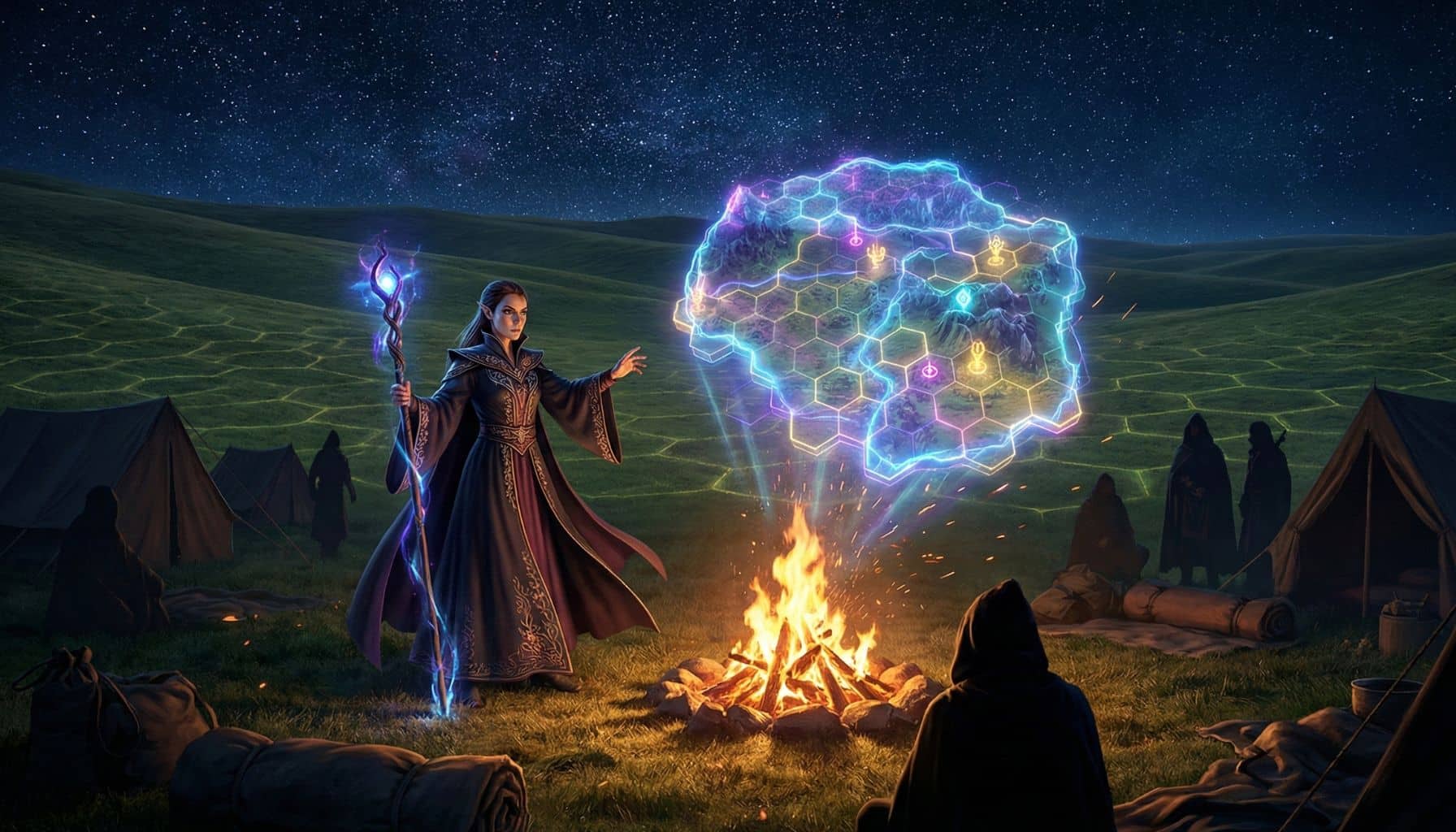
Let’s be for real… because we have all hit that wall. The party steps out of the dungeon and looks at the horizon, and suddenly you feel the panic of needing to fill all that empty space. You want the world to feel vast and dangerous, but running a traditional hexcrawl requires massive preparation and bookkeeping that can totally bog down the pacing of a narrative-focused campaign. The result is often a quick “travel montage” where exploration feels meaningless without a traditional hexcrawl to give it structure.
We can fix that disconnect right now. This guide is packed with TTRPG exploration tips designed to turn that boring travel time into a series of high-stakes gameplay decisions rather than a geography lesson. We are going to stop treating the wilderness like a math problem and start treating it like a game. You do not need a grid to make the wild feel wild when you focus on non-hexcrawl exploration that prioritizes agency and consequences over counting five-foot squares.
To make this work, you have to treat the environment as an adversary and a puzzle rather than just empty space between plot points. Most players tune out during travel because they feel like passive passengers waiting to arrive at the “real content” of the session. We need to implement techniques that put the steering wheel back in their hands. It is time to use D&D 5e exploration mechanics to make them respect the mud, fear the coming storm, and actually plan their route.
This approach delivers the fantasy of being a true pathfinder without the tedious overhead of complex hex management. By the end of this article, you will have a complete toolkit for meaningful exploration 5e players will actually seek out and enjoy. Let’s dive into how to make exploration matter in D&D and Pathfinder by focusing on the adventure instead of the spreadsheet.
- The Core Shift: Exploration Is About Decisions, Not Geography
- Stop Tracking Distance and Start Tracking Cost
- Non-Hexcrawl Structures That Still Feel Like Exploration
- Reward Exploration Without Just Adding Fights
- Time Pressure: The Engine That Makes Travel Matter
- Environment as Gameplay, Not Flavor
- Player Agency Tools That Drive Exploration
- Mechanics That Work in 5e and Pathfinder Without Hex Maps
- Common Mistakes That Make Non-Hexcrawl Exploration Fail
- Advanced Exploration Modules: Magic, Camping, and Getting Lost
- Final Thoughts: Exploration Matters When Curiosity Pays Off
The Core Shift: Exploration Is About Decisions, Not Geography
The biggest misconception in D&D wilderness exploration is that you need a detailed map for the journey to matter. Exploration becomes meaningful when players make choices that change outcomes, not when they simply move their token from point A to point B. If the party travels through the Haunted Woods and nothing happens regardless of their preparation, you are just narrating a cutscene. To fix this, you must treat exploration as problem-solving where every route and method carries a distinct weight. When you make exploration matter in D&D, you are actually presenting a series of tactical forks in the road that determine the party’s condition upon arrival.
If player choices don’t matter, no amount of beautiful cartography will save your exploration tier from feeling flat. You can describe the trees for twenty minutes, but if the players cannot interact with the setting in a way that alters the story, they will check their phones. We need to shift the focus from “where are we on the grid” to “how are we surviving this journey.” This mentality allows for exploration encounters 5e systems support well, provided you frame the stakes correctly.
Try my AI Tabletop RPG generators...and an extensive library of content!
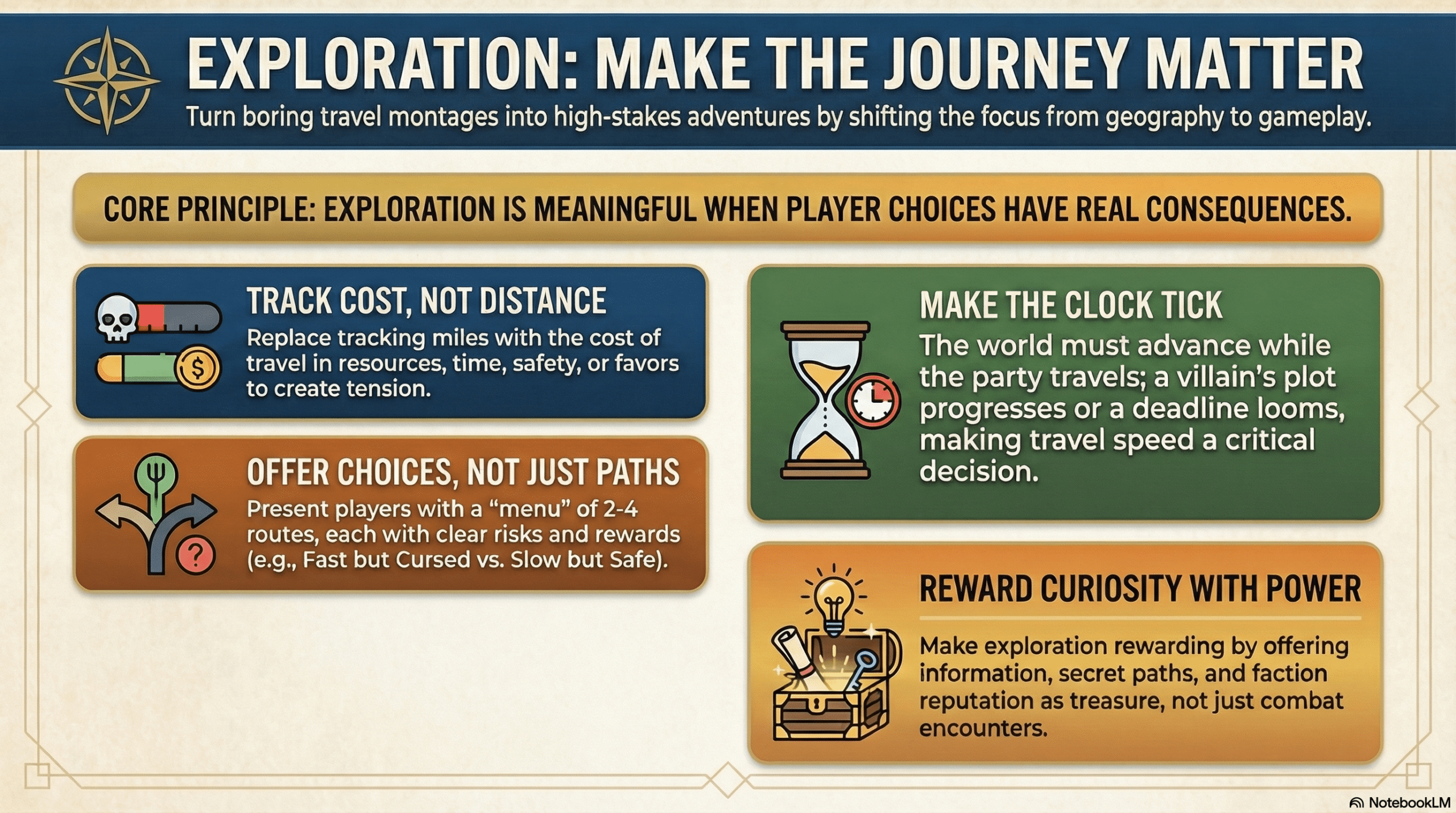
Exploration = Decisions With Consequences
We need to redefine exploration in tabletop RPGs as a chain of decisions rather than physical movement across space. Every time the players commit to a course of action in the wild, there should be a tradeoff involved that creates uncertainty. These decisions allow players to gamble their resources against their goals.
- Route Choice: Taking the high road for visibility versus the low road for cover.
- Travel Pace: Moving fast to save time versus moving slow to spot ambushes.
- Stealth vs. Speed: Utilizing Pass Without Trace slows you down but avoids patrols.
- Foraging vs. Rations: Spending time hunting saves gold but burns daylight.
- Light Discipline: Lighting a fire for warmth/morale versus cold camping to stay hidden.
- Encumbrance Management: Carrying extra water versus traveling light for better dexterity.
- Social Approach: Asking locals for directions risks exposure but grants info.
- Resting Strategy: Pushing through exhaustion versus stopping early and losing ground.
- Magical Resource Burn: Using spell slots for transport means fewer slots for combat.
- Vehicle Choice: Horses are faster but require food and attract predators.
- Scouting Splits: Sending the Rogue ahead grants intel but splits the party during danger.
Consequence is the engine of exploration because it turns a simple walk into a strategic layer of the campaign.

Stop Tracking Distance and Start Tracking Cost
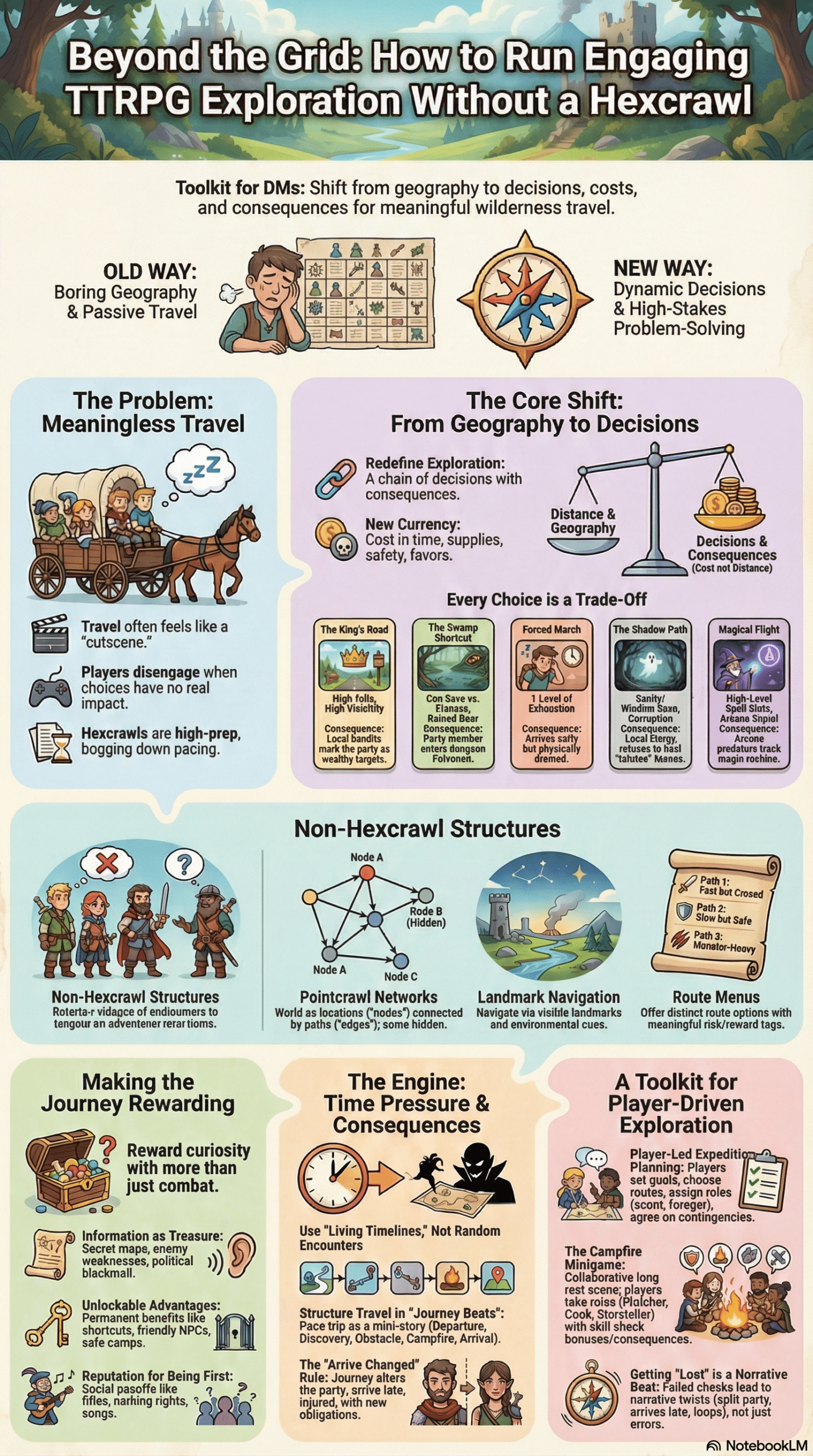
Traditional maps obsess over miles and kilometers, but in a game with magic and monsters, distance is the least interesting metric. To embrace abstract travel mechanics, you should stop asking “how far is it” and start asking “what did it cost to get there.” When you shift the conversation to resource attrition and risk, meaningful travel in TTRPGs becomes instantly accessible. Players may not care that a city is 300 miles away, but they definitely care that the journey will cost them 50% of their hit dice and a favor from a local lord. This method creates tension because every leg of the journey demands a payment.
Cost creates tension even when distance is abstract because it forces players to manage a dwindling pool of assets. If they arrive at the dungeon with zero resources, the exploration phase has successfully raised the stakes of the adventure.
Replace Distance With Consumables and Consequences
Time, safety, reputation, supplies, and favors become the real currencies of travel in this system. You need to present choices where the “payment” is clear, allowing players to decide what they are willing to lose. This creates a narrative economy where meaningful exploration 5e mechanics can support.
⚔️ Fantasy RPG Random Tables Books
Make life as a Gamemaster easier…
If you play Dungeons & Dragons, Pathfinder, or other fantasy RPGs, this
RPG random tables series
is packed with encounters, NPCs, treasure, and more. Available in eBook or print—either way, you’ll have a wealth of adventure ideas at your fingertips.




| Travel Choice | Cost Incurred | Long-Term Consequence |
|---|---|---|
| The King’s Road | High Tolls (Gold), High Visibility | Local bandits mark the party as wealthy targets. |
| The Swamp Shortcut | Con Save vs. Disease, Ruined Gear | A party member enters the dungeon Poisoned. |
| Forced March | 1 Level of Exhaustion, No Hit Die recovery | The party arrives early but physically drained. |
| The Shadow Path | Sanity/Wisdom Save, Corruption | The local clergy refuses to heal “tainted” heroes. |
| Hiring a Guide | Share of the Loot, NPC Protection | The guide spreads rumors about the party’s location. |
| Magical Flight | High-Level Spell Slots, Arcane Signal | Arcane predators track the magic residue to the camp. |
Players care when costs echo forward into the rest of the campaign because it proves that the travel segment wasn’t just filler. When the sacrifices made during exploration directly impact future encounters, resource management, or social interactions, they become integral to the story rather than background noise. This connection between exploration costs and narrative stakes reinforces the idea that every decision carries weight.
As players navigate challenges and consequences that ripple into the unfolding plot, they feel a genuine investment in their journey. This investment enhances engagement, making them eager to explore the world you’ve built, constantly wondering what rewards or repercussions await around the next bend. Ultimately, when travel is imbued with significance, it transforms into a vital chapter of their character’s story—one they’ll cherish rather than mentally gloss over.

Non-Hexcrawl Structures That Still Feel Like Exploration
You can run a robust alternative to hexcrawling by using mapless or low-map structures that still preserve discovery and agency. The goal is to create a mental model of the world that feels open without requiring you to draw every tree and hill. Non-hexcrawl exploration relies on networks of interesting nodes rather than a seamless simulation of geography. By employing structures like pointcrawls or region maps, you provide the illusion of a vast world while only prepping the interesting parts. This approach allows for worldbuilding that emphasizes content density over square footage, making each location feel significant and vibrant.
When players interact with these nodes, they encounter unique challenges or rewards that influence their journey. This structure creates a dynamic interplay between adjacent areas, with each choice reverberating through the campaign’s narrative. It’s essential to ensure that every node has distinctive features—be it a quirky town, a treacherous pass, or a legendary ruin—that ignite curiosity and invite exploration. The richer the details, the more the players will feel driven to immerse themselves in discovering what lies between these locations.
Additionally, by maintaining clear connections between nodes, you empower players to strategize their next steps. When they know that the Misty Glen connects to the Ruined Castle and the Bandit Camp, they can weigh risks, preparing themselves for whatever lies ahead. This motivates them to consider not just where to go next, but how they might approach the journey: whether to sneak through the woods or take the long road to avoid confrontations. By framing exploration this way, you turn every choice into a matter of strategic importance, reinforcing the idea that their decisions shape the adventure.
Incorporating these non-hexcrawl structures allows the players’ engagement and creativity to flourish. With well-defined nodes as focal points, they can envision their journey as a quest for knowledge and power rather than a mindless march across a grid. This cultivates a sense of agency that makes exploration a thrilling part of the game, inviting players to delve deeper into the world, embrace its mysteries, and carve their own paths through its uncharted territories.
Pointcrawl Networks With Hidden Edges
Pointcrawls organize the world into “nodes” (locations) and “edges” (paths connecting them), with some connections hidden until discovered. This is a superior method for narrative exploration design because it focuses entirely on travel choices.
- Seasonal Passes: A mountain path that is only open during summer months.
- Rumor-Only Roads: A smuggler’s trail that only appears on the map after a successful social check.
- Faction-Gated Routes: A tunnel system controlled by dwarves that requires a pass.
- One-Way Shortcuts: A river rapid that takes you downstream fast but cannot be climbed back up.
- Magical Portals: Ancient stones that connect distant nodes but require a key.
- Tidal Causeways: Paths to islands that vanish during high tide.
- Beast Migrations: A safe valley that becomes a death trap during mating season.
- Underdark Bypasses: A dangerous shortcut beneath the earth that avoids surface politics.
Discovery through learning connections makes the players feel like they are mastering the geography of the world. When they uncover hidden paths, forge alliances with local factions, or decipher ancient ruins, they don’t just traverse the landscape—they become part of it. This engagement transforms the wilderness into a symphony of interconnected stories and lessons that enrich their journey. As players learn to read the land and interact with its inhabitants, they gather invaluable insights that not only aid their immediate goals but also empower them to shape the ongoing narrative.
Each location becomes a chapter in their saga, with every interaction revealing deeper lore and potential alliances. This mastery over the world elevates their exploration from mere activity to a rewarding practice, making them feel like true navigators of adventure who can influence the fates of both themselves and the realm around them. Ultimately, this connection fosters a deeper investment in the campaign, encouraging players to seek out new challenges and stories within the vast tapestry you’ve woven, ensuring their exploration is never just a means to an end, but rather an engaging journey in itself.

Landmark Navigation Instead of Coordinates
Instead of coordinates, focus on exploration without a map by using visible landmarks, relative direction, and environmental cues. This encourages players to look at the world through their character’s eyes rather than looking at a grid on the table.
- Smoke Plumes: Indicates a settlement, camp, or disaster in a specific direction.
- River Forks: Distinctive branching water that serves as a checkpoint.
- Ruined Towers: High-elevation silhouettes that act as beacons.
- Star Positions: Using the constellation of the Hunter to find North.
- Sound Cues: The thunder of a distant waterfall or the ringing of a bell.
- Vegetation Shifts: The treeline turning from oak to pine indicating elevation.
- Weather Patterns: Clouds gathering specifically over a cursed mountain.
- Bird Flight: Flocks of scavengers circling a battlefield or carcass.
Instead of relying on precise coordinates or a grid system, immerse players in their surroundings by utilizing vivid sensory descriptions and environmental cues. This approach encourages players to engage with the narrative more actively, as they rely on their characters’ instincts and knowledge rather than a map. By describing the sounds of rustling leaves, the scent of damp earth, or the way the sunlight filters through the trees, you invite players to visualize and interact with the world around them.
⚔️ Fantasy RPG Random Tables Books
Make life as a Gamemaster easier…
If you play Dungeons & Dragons, Pathfinder, or other fantasy RPGs, this
RPG random tables series
is packed with encounters, NPCs, treasure, and more. Available in eBook or print—either way, you’ll have a wealth of adventure ideas at your fingertips.
Each landmark your players encounter can serve as a distinct point of reference, fostering a deeper connection to the terrain. When players must navigate based on these immersive elements, they become invested participants in the journey, enhancing their agency and emphasizing the importance of exploration. This method not only enriches the storytelling but also transforms the wilderness into a living, breathing entity, where every step taken is a part of their journey’s unfolding narrative.
Route Menus With Meaningful Tags
One of the best open world D&D tips is to offer players a “menu” of 2–4 route options labeled by risk and reward. This gamifies the travel planning phase and makes the trade-offs explicit.
- Fast but Cursed: Saves 2 days, roll on the Madness table.
- Slow but Safe: Takes 5 days, negligible combat risk.
- Politically Dangerous: Passes through enemy territory, requires disguise.
- Monster-Heavy: High XP potential, high resource drain.
- Toll-Controlled: Costs gold, safe from monsters but not tax collectors.
- Stealth-Required: Requires constant checks, failure leads to capture.
- Resource-Barren: No foraging possible, must carry all food.
- The Unknown: High chance of discovery, high chance of getting lost.
- The Escort Route: Protect a caravan for slow travel but earns gold.
- The Magic Zone: Wild magic surges occur, travel is unpredictable.
By offering players a menu of route options, you’re not just facilitating travel; you’re transforming it into a strategic decision-making process. This empowers players to select their challenges, whether that’s navigating through a dangerous beast-infested area, braving treacherous terrain, or opting for a longer but safer path. Each choice should be clearly marked with its associated risks and potential rewards, creating an engaging gameplay loop where players weigh their options and make informed decisions. This method fosters a sense of ownership over their journey, as they actively decide the kind of trouble they want to face, ensuring that every leg of the journey feels impactful and rich with narrative potential. Turning travel into strategy ignites player engagement, making exploration not just a means to an end, but an adventure in itself where every choice reverberates through the unfolding story.

Reward Exploration Without Just Adding Fights
If the only thing players find in the woods is combat, exploration feels like a punishment rather than an opportunity. This common pitfall can sap enthusiasm and make the wilderness seem like a relentless gauntlet rather than a realm ripe for discovery. To counteract this, it’s essential that exploration yields rewards that resonate with the players’ broader goals. Fostering a sense of achievement hinges on the understanding that successful exploration should empower players, offering tools and advantages that enhance their capacities in combat, social interactions, or strategic planning.
Establishing meaningful exploration rewards means incentivizing players to venture into the unknown rather than maintaining a narrow focus on battle. Whether it’s uncovering hidden pathways that allow quicker travel or discovering ancient relics that grant powerful boons, these rewards should connect to the other pillars of play. Exploration should not merely deplete resources; it should replenish them, creating a cycle of investment and return that encourages players to dive deeper into the narrative and world.
When players uncover secrets or gain leverage over future encounters, they sense a mastery over their environment that enriches their overall experience. This mastery transforms the challenge of exploration into a rewarding journey, compelling players to make thoughtful decisions that could alter the course of their adventure. By framing exploration this way, DMs can shift the narrative from a grind of combat encounters to a tapestry of discovery and opportunity.
Information as Treasure
Information is often more valuable than gold in exploration stories, so reward curiosity with maps, passwords, schedules, and weaknesses. This leans into discovery-based progression where knowledge equates to power.
- Secret Maps: Reveals hidden nodes in the pointcrawl.
- Gate Passwords: Allows safe passage through faction territory.
- Patrol Schedules: Lets the party bypass a difficult combat encounter.
- Monster Lair Locations: Allows for preemptive strikes or avoidance.
- Herb Locations: Unlocks crafting ingredients for potions.
- Shortcut Keys: Physical keys to ancient gates.
- Local History: Grants advantage on social checks with area spirits.
- Enemy Weaknesses: Reveals a vulnerability of the upcoming boss.
- Resource Caches: Hidden stashes of food or clean water.
- Safe House Locations: A secure place to take a Long Rest.
- Political Dirt: Information that can be used to blackmail a local lord.
- Legend Lore: The true name of a demon or location.
Compounding value over gold ensures that exploration feeds directly back into the main plot. When players uncover treasures that resonate with the narrative—be it a long-lost artifact tied to a personal story, a map leading to ancient ruins, or a local legend that hides secrets—the significance of their journey multiplies beyond mere monetary gain.
This approach nurtures a deeper connection between their exploration and the unfolding story, making their findings integral to the campaign’s progression. As players see how their discoveries drive the plot forward, they become more invested, transforming exploration into an essential thread woven into the fabric of the adventure. Each successful foray into the unknown then feels like a crucial step not only in their characters’ growth but also in the larger narrative arc, reinforcing the idea that every choice and every field of discovery counts towards creating a rich and rewarding experience.
Unlockable Exploration Advantages
Give your players durable benefits gained through discovery that make future travel easier or safer. This makes the world feel like a metroidvania game where unlocking new abilities opens new paths.
- Permanent Shortcuts: Clearing a rockfall opens a direct trade route.
- Ferry Access: Befriending a boatman grants free river travel.
- Safe Camps: Establishing a permanent base that allows for downtime.
- Weather Lore: Ability to predict storms allows for better preparation.
- Guide Loyalty: An NPC who will now travel for free.
- Beast Taming: Gaining a mount that ignores difficult terrain.
- Climbing Gear: Finding permanent pitons on a cliff face.
- Reputation Markers: A badge that wards off low-level bandits.
- Sanctified Ground: A roadside shrine that cures disease.
- Smuggler Tunnels: Keys to a subterranean network.
Exploration as progress gives players a sense of ownership over the map they are traversing. When players uncover new locations, they aren’t just filling in spaces on a grid; they are etching their marks into the fabric of the world. Each discovery transforms the players from mere travelers into pioneers, forging a connection that makes the wilderness feel like a reflection of their choices and actions.
This sense of agency and direction instills a deeper investment in the narrative, encouraging players to explore more fully and strategically, knowing that their efforts shape the landscape of their adventure. By taking ownership of the map, they become true navigators, with every step taken adding to their legacy within the campaign.
Reputation for Being First
Tap into the human desire for recognition by offering first-contact and first-mapping rewards. This fits perfectly into exploration story hooks where the players are pioneers.
- Naming Rights: Players get to name the valley or mountain on the map.
- Explorer Titles: “Pathfinder” or “Trailblazer” honorifics from the crown.
- Cartography Contracts: Selling the map they made for massive gold.
- Faction Access: The Explorers’ Guild opens its library to them.
- Trade Route Rights: A percentage of taxes from a new road they opened.
- Legal Exceptions: Immunity to certain local trespassing laws.
- Bardic Tales: Songs are written about their journey, increasing fame.
- Statues: A marker erected at the point of discovery.
Social payoff makes the solitary act of exploration matter when they return to civilization.

Time Pressure: The Engine That Makes Travel Matter
Time is the most important resource in exploration, yet it is often the one that even experienced DMs overlook the most. Travel fatigue mechanics and narrative tension only pack their punch when the clock is ticking. If players feel they can take three weeks to walk ten miles, they’ll arrive perfectly rested… but also bored and disengaged. To counteract this, you must utilize the wilderness as a key piece of narrative space where time carries a cost.
Try my AI Tabletop RPG generators...and an extensive library of content!
As your players journey through the wilds, the villain’s plot should advance, the victim should edge closer to their demise, or the weather must worsen with each passing day. This time pressure ensures players cannot simply skip over travel; it forces them to optimize their routes and consider their decisions carefully, turning what might have been a meandering trek into a strategic endeavor.
When time becomes an integral part of exploration, every choice is imbued with urgency, enhancing the stakes and the players’ investment in the unfolding story. This dynamic elevates travel from a dull segment of the game into a captivating adventure that resonates with tension and excitement, compelling players to engage actively with the world you’ve crafted.
Living Timelines Instead of Random Encounters
Use “Living Timelines” or “Fronts” that advance when players travel, making the world move regardless of their presence. This is far more effective than random encounters at creating a dynamic world.
- Invasions: An enemy army marches closer to the capital each day.
- Rituals: The cult needs 3 days to summon the demon; travel takes 2.
- Market Shifts: Prices for grain skyrocket as winter approaches.
- NPC Relocation: The quest giver moves to a new town if you take too long.
- Seasonal Changes: The river freezes over, changing available routes.
- Plague Spread: The infection zone expands by 1 mile per day.
- Political Coups: The king is assassinated while the party is in the woods.
- Resource Decay: The magical fruit rots if not delivered in 48 hours.
- Rival Parties: Another group grabs the loot if they beat you there.
- Weather Fronts: A hurricane makes landfall in 1d4 days.
The world moves with the party, making their travel speed a critical tactical decision.
Journey Beats (3–5 Scenes Per Trip)
Structure travel as a sequence of cinematic scenes instead of a series of perception rolls. A standard “5-beat journey” ensures narrative pacing without the slog. Each leg of the journey should consist of distinct beats that highlight pivotal moments, obstacles, or discoveries. For example, you might begin with the group’s preparations as they set out, followed by an unexpected encounter, a moment of reflection where they share stories or plan ahead, a challenge that requires teamwork to overcome, and finally, the arrival at their destination. This framework helps maintain energy and engagement, turning what could be monotonous travel into a series of impactful interactions that keep players invested in the journey. By framing exploration in this cinematic manner, players are more likely to feel like active participants in shaping the narrative rather than mere spectators waiting for the next plot point.
- Beat 1: The Departure: A social encounter at the gate or a final gear check.
- Beat 2: The Discovery: Finding something interesting (ruin, view, oddity).
- Beat 3: The Obstacle: A terrain or combat challenge that drains resources.
- Beat 4: The Campfire: A roleplay moment where characters discuss the journey.
- Beat 5: The Arrival: The transition into the destination zone.
Cinematic pacing keeps the energy high and ensures every travel segment tells a mini-story.

The “Arrive Changed” Rule
Every journey must alter something about the characters or their situation. If they arrive exactly as they left, the travel was wasted time. Exploration should not be a static experience where players merely traverse from one point to another without consequence. Instead, each leg of the journey should echo with the impact of their choices, enhancing their identities and relationships along the way.
This transformation can manifest in many forms: scars from battles faced, bonds strengthened through shared adversity, or new insights gained from the heart of the wild. By ensuring that travel leaves a tangible mark on the characters, you create a narrative where exploration acts as a catalyst for character growth and story advancement. This focus on change not only elevates the journey’s significance but also makes each moment in the wilderness pulse with potential, compelling players to fully immerse themselves in the adventure that lies ahead.
- Lost Time: They arrive late, and the situation has deteriorated.
- Injuries: They start the dungeon with missing Hit Dice.
- New Obligations: They owe a favor to a creature they met on the road.
- Altered Reputation: They arrive covered in mud and blood, scaring the locals.
- New Information: They know a secret entrance they didn’t know before.
- Missing Gear: A pack mule ran off with the rope and rations.
- Curse/Disease: A lingering effect from the swamp transit.
- Morale Shift: They are emboldened or terrified by what they saw.
- Followers: They picked up a stray dog or NPC.
- Resource Surplus: They found rare herbs that buff them for the next fight.
Unchanged travel teaches players to skip it, so ensure the journey leaves a mark.

Environment as Gameplay, Not Flavor
Reframing terrain as interactive problems transforms the backdrop into a gameplay mechanic. Environmental storytelling in TTRPGs is not just about describing mossy stones; it is about making the moss slippery and the stones unstable. The environment should attack the players just as aggressively as a goblin with a sword. Instead of merely navigating through the wilderness, players should confront it.
Consider rivers that swell with sudden storms, requiring quick decisions to avoid being swept away, or cliffs that crumble underfoot, forcing players to figure out a safe path or find materials to secure their ascent. By treating the setting as a puzzle, you engage the players’ problem-solving skills, prompting them to think creatively about their surroundings and utilize the tools at their disposal.
Exploration is play, not narration; players must beat the mountain, not just walk over it. Encounter challenges that require teamwork, ingenuity, and resourcefulness, whether it’s constructing a makeshift bridge, creating distractions to cross treacherous terrain, or navigating through an enchanted forest where the trees shift locations. This elevated challenge turns the wilderness into a dynamic opponent, rewarding players not just for their physical movement, but for their ability to interact meaningfully with the environment itself.
⚔️ Fantasy RPG Random Tables Books
Make life as a Gamemaster easier…
If you play Dungeons & Dragons, Pathfinder, or other fantasy RPGs, this
RPG random tables series
is packed with encounters, NPCs, treasure, and more. Available in eBook or print—either way, you’ll have a wealth of adventure ideas at your fingertips.
Terrain as a Puzzle
Rivers, cliffs, storms, and marshes should be solvable challenges that require creativity.
- Raging River: Needs a rope bridge, magic, or a risky swim check.
- Sheer Cliff: Requires climbing gear, flight, or finding a hidden goat path.
- Dense Fog: Requires navigation magic or relying on sound.
- Quicksand Field: Requires creating a dispersed weight platform.
- Lava Flow: Needs heat protection or creating a rock bridge.
- Heavy Snow: Needs snowshoes or magical warmth to avoid exhaustion.
- Toxic Spores: Requires holding breath or makeshift filtration masks.
- High Winds: Makes flying impossible and ranged attacks useless.
- Darkness/Shadow: Torches are snuffed out; requires Darkvision or magical light.
- Crumbling Ruins: Floor is unstable; requires careful weight distribution.
Player ingenuity shines when they use their spells and gear to overcome the physical world.
Evidence-Chain Environmental Storytelling
Create clue chains that imply stories and lead players naturally toward content. This is a core part of narrative exploration design.
- Tracks -> Ruins: Goblin footprints lead to a ruined tower.
- Smoke -> Camp: Smoke on the horizon leads to a bandit camp.
- Blood -> Lair: A trail of blood leads to a predator’s cave.
- Broken Weapons -> Battlefield: Shattered swords lead to an ancient war site.
- Strange Flora -> Magic Source: Glowing plants lead to a ley line nexus.
- Carved Signs -> Settlement: Ranger markings lead to a hidden village.
- Discarded Loot -> Trap: Valuable items on the ground lead to a pit trap.
- Fleeing Animals -> Big Monster: A stampede of deer leads away from a dragon.
Curiosity-driven movement feels organic and rewards players for paying attention to the details.
Seasonal World Rules
Seasons change access and danger, making the world feel dynamic and real.
- Winter: Frozen lakes become walkable; mountain passes are blocked.
- Spring: Flooded rivers block paths; flowers provide alchemy ingredients.
- Summer: Heat exhaustion risks; dried riverbeds reveal hidden caves.
- Autumn: Falling leaves hide traps; harvest festivals offer social play.
- Monsoon Season: Heavy rain obscures vision and creates mudslides.
- Dry Season: Water is scarce; fire hazards are high.
- Migration Season: Roads are blocked by massive herds of beasts.
- Fog Season: Visibility is permanently reduced; ambushes are frequent.
Long-term planning becomes essential when players know the environment will shift in a month.

Player Agency Tools That Drive Exploration
Exploration must be player-led to be engaging. If the DM is the only one describing the world and picking the path, the players are just audience members. Player-driven exploration requires you to provide tools that let them dictate the terms of the journey. When players feel ownership over the expedition, they are far more likely to engage with the mechanics and the story.
Ownership means the success or failure of the trip rests on their planning, not your script.
Player-Led Expedition Planning
Let players choose their goals, routes, and contingencies before they leave town. This buy-in phase is critical.
- Goal Setting: The party decides why they are leaving (Loot, Rescue, Scouting).
- Route Selection: They choose a path from the “Route Menu.”
- Gear Procurement: They buy specific items for the terrain (climbing kits, antivenom).
- Role Assignment: They decide who is Scouting, Foraging, and Mapping.
- Contingency Planning: They agree on a retreat condition (“If we lose half HP, we turn back”).
Buy-in guarantees that they care about the outcome because it was their plan.
“Ask the Table” Discovery Prompts
Use shared narrative input to flesh out the world. This relieves the burden on the DM and engages player imagination.
- “What is the most unsettling thing about this forest?”
- “You find a sign of a previous traveler. What did they leave behind?”
- “What smell tells you that you are getting close to the swamp?”
- “You see a ruin in the distance. What shape is the silhouette?”
- “The weather turns bad. What does the storm look like here?”
- “You find a plant you recognize. What is it used for?”
- “What sound makes your character nervous tonight?”
- “How does your character entertain themselves during the long walk?”
Collaborative investment makes the world belong to the whole table, not just the DM.
Companion and Guide Systems With Opinions
Guides should not be silent GPS systems; they should be biased NPCs with opinions and complications.
- The Coward: Knows the way but demands to hide at the first sign of trouble.
- The Greedy: Wants to stop at every ruin to loot, slowing the party down.
- The Cultist: Is leading you to the destination but for a dark purpose.
- The Drunk: Brilliant pathfinder but unreliable in the mornings.
- The Fugitive: Knows the backroads because they are hiding from the law.
- The Superstitious: Refuses to enter certain areas due to omens.
- The Spy: Is reporting your progress to the villain.
- The Pacifist: Refuses to help in combat but is great at survival.
Social texture adds a layer of roleplay to the mechanical act of travel.

Mechanics That Work in 5e and Pathfinder Without Hex Maps
You can introduce lightweight mechanics compatible with common systems like D&D and Pathfinder to structure non-hexcrawl exploration. These should be system-agnostic design principles that layer over the existing rules rather than replacing them. By using simple abstractions, you can create the feeling of a complex simulation without the math. D&D exploration mechanics work best when they are transparent and fast.
System-agnostic design allows you to port these ideas to any fantasy RPG you are running.
Risk Budgets Instead of Encounter Tables
Assign a “Risk Budget” per journey based on the danger level. Players “spend” this budget by making failed checks or taking risky actions, and when the budget is full, a consequence triggers.
| Risk Spend Trigger | Mechanical Effect | Player-Facing Signal |
|---|---|---|
| Failed Stealth Check | +1 Risk Point | “A branch snaps loudly, echoing.” |
| Ignoring Terrain | +2 Risk Points | “You slip, causing a mini-avalanche.” |
| Lighting a Fire | +1 Risk Point | “The smoke rises high above the trees.” |
| Using Loud Magic | +2 Risk Points | “The thunderwave disturbs the birds.” |
| Traveling at Night | +3 Risk Points | “Eyes reflect your torchlight.” |
| Budget Full (Limit 5) | Encounter Triggers | “They have found you. Roll Initiative.” |
Guaranteed friction without grind ensures that bad rolls build tension toward a climax rather than just punishing players randomly.
Discovery Tracks for Finding Things
Use “Progress Clocks” or “Discovery Tracks” for exploration goals. This visualizes the progress toward finding the hidden temple or tracking the beast.
- Finding the Ruin: 6-segment clock. Fill segments with Survival checks or finding clues.
- Tracking the Prey: 4-segment clock. Fill segments by finding spoor.
- Deciphering the Map: 4-segment clock. Fill by spending time studying during rest.
- Finding a Safe Route: 6-segment clock. Fill by scouting ahead.
- Gathering Rumors: 4-segment clock. Fill by talking to locals.
- Unlocking the Gate: 8-segment clock. Fill by finding keys or solving puzzles.
Tension and clarity are achieved because players can see exactly how close they are to success or failure.

Common Mistakes That Make Non-Hexcrawl Exploration Fail
There are several pitfalls that can ruin a non-hexcrawl exploration campaign. Most of these stem from a lack of consequences or interactivity.
- No Consequences: Travel is just flavor text with no resource cost.
- All Routes Equal: Choices are illusory; all roads lead to the same encounter.
- Info Without Payoff: Players find clues that don’t help them solve problems.
- Static Worlds: Nothing changes while the players are moving.
- Over-Description: The DM talks for 10 minutes without player input.
- Randomness Over Logic: Encounters make no sense for the biome.
- Skipping the Journey: Hand-waving travel entirely, removing the pillar of play.
- Punishing Curiosity: Every bush contains a trap, teaching players to touch nothing.
- Hidden Mechanics: Players don’t know the rules of travel, so they can’t strategize.
- Combat Focus: Every encounter is a fight, ignoring social or exploration challenges.
Fixes are usually just systems tuning—adjusting the levers of risk and reward until the journey feels earned.
Advanced Exploration Modules: Magic, Camping, and Getting Lost
We have covered how to move and how to choose, but we missed the gritty details of what happens when the party stops or fails. Most DMs gloss over the actual mechanics of “The Camp” or how to handle spells that seem to trivialize wilderness survival. To truly master non-hexcrawl exploration, you need systems for downtime and failure states that feel fair rather than arbitrary. This section covers the specific modules that turn a generic rest into a roleplay opportunity and a navigation failure into a story beat. By adding these layers, you ensure that D&D 5e exploration rules function as a complete game loop even without a grid.
Handling “Exploration Killer” Spells
A common complaint in D&D exploration design 2025 is that spells like Goodberry, Create Food and Water, and Leomund’s Tiny Hut remove all tension. The solution is not to ban these spells but to shift the challenge from “survival” to “time and exposure.” If the Druid casts Goodberry, the party won’t starve, but they have spent a spell slot that cannot be used for defense or utility. You should reframe magical survival as a resource tax rather than a cheat code.
- Tiny Hut Ambush: The hut is impenetrable, but the enemies know you are there and can set up traps, fires, or unstable terrain directly outside the dome.
- Goodberry Morale: Surviving on magical kibble keeps you alive, but it grants no morale bonuses; eating real, hot food could grant temporary HP or Inspiration.
- Create Water Noise: Casting vocal spells in a silent forest alerts everything within half a mile to your location.
- Teleportation Risks: Fast travel bypasses content, so ensure the destination circle is guarded, broken, or submerged in water.
- Ranger Features: Let the Ranger auto-succeed on navigation, but give them “Bad News” instead of “No News” (e.g., “You know exactly where we are, and we are in the middle of a hunting ground”).
- Light Cantrips: Light and Dancing Lights are visible for huge distances at night, making stealth impossible while active.
When you let magic solve the basic problems, you can escalate to advanced problems. The players feel smart for using their abilities, but the wilderness as narrative space remains dangerous because the threats evolve to match their power.
The Campfire Minigame
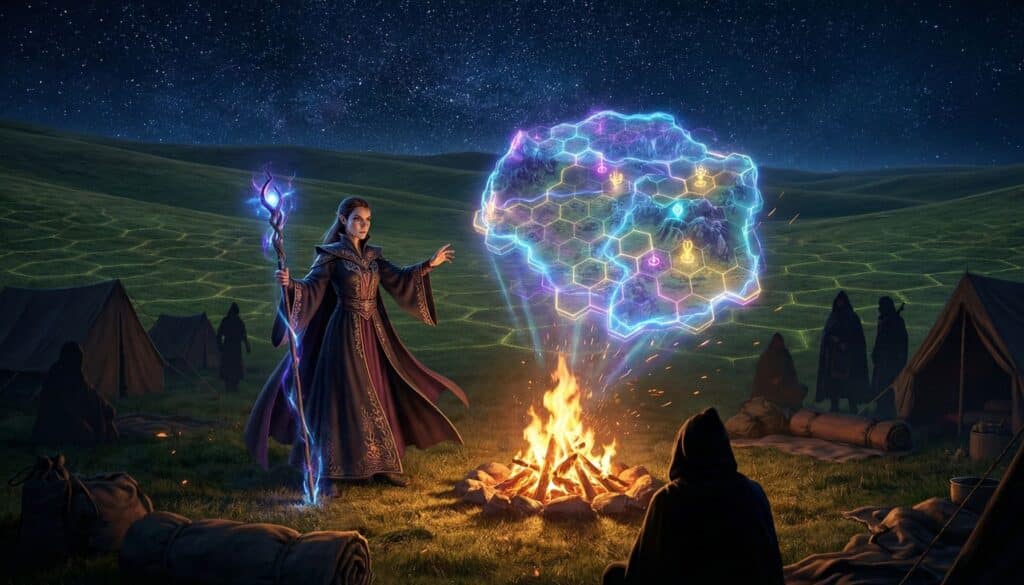
The time spent between travel legs is often hand-waved, yet this is where downtime exploration ideas shine. You should structure setting up camp as a mini-game where everyone has a job that contributes to the next day’s success. This turns the Long Rest from a button press into a collaborative scene where the party debriefs and prepares. By assigning specific roles, you engage players who might otherwise tune out during the resting phase.
| Camp Role | The Skill Check | Success Benefit | Failure Consequence |
| The Watcher | Perception | The party cannot be surprised during the night. | Ambushers get a Surprise Round. |
| The Cook | Survival / Tools | +1 Hit Die recovered on next Short Rest. | No benefit (or Poisoned condition on a 1). |
| The Storyteller | Performance | One ally gains Inspiration. | The performer gains 1 level of Exhaustion from staying up. |
| The Scout | Stealth | Reveals the “Weather” or Terrain for the next leg. | False information about the route ahead. |
| The Camouflager | Nature | Reduces the chance of a Random Encounter by 20%. | The camp is easily spotted by patrols. |
| The Mender | Investigation | Repairs one damaged item or vehicle. | Wastes resources with no repair. |
This structure makes the camp feel like a home base that must be maintained. It creates small, low-stakes interactions that build character relationships and immersion without grids or maps.
How to Get “Lost” Without a Map
In a hexcrawl, getting lost means moving to the wrong hex, but in narrative travel in fantasy RPGs, getting lost is a change in situation. When players fail their navigation checks, do not simply say “you are lost” and make them roll again. Being lost should be a distinct “state” that requires a specific set of actions to resolve. This transforms a failed roll into a new objective that the players must actively solve.
- The Loop: The party realizes they have passed the same landmark twice and must backtrack to find where they deviated.
- The Separation: The terrain splits the party (rockslide, fog), and they must use resources to find each other before finding the path.
- The False Destination: They arrive at a location that looks like their goal but is actually a mimic, a lure, or a ruins.
- The Resource Drain: They are not lost geographically, but the route was much harder than expected, costing extra rations and exhaustion.
- The Loss of Time: They arrive at the correct location, but days later than intended, advancing the villain’s Living Timeline.
- The Forced Camp: They are so disoriented they must stop immediately to re-orient, triggering a risky camp phase.
Getting lost becomes a narrative beat rather than a navigational error. It adds to the story by showing that the unknown regions in tabletop campaigns are confusing and hostile territory that resists being mapped.
Final Thoughts: Exploration Matters When Curiosity Pays Off
Exploration is meaningful when it changes options, costs something, and reveals leverage. It is not about simulating a hiking trip; it is about simulating the pressure of being in unknown territory. You do not need a hex map to achieve this. You only need to present the players with interesting choices and respect the consequences of those choices. If they decide to push through the night to reach the ruins before the rival party, let them succeed, but make them pay for it with exhaustion and supplies. This creates a narrative where their agency defined the story.
Hex maps are optional… agency is not. If travel changes the story, players will seek it out. They will want to see what is over the next hill because they know that finding a shortcut or a secret tunnel gives them a tangible advantage in the adventure. When curiosity pays off with power, leverage, and story progression, your players will stop asking “are we there yet” and start asking “what’s down that path?”
