
The release of the revised 2025 ruleset for Dungeons & Dragons has shifted the optimization landscape. While the core philosophy of 5th Edition remains, changes to feat progression, weapon masteries, and the rebalancing of spell lists have opened cracks in the system’s foundation. “Abusable” in this context does not imply cheating or breaking the rules. It refers to rule-legal builds that exploit stacking mechanics, action economy loopholes, and front-loaded subclass features to generate value that far exceeds the expected curve. These are the builds that make a Dungeon Master sigh when they see the character sheet.
The 2025 update has made multiclassing significantly more volatile. The standardization of subclass progression to level 3 was intended to prevent “one-level dips,” but it inadvertently strengthened the “three-level power spike.” Furthermore, the introduction of Weapon Masteries gives martial characters a reason to multiclass that never existed before, creating control effects that scale without resource expenditure. When you combine this with the new background-based feat trees, you can assemble a character that is functionally two levels higher in power than the rest of the party.
This article assumes a high degree of system mastery. We are looking at “white room” optimization applied to practical combat scenarios. We are not looking for “infinite damage” theoretical loops that require a compliant DM, but rather robust, high-leverage combinations that work strictly Rules As Written (RAW). These builds dominate because they attack the game’s math: they raise AC beyond bounded accuracy, generate advantage consistently, or deny enemies their turns entirely.
The ranking criteria for these combos are specific: Raw Power (damage or mitigation), Reliability (does it work every round?), Flexibility (is it useful out of combat?), and Dominance Timing (how early does it break the game?). A build that comes online at level 20 is useless for most tables; a build that makes level 6 feel like level 14 is top-tier.
The following list represents the apex of current theorycrafting. These combinations strip away the intended weaknesses of single-class builds, creating engines of destruction that require DMs to specifically design encounters to counter them. Proceed with caution, as bringing these to a casual table may disrupt the social contract of the game.
- The Top 10 Multiclass Combos (Ranked)
- #1 Artificer + Monk — Infusion-Powered Ki Abuse
- #2 Bard + Cleric — Narrative and Spell Synergy Powergaming
- #3 Druid + Warlock — Psychic, Radiant, and Healing Stack
- #4 Barbarian + Wizard — Intelligence-Based Tank Caster
- #5 Fighter + Sorcerer — Dice and Size Manipulation Burst Turns
- #6 Rogue + Bard — Social Dominance and Psychic Sneak Attacks
- #7 Paladin + Druid — Divine Smiting Beast-Shape Tank
- #8 Monk + Cleric — Divine Flurry Mobility Engine
- #9 Ranger + Wizard — Summoner Control with Pets and Undead
- #10 Fighter + Bard — High-Crit Support Striker Mastery Spam
- Why These Builds Break Tables
- The Hidden Architecture: Species and Feat “Glues” That Hold Broken Builds Together
- Final Thoughts on Power Multiclassing in D&D 2025
The Top 10 Multiclass Combos (Ranked)
The following rankings evaluate each combo in isolation, assuming the player makes optimal choices regarding species, stats, and feats. While party composition matters, these builds are designed to be self-sufficient. They do not need a Bard to give them Inspiration or a Wizard to Haste them; they generate their own advantage and survivability.
Try my AI Tabletop RPG generators...and an extensive library of content!
It is important to note that the “power ceiling” in D&D 2025 is often defined by action economy. The builds ranked highest are those that act more often, or more effectively, than a standard character. Whether through reaction abuse, bonus action efficiency, or passive aura effects, these characters simply “do more” per round of combat.
We have ranked these by “Abuse Potential,” which is a measure of how much the build disrupts standard encounter design. A high-damage fighter is strong, but a character that cannot be hit, cannot be targeted, and deals high damage is abusive. These builds force the DM to change how they run monsters, often necessitating smarter enemies or distinct environmental hazards just to challenge the player.
Disclaimer: These rankings prioritize mechanical efficacy over narrative flavor. While some of these combinations can be justified with a cool backstory, their primary purpose in this list is mathematical dominance. If you are looking for a quirky, roleplay-first character, look elsewhere. These are weapons of math destruction.

#1 Artificer + Monk — Infusion-Powered Ki Abuse
This combination tops the list because it completely solves the Monk’s historical problems—survivability and MAD (Multiple Ability Score Dependence)—while weaponizing the Artificer’s best feature: Infusions. By taking three levels of Artificer (Armorer) and the rest in Monk, you create a skirmisher that creates a “lose-lose” situation for the DM. The Armorer’s Thunder Gauntlets count as simple weapons, meaning they are Monk Weapons. This allows you to use your Intelligence for attacks (Artificer feature) while still triggering Martial Arts and Flurry of Blows.
⚔️ Fantasy RPG Random Tables Books
Make life as a Gamemaster easier…
If you play Dungeons & Dragons, Pathfinder, or other fantasy RPGs, this
RPG random tables series
is packed with encounters, NPCs, treasure, and more. Available in eBook or print—either way, you’ll have a wealth of adventure ideas at your fingertips.





The abuse stems from the defensive layering. Monks are typically fragile skirmishers. An Artificer/Monk wears light armor (or no armor with Mage Armor via a feat or infusion workaround), carries a shield (if not using Unarmored Defense), and stacks defensive infusions like Repulsion Shield or Enhanced Defense. Suddenly, the Monk has an AC of 22+ in Tier 2 play, moves 50 feet per round, and forces disadvantage on enemies via the Thunder Gauntlets’ taunt mechanic. You punch an enemy, impose disadvantage on their attacks against anyone else, and then run away without provoking opportunity attacks (via the Mobile feat or subclass features).
The synergy continues with spell utility. The Monk lacks utility; the Artificer provides Sanctuary, Absorb Elements, and Longstrider. Pre-casting Longstrider and Aid turns the Monk into a high-hp, uncatchable blur. This build comes online as early as level 6 (Artificer 3 / Monk 3) and scales aggressively. You are not just a damage dealer; you are a tank that is impossible to pin down, forcing enemies to chase you while they effectively cannot hit your allies.
The Abuse Points:
- Intelligence Sadness: You can dump Strength and Dexterity (to 14) and focus solely on Intelligence and Constitution if using Armorer weapons.
- Taunt & Run: Hit up to 4 enemies with Flurry of Blows, marking them all with disadvantage, then leave their reach.
- Infused Defense: Stack Ring of Protection and Cloak of Protection infusions early to break bounded accuracy.
- Shield spell access: Taking the Shield spell via Artificer makes you virtually unhittable on demand.
- Absorb Elements: Mitigates the Monk’s weakness to blast damage before Evasion comes online.
- Returning Weapon: Use a spear or dart with Returning Weapon to maintain ranged threat with Extra Attack.
- Guidance Spam: Artificer cantrips fill the Monk’s out-of-combat utility void.
- Faerie Fire: Grants the Monk advantage on all attacks (Crit fishing) without needing a party member to cast it.
- Boots of Winding Path: Teleportation as a bonus action (Infusion) saves Ki points on Step of the Wind.
- Tool Expertise: You dominate all skill challenges involving tools, granting narrative control.
- Constitution Save Proficiency: Starting Artificer grants CON saves, protecting your concentration on Hex or Divine Favor (via feats).
- Radiant Weapon: Blind enemies on a reaction, further destroying their action economy.
- Speed Stacking: Longstrider (Artificer) + Unarmored Movement (Monk) creates map-breaking velocity.
- Magic Item Slots: You effectively have 2-3 more magic items than a standard character of your level.
This combo is #1 because it has no glaring weakness. High AC, high saves, high mobility, control on hit, and utility spells. It demands heavy DM intervention to challenge, often requiring enemies with auto-hit magic missiles or saving-throw-based damage to threaten the character at all.

#2 Bard + Cleric — Narrative and Spell Synergy Powergaming
This build dominates by monopolizing the action economy of support. In D&D 2025, the synergy between the Bard’s reaction suite and the Cleric’s buff suite creates a “God Wizard” effect where your party simply cannot fail. The abuse here is the combination of Order Domain (Cleric) or Peace Domain with Eloquence or Lore Bard. You control the dice results of every creature on the table.
The core loop involves casting powerful concentration buffs like Bless or Spirit Guardians while using your Bonus Action for Bardic Inspiration and your Reaction for Silvery Barbs or Cutting Words. You essentially act three times a round. If an enemy succeeds on a save, you force a reroll. If an ally misses, you add dice. The breakdown of bounded accuracy is total; a party supported by this build fights as if they are 5 levels higher.
Additionally, the social abuse is unparalleled. With Expertise in Persuasion/Deception and access to Guidance, Enhance Ability, and Charm Person, you can bypass entire combat encounters through dialogue checks that are mathematically impossible to fail.
Synergy Analysis Table
| Synergy Area | Bard Contribution | Cleric Contribution | Resulting Abuse |
|---|---|---|---|
| Dice Manipulation | Bardic Inspiration, Silvery Barbs | Bless, Emboldening Bond | Allies roll d20+2d4+Advantage; Enemies roll twice. |
| Action Economy | Bonus Action Healing/Buffs | Reaction Attacks (Order Domain) | Rogue gets a reaction Sneak Attack when you heal them. |
| Defense | Light Armor, Defensive Duelist | Heavy Armor, Shield of Faith | Caster with AC 20+ standing in the backline. |
| Crowd Control | Hypnotic Pattern, Slow | Spirit Guardians, Command | Enemies are slowed, grouped, and AoE damaged simultaneously. |
| Social | Expertise, Glibness (late) | Zone of Truth, Thaumaturgy | The DM cannot hide secrets; NPCs cannot lie or resist. |
| Recovery | Song of Rest | Channel Divinity (Life/Twilight) | Short rests fully reset party HP; attrition is solved. |
| Counterspelling | Counterspell, Dispel Magic | Silence, Blindness/Deafness | Enemy casters are shut down via multiple avenues. |
| Save Protection | Countercharm (2025 buff) | Bless, Holy Aura | Party creates a “save fortress” against dragon breath. |
This build thrives in campaigns that balance RP and combat. It is rarely the MVP of damage, but it is the MVP of winning. The only counterplay is purely anti-magic zones, which feels punitive and unfun, forcing the DM into a corner.

#3 Druid + Warlock — Psychic, Radiant, and Healing Stack
This is the evolution of the “Coffeelock,” adapted for the 2025 ruleset. The core abuse relies on the interaction between Warlock Pact Magic (slots back on short rest) and Druid Wild Shape survivability. Specifically, the “Cheese Grater” strategy is perfected here. You cast Spike Growth (Druid) and use Repelling Blast (Warlock) to push enemies through the spikes for massive damage, all while sitting safely in a Wild Shape or behind medium armor and a shield.
The 2025 rules typically allow you to maintain concentration in Wild Shape. This means you can cast Armor of Agathys (Warlock), then shift into a Bear or Wolf. You now have a pool of Temp HP that deals cold damage to anyone who hits you, on top of your beast HP. You become a prickly pear of death. If you run out of slots, a one-hour short rest refreshes your Warlock slots and your Wild Shapes, allowing you to repeat the loop infinitely throughout the day.
The abuse extends to healing. The Circle of Stars Druid combined with Genie or Celestial Warlock creates a character that can blast for high damage and heal as a bonus action using the Chalice form. You cover every base: tanking, blasting, and healing, with resources that refresh 3 times faster than the Wizard’s.
Abuse Examples:
- The Cheese Grater: Spike Growth + Repelling Blast + Grasp of Hadar deals 4d4 damage per blast hit.
- Armor of Agathys Carry: Pre-cast max level Armor of Agathys before Wild Shaping to punish melee attackers.
- Short Rest Goodberry: Use leftover Warlock slots before a short rest to cast Goodberry, stockpiling hundreds of HP.
- Eldritch Mind: Take the invocation to gain Advantage on CON saves, making your Wild Shape concentration unbreakable.
- Ghostly Gaze: See through walls (Warlock) to cast Call Lightning (Druid) on enemies in the next room.
- Familiar Advantage: Pact of the Chain familiar takes the Help action to give your spell attacks Advantage.
- Darkness/Devil’s Sight: Cast Darkness on your beast form; you have advantage, enemies have disadvantage, and they can’t target you with spells.
- Thorn Whip Pull: Combine Thorn Whip (Druid) with Repelling Blast to keep enemies in a precise “kill zone.”
- Summon Stacking: Summon Beast (Druid) acts alongside your Chain Familiar for action economy overload.
- Telepathic Wild Shape: Great Old One Warlock allows you to communicate telepathically while in Beast form, negating a major downside.
- Slot Cycling: Burn Warlock slots for Cure Wounds immediately before short resting.
- Shillelagh CHA: If using Pact of the Tome, use Charisma for Shillelagh attacks, consolidating stats.
This build ranks high because it is resource-efficient. While the Paladin is out of slots at 2 PM, the Druid/Warlock is fresh and ready to grind through three more encounters. It requires diligent bookkeeping, however.
⚔️ Fantasy RPG Random Tables Books
Make life as a Gamemaster easier…
If you play Dungeons & Dragons, Pathfinder, or other fantasy RPGs, this
RPG random tables series
is packed with encounters, NPCs, treasure, and more. Available in eBook or print—either way, you’ll have a wealth of adventure ideas at your fingertips.

#4 Barbarian + Wizard — Intelligence-Based Tank Caster
Often called the “Bar-bizard,” this build sounds contradictory—you cannot cast spells while Raging. However, the abuse comes from leveraging the Wizard’s non-spell features and long-duration, non-concentration buffs. By taking two levels of War Magic Wizard, you gain Arcane Deflection: a reaction to add +2 to AC or +4 to a Save. This is not a spell; it works while Raging.
You combine the Barbarian’s massive HP pool and Damage Resistance with the Wizard’s defensive reactions and ritual utility. You pre-cast Mirror Image (no concentration), Longstrider, and Jump. Then you Rage. You are now a tank with effectively double HP, high AC, and a reaction to block saving throw effects. Out of combat, you use Ritual Casting to solve puzzles and travel problems, covering the Barbarian’s usual lack of utility.
The 2025 Weapon Masteries add another layer. You use a weapon with the Topple or Sap property to debuff enemies, while your high Intelligence (needed for the multiclass) shores up the Barbarian’s weak mental saves. You essentially fix the Barbarian’s only weakness (Mind Control) with a 2-level dip.
Challenge vs. Workaround Table
| Challenge | Workaround / Synergy | Resulting Power Gain |
|---|---|---|
| Can’t Cast in Rage | Use War Magic Arcane Deflection (Reaction). | +2 AC or +4 Saves on demand while Raging. |
| Low Mental Saves | INT is a secondary stat + Arcane Deflection. | Highly resistant to Hold Person and Fear. |
| No Out-of-Combat Utility | Wizard Ritual Casting (Book). | Can cast Detect Magic, Identify, Phantom Steed. |
| Low AC (Unarmored) | Mirror Image (No Concentration). | Enemies must hit illusions before hitting your resistance. |
| Action Economy | Fire Shield (No Concentration). | Enemies take cold/fire damage every time they hit you. |
| Ranged Weakness | Longstrider + Jump spells. | Massive mobility increase to close gaps instantly. |
| MAD Stats | Use Headband of Intellect or accept 14 DEX/CON. | Viable stats that cover all saving throw bases. |
This combo rewards system knowledge. A novice will try to cast Fireball and fail. An expert will realize they have built an unkillable juggernaut that contributes to every pillar of play.

#5 Fighter + Sorcerer — Dice and Size Manipulation Burst Turns
This build is designed for the “Nova” round—the single turn where you delete the boss. The synergy relies on Action Surge (Fighter) interacting with the Sorcerer’s spellcasting. In 2025, rules typically clarify that you can cast a leveled spell with your Action and another with your Action Surge Action. This allows for devastating setups that standard casters cannot perform.
The abuse often utilizes Metamagic. You can Quicken a control spell like Hold Person (Bonus Action). If it sticks, you use your Action and Action Surge to auto-crit with melee cantrips (like Booming Blade) or weapon attacks. Alternatively, you can double-cast Fireball for massive AoE clearing.
The 2025 “Rune Knight” or “Giant Soul” variations allow for size manipulation. You can grow to Huge size, increasing your reach and grappling capability, then use Sorcerer spells like Enlarge/Reduce to become Gargantuan. You effectively become a Kaiju on the battlefield, blocking entire corridors and grappling Dragons, all while having the Shield spell and Absorb Elements in your back pocket.
Burst Scenarios:
- The Double Tap: Action Fireball, Action Surge Fireball. Simple, effective, clears the room.
- The Paralyzer: Bonus Action Quicken Hold Person. Action: Attack with Advantage/Crit. Action Surge: Attack again.
- The Grapple God: Become Huge (Rune Knight), cast Enlarge (Sorcerer). Grapple the Tarrasque.
- Defense Supreme: Cast Blur and Shield on a Fighter chassis with heavy armor.
- Reaction Denial: Use Shocking Grasp (Quickened) to strip reactions, then move past the enemy to the backline.
- Vortex Warp Drop: Action Vortex Warp enemy into hazard. Action Surge Vortex Warp another enemy into the same hazard.
- Silvery Barbs Spam: Fighter CON saves maintain concentration on Haste while you spam Silvery Barbs to protect it.
- Self-Buffing: Turn 1 Greater Invisibility + Action Surge Attack. You are now an invisible blender.
- Seeking Spell: Use Seeking Spell metamagic to turn a missed high-level attack spell into a hit.
- Subtle Spell Social: Cast Charm Person or Suggestion in a crowded room without anyone knowing (Fighter intimidation backup).
- Distance Casting: Distant Spell on Vampiric Touch or Shocking Grasp keeps you out of melee while delivering touch spells.
- Transmuted Fireball: Change Fireball to Acid or Thunder to bypass resistance, then Action Surge to do it again.
- Bastion of Law: Clockwork Soul features reduce damage on a Fighter who already has high AC.
This build is volatile. When it works, the encounter ends in one round. When you run out of Sorcery Points and Action Surge, you are just a mediocre Fighter. It ranks #5 because the resource burn is real.

#6 Rogue + Bard — Social Dominance and Psychic Sneak Attacks
This is the ultimate “Skill Monkey,” but in 2025, it is also a combat menace. By combining Rogue Expertise with Bard Jack of All Trades and Expertise, you ensure that you never roll below a 15 on key skills. The abuse focuses on the College of Whispers or Spirits combined with the Soulknife or Phantom Rogue. You stack “pseudo-sneak attack” dice. Psychic Blades (Bard) plus Sneak Attack (Rogue) allows for massive single-hit damage that is almost entirely psychic, bypassing most resistances.
The social abuse is the real danger. With Reliable Talent (Rogue 10) and Silver Tongue (Eloquence Bard), you can mathematically break the game’s social pillar. You can walk into a king’s court, convince him to abdicate, and leave without rolling initiative.
Social and Combat Abuse:
- The Minimum Roll: Reliable Talent + Eloquence Bard means your minimum Persuasion roll is roughly a 22.
- Psychic Nuke: Stack Whispers Bard dice and Sneak Attack dice on a critical hit (via Hold Person).
- Bonus Action Help: Mastermind Rogue + Bardic Inspiration allows you to buff two allies every turn.
- Expertise Overload: You have Expertise in 6+ skills. You are the party Scout, Face, and Librarian.
- Cunning Action Casting: Cast a spell, then Hide or Disengage as a bonus action.
- Uncanny Dodge + Cutting Words: Layered reaction defenses reduce incoming damage to near zero.
- Invisible Mage Hand: Soulknife / Arcane Trickster utility allows for larceny from 30 feet away.
- Rest Casting: Use Song of Rest to make short rest hit dice extremely efficient.
- Silvery Barbs Crit Cancel: Negate crits against you, then use Uncanny Dodge on the regular hit.
- Mental Communication: Soulknife telepathy allows for silent coordination during social heists.
- Disguise Self: Mask of Many Faces (via Eldritch Adept feat or Bard spell) + +15 Deception makes you uncatchable.
- Reaction Sneak Attack: Use Dissonant Whispers (Bard) to force an enemy to run. Reaction Attack (Rogue) for a second Sneak Attack in one round.
This build is #6 because while it conquers the social pillar, its combat output is steady but rarely game-breaking compared to the top 5. It wins the campaign, not necessarily the fight.
#7 Paladin + Druid — Divine Smiting Beast-Shape Tank
While the 2025 rules complicate the “Smite while Wild Shaped” strategy (due to Smite becoming a spell), this combo remains abusive via Aura of Protection and Wild Shape HP pools. The concept is the “Unkillable Commander.” You take enough Paladin levels to get the Aura (+CHA to all saves), then pivot to Moon Druid.
Try my AI Tabletop RPG generators...and an extensive library of content!
You sit in the middle of your party in Bear or Wolf form. You have the AC of the beast, but you add your Charisma to all your saving throws. If you take damage, you drop Wild Shape and are still a full-plate Paladin. You use your Druid spell slots to upcast Aid and Longstrider on the party before the fight.
Form-Smite Interaction Table
| Form Type | Paladin Interaction | Defensive Benefit | Abuse Risk |
|---|---|---|---|
| Bear (High HP) | Aura of Protection active. | Massive HP pool backed by +4/+5 to Saves. | DM ignores you because you deal low damage. |
| Dire Wolf (Pack Tactics) | Advantage generates Crits. | High AC (Barkskin) + Saves. | Reliable knockdown control. |
| Spider (Stealth) | Divine Sense while scouting. | Tiny size, hard to target. | Scouting without risk of ambush. |
| Elemental (High Level) | Resistance to non-magic. | Resistance + Saves + Healing. | Nearly impossible to kill. |
| Caster Form (Base) | Heavy Armor + Shield + Shillelagh. | AC 21 + Shield Spell (via feat). | Just a better Druid. |
| Summoner | Concentrate on Summon Beast. | Two bodies blocking for the party. | Action economy clog. |
This build is heavily dependent on how the DM rules specific interactions between “natural weapons” and Paladin features, and how strict they are on the “Smite is a spell” rule. If the DM allows Smites in Wild Shape, this jumps to #2. If not, it sits at #7 as a defensive anchor.
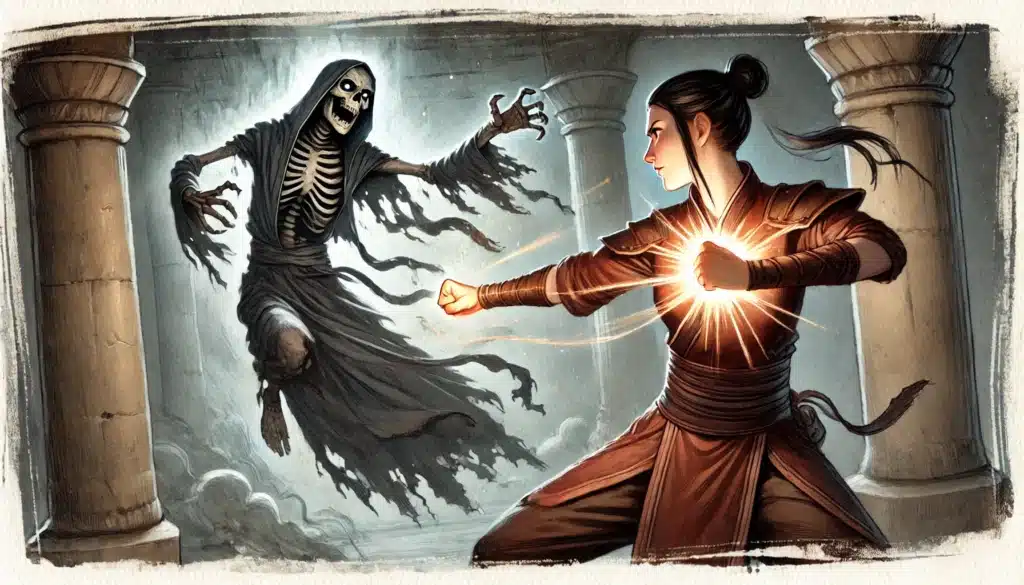
#8 Monk + Cleric — Divine Flurry Mobility Engine
This build exploits the Spirit Guardians spell. By taking Cleric levels to access Spirit Guardians and Monk levels for Step of the Wind and massive movement speed, you become a “Lawnmower.” You cast the spell, then Dash as a bonus action (and Action if needed), running 80-100 feet through the enemy lines.
Every enemy you pass within 15 feet of takes the damage. The Monk’s mobility allows you to tag every enemy on the battlefield in a single turn. You utilize Patient Defense (Dodge as Bonus Action) to stand in the middle of the swarm, forcing them to miss you while they burn in radiant light.
Flurry-Based Abuse:
- The Lawnmower: Move 100ft, tagging 10 enemies with Spirit Guardians.
- Dodge Tank: High WIS (Monk AC) + Patient Defense makes you unhittable while concentrating.
- Stunning Strike Setup: Stun an enemy (Monk) so they automatically fail DEX saves against Spirit Guardians.
- Radiant Soul: Use Sun Soul Monk or Light Cleric features to blast at range.
- Sanctuary Running: Cast Sanctuary and just run through enemies (Help action only) to disrupt formations.
- Inflict Wounds Flurry: Use Inflict Wounds with advantage (from Stunning Strike).
- Deflect Missiles: Catch arrows while concentrating on a game-winning spell.
- Evasion + Warding Bond: Cast Warding Bond on an ally; use Evasion to mitigate the shared damage? (Rules dependent).
- Wisdom Synergy: Both classes use Wisdom, allowing for a single-stat focus.
- Peace Domain Bond: Emboldening Bond + Monk Speed spreads the buff to everyone.
- Healing Word: Pick up unconscious allies with a Bonus Action while still attacking twice.
This build spikes hard at level 8 (Cleric 5 / Monk 3) but flattens out as enemy HP scales higher than Spirit Guardians can manage.

#9 Ranger + Wizard — Summoner Control with Pets and Undead
This build abuses the action economy by putting more bodies on the board than the DM. A Beast Master or Drakewarden Ranger combined with a Necromancer or Conjuration Wizard. You have your Ranger Companion, your Summon Beast/Fey spell, and potentially Animate Dead skeletons.
You clog the battlefield. Enemies physically cannot reach your party because there are walls of fur and bone in the way. You use the Ranger’s weapon masteries (like Push or Slow) to keep enemies engaging your summons rather than you.
Summon Control Table
| Summon Type | Control Benefit | Management Cost |
|---|---|---|
| Primal Companion | Attacks on your turn, blocks squares. | Bonus Action. |
| Summon Beast | Bestial Spirit flies/attacks. | Concentration + Spell Slot. |
| Skeletons (Animate Dead) | Archers providing ranged volley. | Bonus Action (conflict) or General Command. |
| Familiar | Help Action (Advantage). | Risk of 1-hit death. |
| Tiny Servant | Object manipulation/interaction. | 3rd Level Slot. |
| Unseen Servant | Potion administration. | Ritual cast (time). |
| Conjure Animals (2025) | Radiant/Necrotic damage aura. | High Concentration risk. |
Remember: the sheer complexity of managing multiple summoned creatures—whether they be animals, fey, or undead—can quickly become a logistical nightmare. This demands not only constant attention to actions and positioning but also pulls focus from other players at the table. While the potential to disrupt enemy plans with a horde of allies is compelling, the mental load this build places on the player can lead to frustration for both themselves and the rest of the party, ultimately holding it back from achieving a higher ranking on our list.

#10 Fighter + Bard — High-Crit Support Striker Mastery Spam
This combination leverages the power of the Battle Master Fighter and the Swords Bard to create a formidable force on the battlefield. By specializing in maneuvers and flourishes, you transform into a dynamic whirlwind of action and control. The key to this build lies in the synergy between Pushing Attack and Defensive Flourish.
On a successful hit, you can use Pushing Attack to shove an enemy back 15 feet, stripping them of valuable ground and forcing them into unfavorable positioning. But the real brilliance comes from layering on Defensive Flourish. This ability allows you to add AC to yourself with each successful attack, making it difficult for enemies to retaliate effectively. When you hit, not only do you add damage, but you also enhance your survivability, creating a self-sustaining engine of destruction.
The “Nova” control potential of this build is game-changing. With a carefully orchestrated combination of Maneuvers and Bard spells, you can effectively strip an enemy of their movement, reaction, and weapon within a single turn. Imagine pushing a foe away, making it nearly impossible for them to engage, and leaving them susceptible to follow-up attacks from your allies.
⚔️ Fantasy RPG Random Tables Books
Make life as a Gamemaster easier…
If you play Dungeons & Dragons, Pathfinder, or other fantasy RPGs, this
RPG random tables series
is packed with encounters, NPCs, treasure, and more. Available in eBook or print—either way, you’ll have a wealth of adventure ideas at your fingertips.
This build truly shines in tightly-packed environments where mobility becomes crucial. You become a tactical maestro, ensuring enemies cannot escape your grasp while your companions capitalize on the chaos you’ve created. Expect the battlefield to ebb and flow to your rhythm, where each turn becomes a performance that culminates in overwhelming enemy control and damage. By fostering this synergy, you create a character that does not just keep up with the power curve but sets the pace, leaving opponents scrambling to regain their footing.
Synergy Points:
- AC Stacking: Defensive Flourish + Shield Spell (via feat) + Heavy Armor.
- Movement Boost: Blade Flourish increases speed; Action Surge doubles the dash potential.
- Precision Attack: Ensure powerful spell-smites or sharpshooter attacks land.
- Rest Recovery: Both Maneuvers and Flourishes (later) return on Short Rest.
- Silvery Barbs: Protect yourself or grant yourself Advantage.
- Dueling Style: Stacks damage on high-volume attacks.
- Expertise Athletics: Grapple enemies with Expertise + Enlarge (Bard Magical Secrets).
- Counterspell: Jack of All Trades applies to Counterspell checks.
- Ambush: Ambush maneuver + Jack of All Trades on Initiative guarantees going first.
- Mental Defense: Indomitable (Fighter) + Bardic Inspiration on self (high level).
This is a “Jack of all Trades, Master of War” build, striking a balance between power and fairness that many players will appreciate. It excels in high-pressure scenarios where controlling the battlefield is crucial, but not at the expense of overshadowing teammates. With its blend of support capabilities and high critical damage potential, the Fighter/Bard can elevate the performance of the whole party while ensuring they’re an active participant in the combat narrative. Unlike the Artificer/Monk or Bard/Cleric, which can dominate encounters with little regard for context, this combo embodies a more tactical approach. The Fighter/Bard thrives on clever play and synergy, harmonizing with the party’s strengths and weaknesses. Whether it’s stunning an enemy with a well-timed maneuver or inspiring allies when the tide turns, this build showcases how versatility can be just as potent as sheer power, making it a perfect option for players who want to contribute meaningfully without tipping the scales too far.
Why These Builds Break Tables
These builds share three common traits that stress standard D&D encounter design: Action Economy Abuse, Resource Refresh Loops, and Bounded Accuracy Breaking. Standard encounters assume a 65% hit chance and a limited number of actions per side. When a player can take three “actions” worth of impact in a turn (Action, Bonus Action, Reaction) or raise their AC so the hit chance drops to 5%, the math falls apart.
The “Resource Refresh Loop” is the most insidious. Builds that rely on Short Rests (Warlock, Monk, Fighter) can fundamentally alter the adventuring day. If the party rests after every fight, these builds operate at 100% power constantly, obliterating challenges meant to drain resources. Conversely, the “Nova” builds (Fighter/Sorcerer) can end a “Deadly” encounter in round 1, leaving the DM with a climactic boss fight that lasted 12 seconds.
DMs often feel blindsided because these builds look normal on paper. It isn’t until the Dice hit the table—and the Paladin/Druid saves against the Breath Weapon with a +14, or the Artificer/Monk stuns the boss and runs 60 feet away—that the disparity becomes obvious.
Warning Signs of an Abusive Build:
- The player asks for a “Short Rest” immediately after every combat.
- The player rolls 4+ d20s during a single turn.
- The player announces an AC of 23 or higher before level 5.
- The player creates “minions” (summons/undead) that take their own turns.
- The player uses their Reaction every single round.
- The player asks “Does a 24 save?” on a DC 15 check.
- The player deals damage during other players’ turns consistently.
- The player consults a flow-chart to resolve their turn.
- The player is immune to the primary threat of the campaign (e.g., Poison/Charm).
- The player moves more than 60 feet without Dashing.
- The player imposes Disadvantage on enemies without spending a spell slot.
- The DM stops targeting that player because “it’s pointless.”
Communication is the only fix. If you plan to bring a nuclear weapon to a knife fight, it’s crucial to inform your DM. Transparency about your character’s capabilities allows them to adjust the encounter dynamics accordingly. A savvy DM can either buff the monsters to present a greater challenge or, if necessary, ask you to tone down your character’s power level. This conversation ensures that all players remain engaged and that the game balances favorably for everyone at the table. Remember, the joy of D&D comes from shared stories and collaborative experiences, not simply from dominating the battlefield. Open dialogue fosters a healthy gaming environment where each participant can contribute fully, enhancing the overall enjoyment of the campaign and maintaining the spirit of the game.

The Hidden Architecture: Species and Feat “Glues” That Hold Broken Builds Together
The greatest cost of multiclassing in D&D has always been the “ASI Tax.” When you split your levels 3/3 or 5/3, you delay your Ability Score Improvements and Feats. A single-class Fighter has two feats by level 6; a Monk 3 / Cleric 3 has zero. In previous editions, this math gap often killed the viability of complex builds because your primary stats fell behind the expected curve. The 2025 ruleset fundamentally changes this dynamic through the introduction of Origin Feats, stronger Species traits, and Background-locked power.
The most abusive builds do not just pick two classes and hope for the best. They utilize specific Species and Background combinations to “glue” the build together, effectively bypassing the statistical penalties of multiclassing. This “hidden architecture” allows a level 6 character with no ASIs to function as if they had maxed stats. Understanding this layer of optimization is what separates a clunky theory-craft from a table-dominating monster.
For example, the new Human species trait is no longer just “all stats +1” or a generic skill. In 2025, Humans gain an additional Origin Feat and Heroic Inspiration consistency. This means a Human multiclass character can start with Alert (Initiative proficiency) and Tough (HP scaling) at Level 1. This instantly solves the two biggest issues of complex caster multiclasses: going first to set up control and surviving low-HP levels. You do not need to wait for level 4 to fix your build; you fix it at character creation.
Similarly, the Goliath species has become the premier choice for martial multiclassing (like the Fighter/Sorcerer or Paladin/Druid). The ability to turn Large (and eventually Huge) via species traits, independent of spells, allows for “Reach abuse” that was previously impossible without concentration. A Large Goliath with a Polearm controls a 25-foot diameter circle. When you combine this with multiclass features that stop movement (like Slasher or Battle Master maneuvers), you create a “dead zone” where enemies physically cannot reach you.
The “Multiclass Fixer-Upper” Table
Use this table to identify which Species or Feat solves the inherent flaw in your chosen multiclass combination.
| Multiclass Flaw | The “Glue” Solution | Why It Works in 2025 |
|---|---|---|
| Delayed Extra Attack | Nick Mastery (Feat/Class) | Dual Wielder + Nick property grants 3 attacks at level 1-3 without Extra Attack. |
| Low Hit Points | Hill Giant Goliath | Bonus action to topple enemies prone reduces incoming damage significantly. |
| MAD Stats (Need INT/WIS) | Gnome Cunning | Advantage on mental saves covers the weak stats you had to dump. |
| Poor Initiative | Alert (Background) | You can now swap Initiative with allies. You don’t need high DEX; just give your roll to the Rogue. |
| Squishy Caster Form | Dwarven Toughness | Dwarves get extra HP per level, effectively giving a Wizard d8 hit dice. |
| Action Economy Clog | Musician (Origin) | Heroic Inspiration on Short Rest means you reroll failures rather than wasting turns recasting. |
| Lack of Darkvision | Orc / Drow | Crucial for the “Darkness/Devil’s Sight” combo if you aren’t a Warlock. |
| Gap Closing | Cloud Giant Goliath | Teleportation as a racial ability saves spell slots (Misty Step) for damage. |
| Concentration Checks | War Caster (Level 4) | Essential tax. If you delay Level 4, take Constitution Save proficiency via starting class (Fighter/Artificer). |
| Skill Gaps | Skilled (Origin) | If your multiclass misses a Face skill, this feat grants 3 proficiencies instantly. |
The “Background” Meta-Game
In D&D 2025, Backgrounds are no longer flavor text; they are power sources. Because Ability Score increases are tied to Backgrounds in many playtests (and conversely, Feats are tied to them), selecting your background is the most critical math decision you make.
If you are building the Barbarian + Wizard (#4), you cannot pick the “Soldier” background just because it fits the lore. You likely need a background that grants Intelligence and Constitution bumps, or one that grants the Tough feat to offset the wizard’s fragility. The meta-game has shifted to “Feat Hunting.”
Top 3 Abuse-Ready Background Feats:
- Alert: The ability to swap initiative results with a willing ally is game-breaking for combo setups. If your Cleric/Bard goes last, the control spells land too late. With Alert, the high-dexterity Rogue gives their 25 Initiative to the Cleric, ensuring Spirit Guardians or Hypnotic Pattern goes up before the enemies move. This removes the RNG of combat initiation.
- Magic Initiate (Wizard/Druid): For martial multiclasses, this is the “Shield Tax” evasion. Instead of dipping a level into Wizard just for the Shield spell (which delays Extra Attack), you take a Background that grants Magic Initiate. You get Shield once per day for free and can cast it with slots if you have them. This saves you an entire character level.
- Lucky: If available as an Origin or early feat, Lucky acts as “Bad DM Insurance.” For multiclass builds that rely on a specific “Save or Suck” combo (like the Fighter/Sorcerer relying on Hold Person), Lucky forces the reliability needed to make the resource burn worth it.
Weapon Mastery: The Martial Multiclass Cheat Code
The most distinct 2025 addition is Weapon Mastery. This system allows martial classes to apply debuffs (Slow, Push, Topple, Vex) on every hit. For multiclassing, this is a force multiplier.
In the past, a Rogue/Fighter multiclass was often weaker than a pure Rogue because Sneak Attack scaled with level. Now, a Rogue 1 / Fighter 1 can use a Scimitar with the Nick property (extra attack without bonus action) and a Shortsword with Vex (Advantage on next attack).
The sequence becomes:
- Attack 1 (Vex): Hit creates Advantage.
- Attack 2 (Nick – Free): Hit with Advantage triggers Sneak Attack.
- Bonus Action: Cunning Action Disengage.
This loop generates Advantage and Sneak Attack without needing to Hide or have an ally adjacent. The Weapon Mastery system fills the “power void” left by delayed class features. If you are building any martial mix, you must select your weapons based on their Masteries, not their damage dice. A d6 weapon with Topple is infinitely superior to a d10 weapon with no mastery for a build that relies on generating advantage.
The “Stat Squish” Strategy
Finally, the most advanced architectural trick is the “Stat Squish.” Many 2025 feats are “Half-Feats” (granting +1 to a stat). When multiclassing, you often end up with odd ability scores (15 STR, 17 CHA).
The abuse comes from planning your feats to round these out perfectly at Level 4 (the first ASI). Instead of taking +2 CHA, the Paladin/Warlock takes Fey Touched (+1 CHA and Misty Step) or Telekinetic (+1 CHA and Bonus Action Shove).
By planning for Half-Feats, you gain magical abilities and the math fix simultaneously. A Druid/Cleric (WIS based) with Telekinetic can push enemies into their own Spirit Guardians as a bonus action. This turns a “stat fix” into a primary damage engine. The best builders essentially ignore the “Ability Score Improvement” button entirely, viewing every level up as an opportunity to acquire a new active ability that happens to carry a +1 sticker attached to it.
⚔️ Fantasy RPG Random Tables Books
Make life as a Gamemaster easier…
If you play Dungeons & Dragons, Pathfinder, or other fantasy RPGs, this
RPG random tables series
is packed with encounters, NPCs, treasure, and more. Available in eBook or print—either way, you’ll have a wealth of adventure ideas at your fingertips.
Final Thoughts on Power Multiclassing in D&D 2025
Multiclass optimization in D&D 2025 is a high-risk, high-reward game. The reward is a character that feels heroic, competent, and unstoppable. The risk is that you render the rest of the table irrelevant. When one player is the Tank, the Striker, and the Controller, the other players may feel like spectators in your anime protagonist storyline.
The best optimization is the kind that elevates the whole party. The Bard/Cleric (#2) is often loved by tables because it makes everyone else feel strong. The Artificer/Monk (#1) is often hated because it plays a solo game of “catch me if you can.” Before you commit to one of these builds, ask yourself: “Is this fun for the person sitting next to me?”
Try my AI Tabletop RPG generators...and an extensive library of content!
Furthermore, remember that “Abusable” does not mean “Invincible.” A creative DM can counter any mechanical advantage. Heat Metal cooks the high-AC Artificer. Counterspell shuts down the Sorcerer. Antimagic Field humbles the Druid. If you escalate the arms race, the DM has infinite resources to escalate back.
Ultimately, these combos are tools. Used responsibly, they allow you to realize specific character fantasies—the magical speedster, the heavily armored mage, the shapeshifting commander. Used recklessly, they break the immersion and tension of the game.
The most dangerous build isn’t the one with the highest numbers; it’s the one the DM didn’t prepare for. If you show up with #1 on this list, expect the monsters to start showing up with tactics designed specifically to put you in the dirt. Choose your power level wisely.